There is little information about the life of St. Andrey Rublev. His name is mentioned in the chronicles, the life of St. Nikon of Radonezh, the writings of St. Joseph of Volotsk, ancient months and legends about icon painters. No separate ancient life of the saint has been preserved, but church tradition testifies to his righteous life, spiritual wisdom and deep reverence already in the XV–XVII centuries.
The year and place of St. Andrew's birth are unknown. Presumably, he was born around 1360. There is no reliable information about where he studied icon painting. Researchers assume that he could have become acquainted with the Byzantine artistic tradition in the Balkans or in Constantinople. Undoubtedly, his work was influenced by his collaboration with the famous master Theophanes the Greek.
The saint's life was connected primarily with two monasteries — the Trinity-Sergius and the Savior-Andronikov monasteries. In spirit, St. Andrew belonged to the tradition of St. Sergius of Radonezh and his disciples. He lived in an environment where monastic work, prayer, theological education, and the ministry of the Church formed a single whole.
St. Andrew worked in an era of severe trials for Russia. He was a contemporary of the Battle of Kulikovo, the devastation of Moscow by Khan Tokhtamysh and the invasion of Tamerlane. Amid wars, civil strife and national disasters, his icons testified to peace, love, hope and spiritual unity.
The chronicles report that in 1405, Andrei Rublev, along with Feofan the Greek and Elder Prokhor from Gorodets, participated in the painting of the Annunciation Cathedral in the Moscow Kremlin. In 1408, together with the iconographer Daniel Cherny, he painted the Assumption Cathedral in Vladimir. Icons and murals of the churches of Zvenigorod, the Trinity-Sergius Monastery and the Spaso-Andronikov Monastery are also associated with the name of St. Andrew.
The main creation of the saint was the icon of the Holy Trinity, painted, according to legend, in praise of St. Sergius of Radonezh. The mystery of Divine unity and love is revealed in her images. The harmony, silence and light with which the icon is filled attest not only to the outstanding artistic skill, but also to the deep spiritual experience of its creator.
The closest associate of St. Andrew was Daniel Cherny. St. Joseph of Volotsky wrote that these renowned icon painters were distinguished by their strict monastic life, fasting and prayer. Even in their free time, they contemplated the holy icons and were filled with "Divine joy and grace." For them, icon painting was not a craft, but a service to God and people.
Tradition has preserved evidence of the spiritual unity of the two ascetics. After Andrew's death, Daniel, who was seriously ill, saw his companion in heavenly glory, joyfully calling him to eternal bliss. Both icon painters were buried in the Spaso-Andronikov Monastery.
Veneration of St. Andrew has existed for many centuries. The Hundred-Domed Cathedral of the XVI century ordered icon painters to paint the image of the Holy Trinity the way Andrei Rublev wrote. In ancient iconographic originals, he is called the monk, and on book miniatures he is depicted with a halo.
In the 18th and 19th centuries, the ancient traditions of Orthodox icon painting were largely forgotten. A new interest in the legacy of St. Andrew arose at the beginning of the 20th century. His "Trinity" and other works began to be perceived throughout the world as evidence of the spiritual beauty of Orthodoxy.
The church glorified St. Andrew for the sanctity of his life and the feat of icon painting. Like the evangelist, he proclaimed the truth about God not with words, but with colors and images. Even today, His creations turn the human mind and heart to Divine light, peace and love.
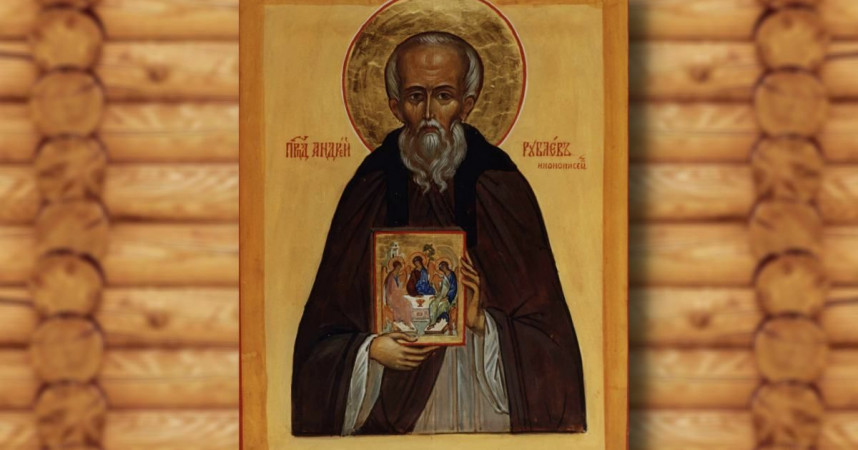
The church remembers Reverend Andrei Rublev.
17.07.2026, 06:00




-

The Power of Books
Alyona Bogolyubova
All Authors