According to some reports, Angelina belonged to the Chernoevich family – she was the daughter of Andrei, nicknamed Arvanit the Brave, and the niece of Voivode Ivan Bey, ruler of Montenegro in 1465-1496. When her brother was apparently no longer alive, Ivan married her off to Serbian despot Stefan the Blind Brankovich. Like most marriages of ruling personages, this one was probably concluded for political reasons, which makes the sanctity that shone through the whole family even more remarkable.
The life of Serbian despot Stefan Brankovic and his family was full of vicissitudes and troubles. Stefan and Angelina lived in love and harmony and had two sons, George and John, and two daughters, Mara and Milica. The family spent about ten years hiding from the Turkish massacre in the Italian region of Furlania. Here St. Stephen, together with his sister Katarina, bought the castle of Belgrade, where he reposed.
Widowed in 1476, Angelina lived and raised her children in difficult circumstances. The Hungarian king Matthew Corvinus allocated them lands in Sirmium that had once belonged to Stefan's grandfather Vuk Brankovich, and in 1486 they settled in the village of Kupinovo, where they moved the relics of despot Stefan. The church of St. Luke the Apostle was founded here, where these relics, which performed numerous miracles, were originally kept. The ruler of Sirmium was first Angelina's eldest son George, who descended from the throne in 1497, took vows with the name Maxim and achieved sainthood (+ 1516), and then her youngest son– the holy despot John (+ 1502).
Saint Angelina took the veil around 1509, or perhaps earlier, upon her arrival in Srem. In 1512-1516, after returning from Wallachia, she founded a convent near the Candlemas Church she had built.
Back in 1509, she sent her confessor Eugene to the Russian Grand Duke Vasily III with a touching request for help: "Our power is now falling, and your power is rising. Take upon yourself our care and care of the holy temples and monasteries that your and my pious ancestors created." In her petition, she spoke about her desire to build a church where she intended to bury the relics of her husband Stephen and son John. The place for the church had already been bought for 100 ducats. The Russian prince responded to her request, in addition to the church, cells for nuns were also built, and the Krushedol monastery appeared, in which St. Nicholas Angelina became the abbess and spent her last days in prayer over the relics of her husband and sons.
She died in 1520.
The service of St. Angelina speaks of her truly masculine fortitude, boundless mercy, patience and wisdom, marital devotion and maternal sacrifice. For years she had to live in a foreign land, without loved ones, she had the difficult fate to survive not only her husband, but also all the children and several times carefully carry their holy remains.
Mother Angelina eventually became one of the most revered Serbian saints. Her relics, along with the remains of her holy family, were buried in the Krushedol monastery and remained there until 1716, when the monastery was occupied by the Turks during the retreat from Varadin. Among the relics that have survived to this day, the hand of Mother Angelina has been preserved. The glory of the Krushedol Monastery is celebrated on the memorial day of the Venerable Mother Angelina.
A fragment of her relics was also preserved in the monastery of the village of Hopovo, where, in the first half of the 20th century, the inhabitants of the Russian Lesninsky Holy Mother of God Monastery found shelter. Upon leaving Yugoslavia for France, the nuns took this particle with them.
On the icon of St. Peter. Angelina is depicted in a monastic robe, holding a book in one hand and a rosary or a cross in the other. Her face is represented on all the icons of the holy Brankovic family, as well as among the twelve most revered Serbian national saints. He can be seen in the cathedral church of Archangel Michael in Belgrade, in the Peche Patriarchate in Kosovo, in the Serbian monastery of Hilandar on Mount Athos and in other temples.
In Vojvodina, in the village of Kupinovo, next to the church of St. Luke, there was a church dedicated to St. Angelina until 1930.
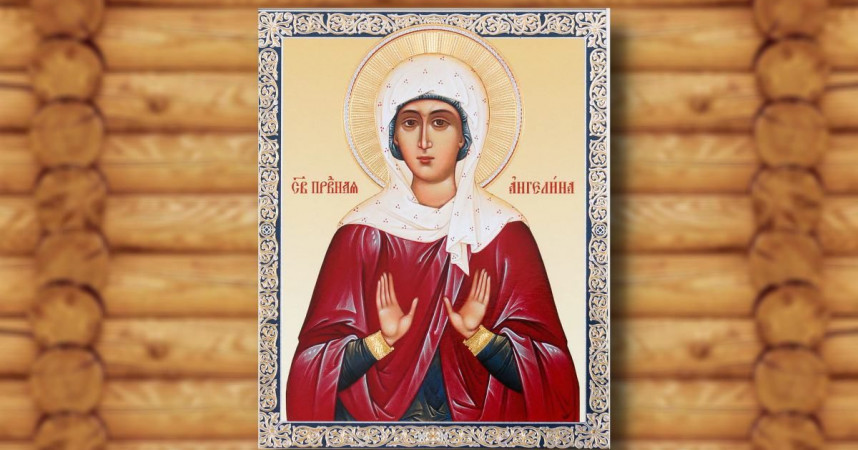
The Church remembers St. Angelina of Serbia (Brankovic)
14.07.2026, 06:00




-
The Strength of Weakness
Alexey Shirikov
All Authors