Saint Dionysius, Archbishop of Suzdal, in the world of David, was born in the south of Russia, in the Kievan borders, at the beginning of the XIV century.
From an early age, he was a monk of the Kiev Caves Monastery, from where, with the local blessing of the icon of the Mother of God with the upcoming Saints Anthony and Theodosius, he arrived on the Volga. Not far from Nizhny Novgorod, Saint Dionysius dug a cave and labored in complete silence. The brethren gradually flocked to the holy ascetic, and around 1335 he founded a monastery in honor of the Ascension of the Lord. With his extensive knowledge of the rules of faith and his strict ascetic life, Saint Dionysius gained universal respect for himself.
His contemporaries saw in him "a meek, prudent man, knowledgeable of the Holy Scriptures, learned, glorious in fasting and full of love for all." The disciples of Saint Dionysius were the Venerable Euthymius of Suzdal (April 1/14) and Macarius of Zheltovodsk, Unzhensky (July 25/August 7).
In 1352, the holy elder sent twelve of his brethren to "the upper cities and countries, where God will bless whom," for the spiritual enlightenment of the people and the foundation of new monasteries. The monastery of St. Dionysius had a highly beneficial effect on the inhabitants of Nizhny Novgorod. In 1371, the saint tonsured the forty-year-old widow of Prince Andrei Konstantinovich, following whose example many "bolyars, wives, widows, and maidens" took monastic vows.
In 1374, Saint Dionysius was ordained Bishop of Suzdal by Metropolitan Alexy. The years of his saintly ministry fall at a significant time – Russia was rising to throw off the Tatar yoke. On March 31, 1375, a Tatar military commander, captured by the inhabitants of Nizhny Novgorod, found himself in the bishop's courtyard and shot Saint Dionysius with an arrow. But the Lord protected His chosen one – the arrow only grazed the bishop's mantle. In 1377, with the blessing and, possibly, under the editorship of St. Dionysius, Monk Laurentius compiled the famous Laurentian Chronicle, which inspired Russia to the liberation struggle.
In 1379, protecting the honor of the primatial see, St. Dionysius, one of all the bishops gathered in Moscow at the behest of the prince, opposed the election of the prince's protege, the infamous Archimandrite Mitya, to the metropolitanate.
In the same year, 1379, Saint Dionysius left for Constantinople to protest about the intention to elect Mitya and the case of the heretical strigolniks. The saint made a strong impression on the Greeks with his high spiritual attitude and deep knowledge of the Holy Scriptures. Patriarch Nilus, calling the saint "truly a divine and spiritual man," wrote that he himself had seen him "fasting and almsgiving, and vigil, and prayers, and tears, and all the good things." From Constantinople, Saint Dionysius sent two copies of the icon of the Mother of God for the cathedrals of Suzdal and Nizhny Novgorod. In 1382, the saint received the title of archbishop from the patriarch. After returning to Russia, the saint traveled to Pskov and Novgorod to combat the heresy of the Strigolniki. He visited Constantinople for the second time in 1383 to discuss with the patriarch the issue of governing the Russian metropolis. In 1384, St. Dionysius was appointed "Metropolitan of Russia" by Patriarch Nilus. But upon his return to Kiev, the saint was captured by order of Prince Vladimir Olgerdovich of Kiev and imprisoned, where he died on October 15, 1385. The saint was buried in the Kiev Cave of the Great Anthony. On June 26, the memory of St. Dionysius is celebrated for the sake of namesake with St. David of Thessalonica, whose name he bore in the world. In the Synod of 1552 of the Nizhny Novgorod Pechersk Monastery, Saint Dionysius was called "the venerable wonderworker."
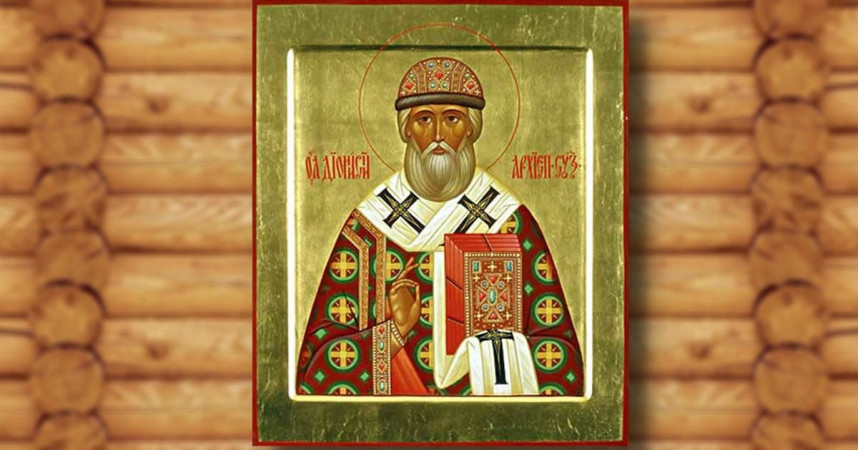
The church remembers St. Dionysius, Archbishop of Suzdal
09.07.2026, 06:00





-

The Power of Books
Alyona Bogolyubova
All Authors