On July 2, 2026, Metropolitan George of Nizhny Novgorod and Arzamas consecrated a monument to St. Luke (Voino-Yasenetsky) on the territory of the Holy Trinity Serafimo-Diveevsky Convent near the hospital building.
The abbess of this monastery, Abbess Sergiya (Konkova), and the sisters of the monastery, adviser to the head of the Nizhny Novgorod Archdiocese, and program director for St. Seraphim of Sarov, Olga Barayeva, prayed at the service.
Before the consecration, Metropolitan George addressed the audience: "St. Luke is a true pillar of faith, a lamp of God. Even while in prison, suffering for his faith, he asked to be allowed to practice surgery to heal our soldiers during the Great Patriotic War. For us, he is an example of an ascetic of faith, a true Christian attitude towards people."
The monument, made of reinforced concrete, is a waist sculpture of the saint standing on a pedestal. The saint holds a book in his hands. His head is slightly turned to the side, as if he was thinking about something.
On the pedestal there are the words of St. Luke: "I have recognized that I have no right to do what I like, and I must do what is useful for suffering people." And another quote from him: "I fell in love with suffering, which cleanses my soul so beautifully, because I felt quite really, quite palpably that the Lord Jesus Christ Himself was walking next to me and supporting my burden and my cross."
The monument was designed by the Honored Artist of Russia, sculptor Alexander Apollonov, who died in 2017.
There are several such copies of the monument designed by Alexander Apollonov in many cities of Russia, including those related to the life of St. Luke. They are standing near medical facilities.
Pavel Astakhov, an Honored lawyer of Russia, public figure and TV presenter, and like-minded people initiated the installation of the monuments.
***
The holy saint Luke, who shone forth among the saints of the Church of Christ as a confessor, revealed in his person the image of a good shepherd who heals both mental and physical ailments, and showed an example of combining the ministry of an archpastor and a doctor. His theological treatises awaken faith and convince those who doubt the truth of God's existence, refuting pseudoscientific theories. By his feat, the saint showed what "bearing the cross of Christ" is.
Archbishop Luke (in the world Valentin Feliksovich Voino-Yasenetsky) was born in Kerch on April 27, 1877. After graduating from high school, he thought about choosing a life path and decided that he was obliged to do only what was "useful for suffering people." He chose medicine. After graduating from the university, the future saint engaged in medical practice and scientific research. In the 1920s, he worked as a surgeon in Tashkent, actively participating in church life, attending meetings of the church fraternity. The words of Bishop Innokenty of Tashkent, "Doctor, you need to be a priest," were perceived as a divine call. After serving as a priest for three years, after the death of his wife, Father Valentin took monastic vows with the name of the apostle, evangelist and physician Luke. On May 30, 1923, Hieromonk Luke was secretly consecrated bishop. Since that time, Vladyka's journey of the cross as a confessor began.
Numerous arrests, tortures, and exile did not weaken the saint's zeal in fulfilling his archpastoral duty and serving people as a doctor. He is the author of 55 scientific papers on surgery and anatomy, as well as ten volumes of sermons. His most famous book is Purulent Surgery, which went through three editions (1934, 1946, 1956).
From 1946 to 1961, Archbishop Luke was the ruling bishop of the Crimean Diocese. He died on June 11, 1961, on the day of All Saints who shone forth in the land of Russia.
But the pastor did not leave his flock. Through His prayers, numerous miraculous healings were performed. In 1996, the holy remains of Archbishop Luke were found, which currently rest in the Holy Trinity Cathedral in Simferopol.
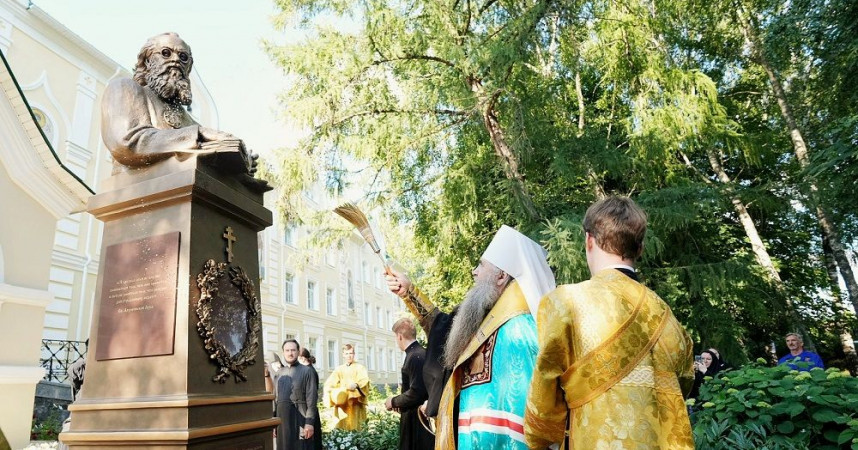
A monument to St. Luke (Voino-Yasenetsky) was consecrated on the territory of the Serafimo-Diveevsky Monastery
08.07.2026, 15:00


-

What Should We Remember?
Olga Kutanina
All Authors