On July 30, 2026, the Military Spiritual and Educational Center of the Museum and Temple Complex of the Armed Forces of the Russian Federation in Patriot Park in the Odintsovo City District of the Moscow Region hosted a round table entitled "Spiritual support: the role of clergy in helping the families of participants and veterans of their military operations." The event was organized by the United Russia Party faction of the Moscow City Duma.
The round table was attended by deputies of the Moscow City Duma, representatives of executive authorities, the Armed Forces of the Russian Federation, the Defenders of the Fatherland State Foundation, representatives of the Synodal Department for Church Charity and Social Service and the Synodal Department for Cooperation with the Armed Forces and Law Enforcement Agencies, heads of specialized public and veteran organizations.
Opening the meeting, Daria Borisova, Deputy Chairman of the Moscow City Duma Commission on public associations and religious organizations, noted that the spiritual support of the Church is the most important support for military personnel both on the front line and at home, as well as for their families.
Deacon Igor Kulikov, Director of the Patriarchal Humanitarian Mission, gave an overview of the activities of the Russian Orthodox Church in providing assistance to veterans of a special military operation and their families.
"Supporting veterans of a special military operation and their loved ones is the task of every Orthodox parish, from a cathedral in a city of millions to a small rural church,— Deacon Igor Kulikov said in his speech. — The main thing we can do for combat veterans is to help them find meaning in life "outside the war." And it is the Church that has unique opportunities for this. Now we are working to ensure that each parish is a place where a member of the military who has returned from the front can truly feel needed and in demand."
Deacon Igor Kulikov gave several examples of successful parish projects aimed at supporting veterans and their loved ones. The director of the Patriarchal Humanitarian Mission also spoke about the training manual "Return. Spiritual and practical aspects of helping the participants of the SVO and their loved ones."
The moderator of the round table, Daria Borisova, emphasized the special role of the Russian Orthodox Church in supporting participants in the special military operation. She also expressed the hope that the "Return" benefit would be in demand not only by representatives of the clergy, but also by secular specialists who provide assistance to military personnel and their loved ones.
Archpriest Sergiy Klyaev, head of the military hospital assistance department of the Synodal Department for Charity, also spoke at the round table. He spoke about the pastoral support provided by volunteer priests from all over the country, visiting 45 hospitals in Donbass and the border regions.
Maxim Rudnev, head of the Moscow City Duma's working group on support for members of the SVR and their families, noted that the role of the clergy cannot be overestimated: priests become a support for military personnel in the most difficult circumstances.: "In the Moscow City Duma, we see how organically spiritual support is integrated into the overall system of support measures, and we will further develop this interaction with parishes, dioceses, and relevant church structures so that assistance is as targeted and timely as possible."
During the event, Archpriest Konstantin Tatarintsev, Deputy Chairman of the Synodal Department for Cooperation with the Armed Forces and Law Enforcement Agencies, also spoke.
Lieutenant-General Oleg Veselkov, Deputy Head of the Main Military-Political Directorate of the Armed Forces of the Russian Federation, head of the Directorate for Cooperation with Religious Associations, stressed that about 100 military priests are in the SVR zone every day, most of them are volunteers and volunteers.
The participants of the round table discussed the development of spiritual assistance to the families of the participants of the SVR, issues of adaptation of military personnel after graduation, the organization of spiritual and educational trips for veterans, as well as the development of volunteer and charitable initiatives.
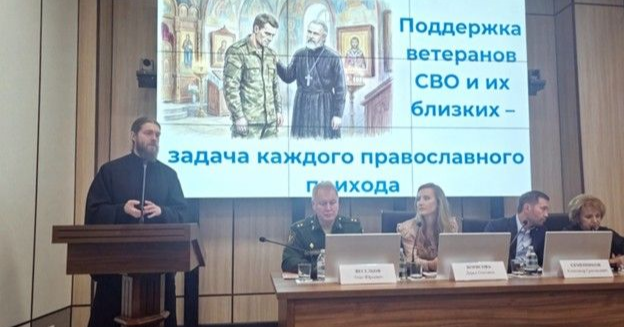
A round table was held on the issues of spiritual and social support for the families of participants and veterans of a special military operation.
03.08.2026, 09:00


-

Invisible Wings
Yana Kapaeva
All Authors