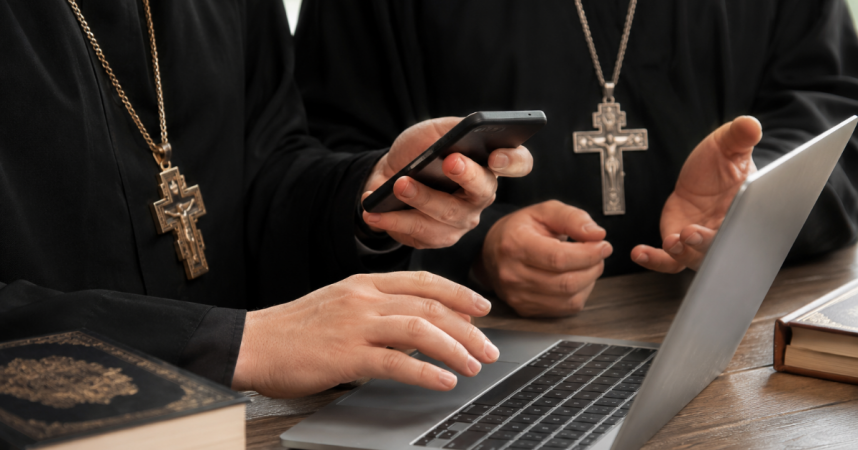
Metropolitan Nicholas, First Hierarch of the Russian Orthodox Church Outside Russia (ROCOR), has called on clergy to exercise greater caution in their use of social media, urging priests to avoid political arguments online and to prioritize personal pastoral care over building a digital following.
In a pastoral message issued to mark the 50th anniversary of the deaths of several prominent ROCOR hierarchs, particularly Archbishops Nikon (Rklitsky) and Averky (Taushev), Metropolitan Nicholas said their teachings remain remarkably relevant in the digital age.
Quoting Archbishop Averky, the metropolitan reminded clergy: "Do not confuse public recognition with ministry." He stressed that a priest's vocation is not to become a prominent online personality but to care for the spiritual well-being of the faithful.
The message warns that modern communications technologies have significantly increased the responsibility of clergy. According to the statement, an impulsive social media post or harsh online comment can scandalize believers and damage the Church's witness.
"A priest is called to conduct himself in a Christian manner not only in church and everyday life, but also in the virtual space," the document states. Rather than becoming arenas for accusations, sarcasm, and endless debates, online platforms should primarily serve as tools for evangelization and pastoral outreach.
The appeal also cautions priests against becoming deeply involved in political disputes. Citing Archbishop Averky, Metropolitan Nicholas noted that pastors should avoid becoming absorbed in "purely worldly affairs," arguing that political struggles inevitably divide communities.
Another concern raised in the message is dependence on the constant flow of online information. The metropolitan encouraged clergy to spend less time scrolling through news feeds and social media and instead devote more time to prayer, reading the writings of the Church Fathers, and engaging in face-to-face conversations with parishioners.
"What we need is not a virtual substitute for presence, but continual living contact with people," the message says, emphasizing that listening to individuals and sharing in their struggles remains the foundation of pastoral ministry.
The statement was prompted by a significant anniversary in ROCOR's history. In 2026, the Church commemorates the 50th anniversary of the deaths of four distinguished bishops, with particular attention given to Archbishops Nikon and Averky, who played central roles in the development of ROCOR's Eastern American Diocese.
Archbishop Nikon (1892–1976), a native of the Chernihiv region, left Russia after the Civil War and spent decades serving in the United States. A close associate and biographer of Metropolitan Anthony (Khrapovitsky), one of ROCOR's founders, he became known for establishing new parishes and providing dedicated pastoral care to Orthodox faithful in the Russian émigré community.
Archbishop Averky (1906–1976) is widely regarded as one of the most influential figures in the history of the Russian Orthodox Church Outside Russia. For nearly 25 years, he led Holy Trinity Monastery and Seminary in Jordanville, New York, transforming it into one of the foremost spiritual and educational centers of the Russian Orthodox diaspora. His writings on Scripture and Church life continue to be republished and studied in Orthodox seminaries around the world, and contemporaries often referred to him as "the conscience of the Russian Orthodox Church Outside Russia" for his steadfast defense of Orthodox tradition.
The Russian Orthodox Church Outside Russia was established after the 1917 Russian Revolution to unite bishops and clergy who had fled the country. It remained administratively separate from the Moscow Patriarchate for decades while preserving many pre-revolutionary ecclesiastical traditions. In 2007, ROCOR and the Russian Orthodox Church restored full canonical communion through the signing of the Act of Canonical Communion. Today, ROCOR includes hundreds of parishes across North and South America, Europe, Australia, and other regions.
Concluding his message, Metropolitan Nicholas encouraged clergy not only to commemorate the late hierarchs in memorial services but also to study their writings. He said their example demonstrates that, amid the noise of social media and the pressures of the digital age, the Church's mission remains rooted in prayer, personal example, and direct human relationships rather than the pursuit of online attention.


-

The Most Valuable Lesson Didn't Come from the Textbook
Tatiana Lyubomirskaya
All Authors