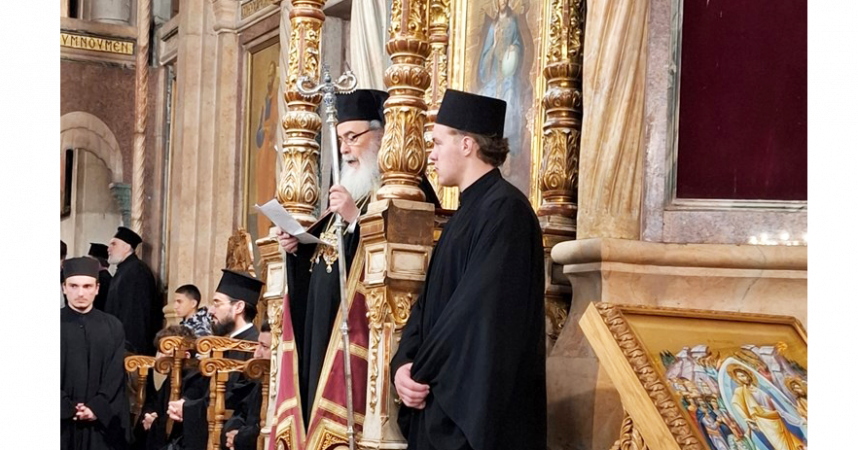
A solemn service featuring the reading of the first part of the Akathist Hymn to the Mother of God was celebrated at the Church of the Holy Sepulchre in Jerusalem, led by Theophilos III, Patriarch of Jerusalem.
In his sermon following the service, Patriarch Theophilos described Great Lent as a “favorable time” and an opportunity for spiritual renewal. He stressed that the meaning of fasting lies not only in abstinence, but above all in humanity’s return to authentic life with God.
Through the Incarnation of Christ, he said, the possibility of union between humanity and the Creator—lost after the Fall—has been restored. The Patriarch highlighted the special role of the Mother of God, whose humility and obedience made possible the coming of the Savior into the world.
Speaking about the spiritual struggle of Lent, Theophilos III emphasized the importance of inner effort: renouncing evil, overcoming passions, and strengthening faith. Quoting the Apostle Paul’s call to “cast off the works of darkness and put on the armor of light,” he noted that spiritual life requires mindfulness and perseverance.
He urged the faithful to unite fasting with prayer and acts of mercy in preparation for Easter, adding that through repentance and a change of life a person discovers true freedom and hope for salvation.
The Akathist to the Most Holy Theotokos is a solemn hymn of praise dedicated to the Mother of God. The word “akathist” means “not seated,” indicating that the faithful stand while it is sung or read. The hymn consists of 24 stanzas arranged in an alphabetical acrostic of the Greek language—12 longer oikoi and 12 shorter kontakia—beginning with the opening kontakion, “To Thee, the Champion Leader.”
The ancient hymn emerged in Byzantium in the sixth and seventh centuries. According to tradition, it was first sung in Constantinople in 626 in thanksgiving for the deliverance of the city from siege. Over time, it became part of the Church’s liturgical rule and remains the only akathist assigned a fixed place in the annual cycle of services.
In the Russian Orthodox Church, the Akathist is sung in full at Matins on the Saturday of the fifth week of Great Lent, known as the Saturday of the Praise of the Most Holy Theotokos. In the Greek tradition, it is read in parts during the first four weeks of Lent and then in full on the fifth Saturday.


-

What Should We Remember?
Olga Kutanina
All Authors