The Church remembers the glorification of the righteous warrior Feodor Ushakov
Admiral of the Russian Fleet Feodor Ushakov was born on February 13, 1745 in the village of Burnakovo, Romanovsky district, Yaroslavl province and came from a poor, but ancient noble family. His parents' names were Feodor Ignatievich and Paraskeva Nikitichna, and they were pious and deeply religious people.
In the post-Petrine times, noble youths were usually assigned to the guard, the father of the future admiral Feodor Ignatievich also served in it, and he even had to fight with the Turks in the war of 1735-1739, but after the birth of his third son Feodor, he was dismissed from service with the award of the sergeant rank of the Life Guards of the Preobrazhensky regiment. Returning to his native village, he changed the royal service for household chores and raising children.
The birthday of the future admiral of the Russian Fleet – February 13 – falls between the celebration of the memory of two great-martyred soldiers: Theodore Stratilat and Theodore Tyrone (February 8 and 17), and the whole life of the Russian naval commander, from infancy to the day of his death, was under the beneficial influence of his own uncle, the Monk Theodore of Sanaksar – a great warrior in spiritual warfare. The Monk Theodore was born and grew up in the same village of Burnakovo, from here he left in his youth to serve in the metropolitan guard, but then, striving with his soul for another ministry, wanting to acquire the title of a soldier of the Heavenly King, he fled from the capital to the deserted Dvina forests to work for God alone, strengthening himself in the feat of fasting and prayer; he was found, brought to the Empress, who, heeding God's Providence for the young ascetic, was pleased to leave him in the Alexander Nevsky Monastery, where he took monastic vows in 1748 - and this exceptional event for the Ushakov noble family, coupled with subsequent news about his monastic service to God, was a constant subject of conversations among relatives and it served them as an edifying example.
At the age of sixteen, Feodor was presented to the heraldmaster's office for a review, where he showed that "he was trained in Russian literacy and writing... he wishes, Theodore, to join the Naval Cadet Corps as cadets."
The future admiral, distinguished by good studies and good morals, diligently comprehended the sciences taught to him, showing a special aptitude for arithmetic, navigation and history, and five years later successfully, one of the best, graduated from the Marine Corps, received an officer's rank and was sworn in:
"Az, Feodor Ushakov, I promise and swear by Almighty God before His Holy Gospel that I am and owe to HER IMPERIAL MAJESTY my most gracious EMPRESS CATHERINE ALEKSEEVNA AUTOCRAT and HER IMPERIAL MAJESTY's most gracious Son Sovereign Caesarevich and Grand Duke Pavel Petrovich, the rightful Heir to the All-Russian throne, faithfully and unfeignedly serve and obey in everything, not sparing his belly to the last drop of blood... May the Lord God Almighty help me in this!".
The whole subsequent life of Feodor Feodorovich became a confirmation that he did not change his oath in any way.
... After retiring from official affairs, he lived for some time in St. Petersburg, continuing to patronize his nephews, and was preparing to move to a permanent and already the last place of his earthly life. He had several small villages in his homeland in the Yaroslavl province, there was a plot of land near Sevastopol... The Admiral's soul, which had sought the Lord from infancy, asked for peace, solitude, and prayer. He made a decision full of deep meaning: he chose to live in the quiet village of Alekseevka, in the Temnikovsky district, near the Sanaksar Christmas-Theotokos Monastery, where his own uncle, the Monk Theodore, prayed for him during the years of his military exploits. There is no doubt that their prayerful communication was never interrupted. That's why the admiral's soul rushed here to the holy monastery, because here the most spiritually close person on earth struggled for the Lord and rested. The monk and the sailor – they were both soldiers of Christ, both did the same thing: they zealously served the Lord – in the field to which He called them.
Before finally leaving the capital in 1810, Feodor Feodorovich, "remembering the hour of death with what suddenness it happens," wrote a will. Having never had his own family and his own children, he transferred all his poor possessions to his nephews, "whom I honor instead of my children and try for their good as their own father." The testimony of the then abbot of the monastery, Hieromonk Nathanael, about the final period of Feodor Feodorovich's earthly life has been preserved: "Admiral Ushakov, a neighbor and famous benefactor of the Sanaksar monastery, upon his arrival from St. Petersburg, led a secluded life in his own house, in the village of Alekseevka, a distance of three versts from the monastery through the forest, which on Sundays and holidays he came to the monastery for a pilgrimage to the services of God at all times. During Lent, he lived in a monastery, in a cell, for his fasting and preparation for St. For a whole week, and every long service with the brethren in the church, he stood indefatigably and listened reverently; from time to time, he donated considerable charity from his zeal to the monastery; also, he always gave merciful alms and offerings to the poor and beggars."
The Patriotic War of 1812 began. The whole nation rose up to fight the French. In the Tambov province, as well as throughout Russia, militias were created to protect the Fatherland. At the provincial meeting of the nobility, in which Feodor Feodorovich could not take part due to illness, he was elected by a majority of votes as the head of the internal Tambov militia. The leader of the nobility wrote to him: "The long-term experience of your service and excellent zeal before the throne of the Russian state, proven by you, may they give the nobility firm ways to zealous exploits for the common benefit, may they encourage everyone to beneficent donations and may they inspire readiness in everyone's heart to take part in the salvation of the Fatherland...". "For a benevolent, kind I have an opinion and for the honor I have done, I bring my most humble gratitude," the admiral replied. "With excellent zeal and zeal, I would like to take on this position and serve the Fatherland, but with extreme regret for my illness and great weakness of health, I cannot and cannot take it on myself and fulfill it in any way." But, meanwhile, together with the Temnikovsky cathedral archpriest Asinkrit Ivanov, he arranged a hospital for the wounded, giving money for its maintenance. Two thousand rubles were contributed to the formation of the 1st Tambov Infantry Regiment. All that he had, he gave "to help his neighbors suffering from the ruin of a malicious enemy...". Back in 1803, he contributed twenty thousand rubles to the Guardianship Council of the St. Petersburg Educational Home; now he transferred the entire amount with the interest due on it to the benefit of those ruined by the war: "I have long had a desire to distribute all this money without withdrawal to the needy and wandering, who do not have homes, clothes and food." Not only the peasants of the surrounding villages and residents of the city of Temnikov, but also many people came to him from remote places. With the sufferers who lost their possessions, he shared what he had; He comforted those burdened with sorrow and despondency with an unshakable hope for the goodness of Heavenly Providence. "Don't despair! – he was saying. – These terrible storms will turn to the glory of Russia. Faith, love for the Fatherland and commitment to the Throne will prevail. I have not much left to live; I am not afraid of death, I only wish to see the new glory of the dear Fatherland!"
The rest of his days, according to the same hieromonk Nathanael, the admiral spent "extremely abstinently and ended his life as a true Christian and faithful son of the Holy Church of October 1817 on the 2nd day and was buried at his request in a monastery near his kinsman from the nobility, the founder of this monastery hieromonk Theodore by the name of Ushakov."
The funeral service of Feodor Feodorovich was held in the Transfiguration Church of the city of Temnikov by Archpriest Asinkrit Ivanov, who the day before the death of the righteous man, on the feast of the Intercession of the Most Holy Lady of Our Theotokos, took his last confession and communed with the Holy Mysteries; when the coffin with the body of the deceased admiral with a large gathering of people was carried out of the city, they wanted to put him on a cart but the people continued to carry him all the way to the Sanaksar monastery. The monastery brethren met the faithful boyar Theodore there. Feodor Feodorovich was buried at the wall of the cathedral church, next to his native venerable elder, so that from now on they would be together forever.
Almost two centuries have passed since the righteous death of Feodor Feodorovich. His ascetic and highly spiritual life, his virtues were not forgotten in his native fatherland. Russian Russian soldiers and naval commanders, the Orthodox Russian army lived by His precepts.
When the time of persecution of the Russian Orthodox Church came, the Sanaksar Monastery, where Feodor Feodorovich rested, was closed. The chapel built over the grave of the admiral was completely destroyed, his honest remains were desecrated by atheists in the 1930s.
During the Great Patriotic War of 1941-1945, the military glory of Feodor Feodorovich Ushakov was remembered, his name, along with the names of the holy warrior princes Alexander Nevsky and Dimitri Donskoy, inspired the defenders of the Motherland to the feat. The Order of Battle of Admiral Ushakov was established, which became the highest award for soldiers-sailors.
At the same time, in 1944, the question arose about the burial place of Admiral Ushakov. A state commission was established, which excavated the territory of the Sanaksar monastery and opened the grave of Admiral Ushakov at the wall of the cathedral church. The honest remains of Feodor Feodorovich turned out to be incorruptible, which was noted in the relevant document of the commission.
Since that time, the grave of Theodore Ushakov and, as a result, the entire Sanaksar monastery were under the supervision of the state authorities, which prevented the destruction of the monastery revered by the righteous.
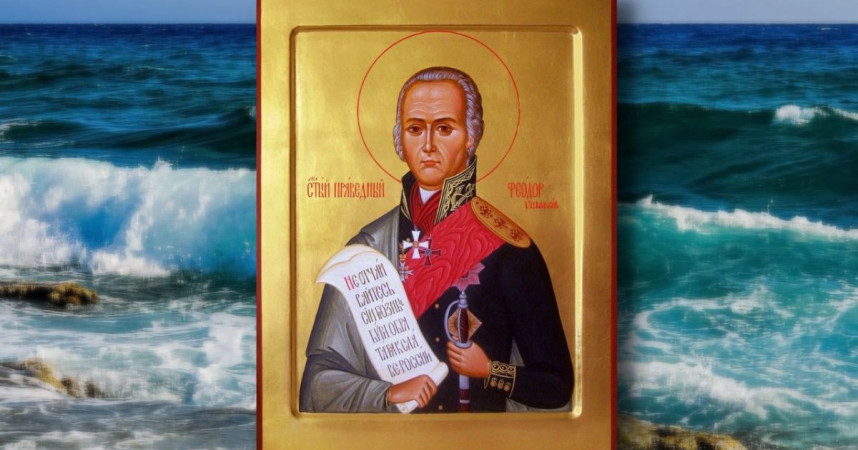
The Church remembers the glorification of the righteous warrior Feodor Ushakov
05.08.2023, 06:00


-

Faith vs. Fitness? The Real Battle Isn’t Where You Think
Alyona Bogolyubova
All Authors