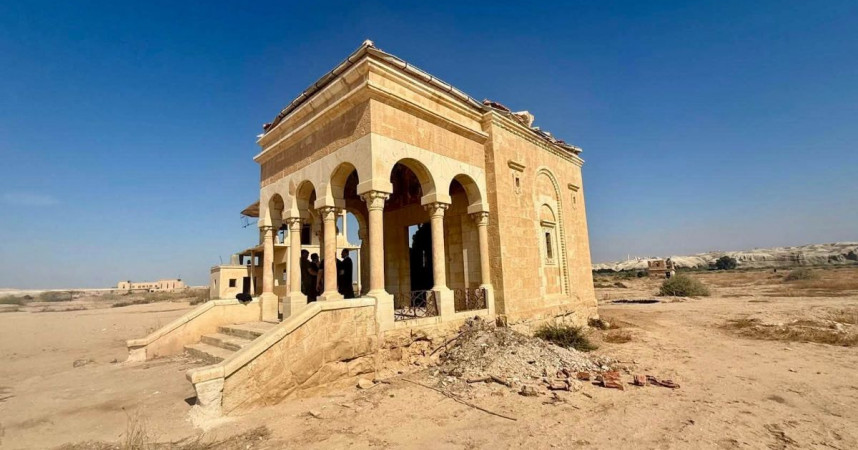
Romanian and Israeli experts have discussed plans to restore an Orthodox church at the Romanian Hermitage on the Jordan River, marking the first official stage of a joint restoration project. The meeting of the two expert commissions took place on November 4, according to the Romanian Orthodox Church’s news agency Basilica.ro.
The Romanian delegation included architect Bogdan Teodorescu and restoration specialist Cătălin Palamariu, who were appointed by Romanian Patriarch Daniel. The experts examined the condition of the church and discussed the work required to restore the building and its interior paintings. Sections of the plaster have deteriorated, with some areas peeling away and crumbling.
The Hermitage of St. John the Baptist is located in the Qasr al-Yahud area, near Jericho, at a site traditionally associated with the biblical account of the Baptism of Jesus Christ in the Jordan River. The hermitage forms part of the Romanian Orthodox Church’s monastic establishment in the Holy Land.
The site is also associated with St. John the New of Hozeva, who lived at the hermitage between 1947 and 1952 before being canonized.
The church was built in 1935 according to a design by Dumitru Ionescu-Berechet, an architect working for the Romanian Patriarchate. Its iconostasis was created by sculptor Anghel Dima, while the icons were painted by artist Dimitrie Belizarie. The church was decorated with frescoes in 1968.
The building suffered extensive damage during the 1967 Arab-Israeli conflict. A shell strike caused part of the roof and a side wall to collapse, although the structure itself survived.
In the years that followed, the area was designated a closed military zone and was heavily mined. Demining operations were completed only in 2020, making it possible to resume efforts to restore the church.
In September 2026, a rite of the Lesser Blessing of Waters was celebrated at the site for the first time in several decades.
Archimandrite Ioan Meiu, representative of the Romanian Patriarchate in the Holy Land, expressed hope that the restoration would enable regular church services to resume. According to him, liturgical services have not been held in the church for almost 60 years.
The planned restoration is expected to help preserve an important part of Romania's Orthodox heritage in the Holy Land and reopen the historic church for worship.







-

Too Much Freedom?
Alexey Shirikov
All Authors