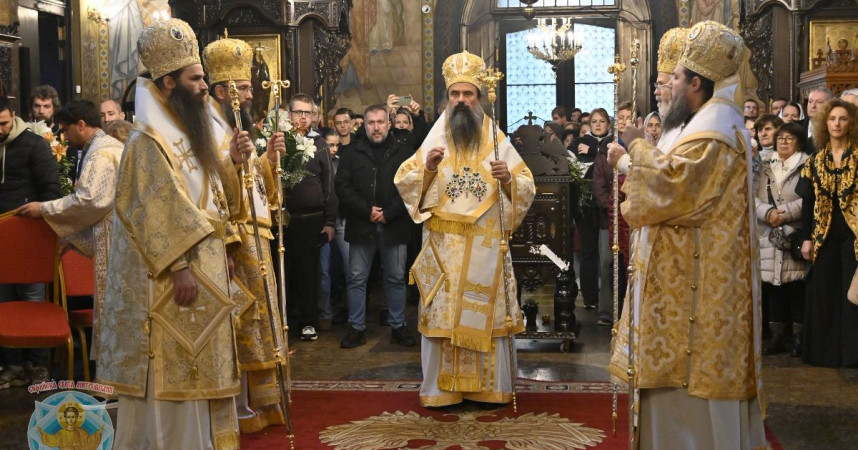
Representatives of five Orthodox churches gathered in Sofia to commemorate Serbian King Stefan Milutin, whose relics have been kept in the Bulgarian capital for about 560 years. Bulgarian Patriarch Daniel led a solemn liturgy at the Cathedral of St. Kyriaki, urging believers not to let national or political differences divide them.
The service was attended by representatives of the Bulgarian, Serbian, Russian and Romanian Orthodox Churches, as well as monks from the Athonite monasteries of Hilandar and Zograf. Many worshippers, including pilgrims from Serbia, filled the cathedral. After the liturgy, a procession carrying the saint’s relics passed through the streets of Sofia.
“We must overcome what divides us. It should not be ethnicity, political affiliations or nationalism that define our relationships, but the Orthodox faith,” Patriarch Daniel said. He noted that the commemoration had brought together people from different countries and church traditions.
Stefan Uroš II Milutin (c. 1253–1321) was one of the best-known rulers of medieval Serbia and a member of the Nemanjić dynasty. He reigned from 1282 to 1321, expanding the state’s territory and strengthening its political and ecclesiastical position in the Balkans.
Milutin is remembered above all as a major patron of Orthodoxy. According to church tradition, he built or restored a church for every year of his reign—about 40 in total. Among the best-known monuments associated with him are the Gračanica and Banjska monasteries in Kosovo. He also supported Hilandar on Mount Athos, established a shelter for pilgrims in Jerusalem and helped maintain a hospital in Constantinople. For his charity and support of the Church, he is venerated as a saint; the Serbian Church canonized him soon after his death.
Milutin was initially buried at the Banjska Monastery, which he had founded. After the Battle of Kosovo in 1389, his remains were moved, and around 1460 they arrived in Sofia. The relics were first placed in the old Church of St. Panteleimon and later spent some time at a monastery in the Gorna Banya district. In 1863, they were transferred to the Cathedral of St. Kyriaki, where they remain. Because of the relics, the cathedral was once also known as the Church of the Holy King.
Saint Milutin’s feast day is observed on October 30. The Cathedral of St. Kyriaki also celebrates its secondary patronal feast on that day. By tradition, the relics are dressed in new garments during the celebrations and then brought out for veneration.







-

“I Praise You, Brothers”: The Spiritual Art of Recognizing the Good
Alexey Shirikov
All Authors