
An international team of researchers, led by specialists from the University of Glasgow, has successfully restored 42 previously lost pages of one of the earliest Christian manuscripts, known as Codex H, the university announced on its website.
The 6th-century Greek manuscript contains the letters of the Apostle Paul. In the 13th century, monks from the Great Lavra on Mount Athos disassembled the manuscript, reusing its durable parchment for new texts due to its high cost. Over time, fragments of the original pages became dispersed across libraries in different European countries.
The breakthrough was achieved using modern technology, specifically multispectral imaging, which can detect faint traces of ink invisible to the naked eye. Researchers explained that the process of reusing pages left a “mirror impression” of the original text, now revealed through advanced analysis. Radiocarbon dating confirmed the age of the recovered parchment.
While the rediscovered pages contain texts already known from Paul’s letters, the discovery offers fresh insights into how the New Testament was read and organized in early Christianity. The fragments feature the earliest known chapter divisions, which differ significantly from modern Biblical editions, as well as scribal notes and historical annotations intended to aid contemporary readers in understanding the messages.
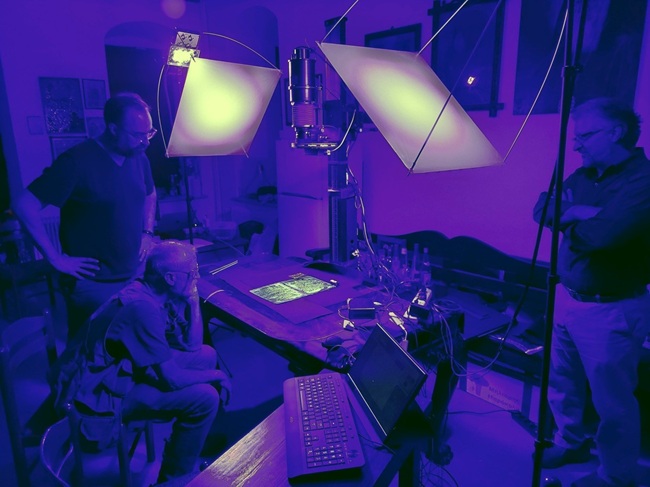
Scientists scan the text in the laboratory. Photo: University of Glasgow
The findings also illuminate 6th-century scribal practices, showing how copyists edited texts, added commentary, and structured complex systems of marginal notes. The manuscript’s condition provides additional evidence of medieval book reuse practices.
“The recovery of such a substantial portion of previously lost material is a truly significant event for biblical scholarship and the study of Christian cultural history,” said the project leader. The restored texts are now available in an open-access digital format, with a printed edition of the manuscript forthcoming. Researchers highlight that the combination of cutting-edge technology and traditional scholarship is opening new pathways for the study of ancient texts and promises further discoveries in the future.


-

What Should We Remember?
Olga Kutanina
All Authors