On the eve of the 85th anniversary of the outbreak of the Great Patriotic War, on June 21, 2026, after the Divine Liturgy at the Resurrection Cathedral in Brest, His Holiness Patriarch Kirill of Moscow and All Russia visited the Brest Hero Fortress Memorial Complex.
His Holiness visited St. Nicholas Church, the historic St. Nicholas Garrison Cathedral of the Brest Fortress.
Then, at the memorial sign erected in memory of the fallen soldiers near the state border of the Republic of Belarus, His Holiness Patriarch Kirill celebrated a requiem mass in memory of the defenders of the Brest Fortress and all those who fell in the Great Patriotic War.
The following people prayed during the service: Patriarchal Exarch of All Belarus, Metropolitan Veniamin of Minsk and Zaslavl; Metropolitan Gregory of Voskresensk, managing Director of the Moscow Patriarchate; Archbishop John of Brest and Kobrin; Bishop Alexy of Ramenskoye, Personal Secretary of His Holiness; clergy of the Belarusian Exarchate and Moscow.
At the end of the service, His Holiness Patriarch Kirill addressed the audience with a Primatial address:
"I would like to thank you, Your Eminence, Metropolitan Vladyka, dear hierarchs, fathers and brothers, for the opportunity to pray in this place, including for my uncle, my dear and close friend, the ever-memorable Vladimir, after whom my mother named me. and who died here, on the frontiers, defending our Fatherland in the early days of the terrible invasion of foreigners.
We have always preserved the memory of the ever-memorable Vladimir in our family. Mom loved Volodya very much, that's what she called him. He was a very talented man: his wonderful literary works have been preserved in our family. He was a man who could have made a good career, but when a difficult moment came for the Fatherland, he went to the front. And it was in this place, somewhere very close, that he went missing.
Those who went missing at that time were our heroes who died defending their homeland. So my uncle Vladimir, whom my mother kept a special memory of, also fought here, in this place, for freedom, for the independence of our Fatherland, to defeat the enemy.
They failed to repel the enemy at that time, but they contributed to the victory. If it had not been for the Brest Fortress and these victims, our troops would not have entered Berlin and crushed that terrible reptile that sought to enslave the whole world, but first of all, Russia, our Fatherland.
We will keep these heroes in our memory, first of all, a prayerful memory. I ask all of you to remember the warrior Vladimir, in whose memory I received my baptismal name.
May the Lord, I believe that He has already accepted them into His Heavenly Kingdom, create in our memory, in our consciousness, and in our prayers an eternal prayerful memory of them.
God bless you!"
After visiting the Brest Fortress, His Holiness Patriarch Kirill left for Moscow.
***
With the outbreak of hostilities on June 22, 1941, the Brest Fortress became one of the most persistent pockets of resistance on the western border of the USSR. The defense of the Brest fortress lasted about a month. By decree of the Presidium of the Supreme Soviet of the USSR on May 8, 1965, she was awarded the title of "Hero Fortress".
The Brest Hero Fortress Memorial Complex was opened on September 25, 1971. Today, battle sites, ruins, preserved fortress structures, and museum exhibitions are combined here: the Museum of the Defense of the Brest Fortress (1956), the Museum of War — the Territory of Peace (2014), The Chronicle of the Brest Fortress (2019), and the Defense of the Eastern Fort (2020). The memorial complex and the complex of fortifications of the Brest Fortress are included in the State List of Historical and Cultural Values of the Republic of Belarus. The Nikolaevsky Garrison Cathedral and the Nativity of the Virgin Convent are located on the territory of the complex.
On June 22, 2011, the sculptural composition "To the heroes of the border, women and children who stepped into immortality with their courage" was inaugurated in the Brest Fortress. A bronze monument on a granite pedestal is installed at the Terespol Gate on the ruins of the building where the 9th border outpost and the 3rd border commandant's office were located on the eve of the war. The head of the 9th border post was Lieutenant Andrey Kizhevatov. The soldiers and commanders of the outpost stood to the death, showed heroism in unequal battles.
The author of the sculptural composition is sculptor—architect, Lenin Prize laureate Valentin Pavlovich Zankovich, one of the members of the creative group for the creation of the Brest Hero Fortress memorial complex. The sculptural composition is an image of three soldiers going on the attack, the commander's wife with children, a wounded border guard, to whom a woman gives water. In the center there is a border post with the coat of arms of the USSR and a memorial plaque.
***
The Nikolaevsky Garrison Cathedral was built in the middle of the 19th century in the Byzantine style with side naves, a large apse, and a majestic dome topped by a St. George's cross. In 1886, Emperor Alexander III, together with his heir Tsarevich Nicholas II and Crown Prince William, visited the shrine. During the First World War, the temple was damaged. In 1915, the bells of the cathedral were evacuated to Russia.
In 1921, after the signing of the Riga Peace, the fortress Cathedral, like the whole of Western Belarus, became part of the Polish-Lithuanian Commonwealth. From 1922 to 1930, the temple was changed beyond recognition. According to the project of the Polish architect Lisetsky, it was rebuilt into the Roman Catholic garrison church of St. Christophe, the right altar of which became the altar of the Mother of God of the Queen of the Polish Crown. In September 1939, the temple was damaged during the defense of the fortress by Polish soldiers from German troops. The evidence of this is the trace of an exploding bomb on the altar apse.
From 1939 to 1941, the Red Army club was located in the church.
In June 1941, the heroic defenders of the fortress courageously repelled the attacks of the Nazi troops in the garrison cathedral. After the war, the temple stood in a ruined state. In 1994, he returned to the fold of the Russian Orthodox Church.
On July 24, 2001, St. Nicholas Cathedral was visited by President of the Republic of Belarus Alexander Lukashenko and His Holiness Patriarch Alexy II, who consecrated the church. By the decree of His Holiness Patriarch Alexy, on the day of the 60th anniversary of the Victory, the garrison Cathedral was awarded the Order of the Blessed Prince Dimitry Donskoy, II degree.
Today, the temple, as before 1917, has again become a military temple. The cleric of the temple is supported by military units of the Brest garrison, border outposts, a battalion of Internal Troops, and law enforcement agencies. Solemn military oaths are held near the walls of the cathedral with prayerful instruction of the recruits and their consecration with holy water.
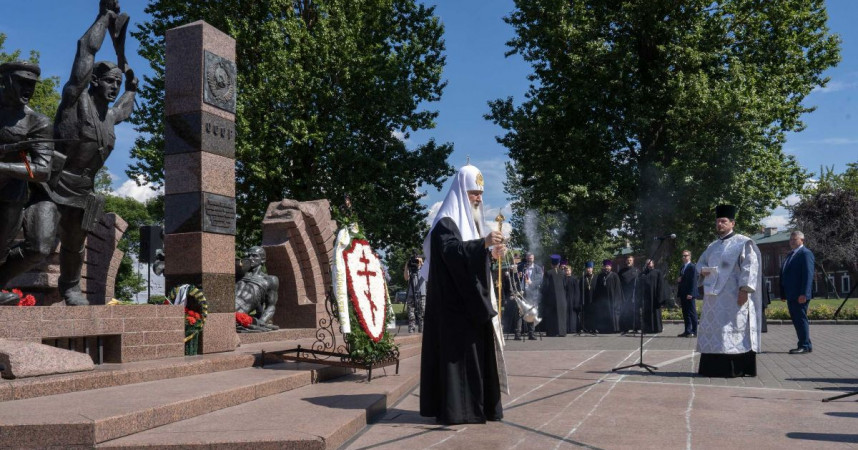
His Holiness Patriarch Kirill celebrated Litiya at the Brest Fortress
22.06.2026, 07:00




-
The Strength of Weakness
Alexey Shirikov
All Authors