On October 14, the Russian Orthodox Church celebrates the Protection of the Most Holy Theotokos. This day reminds of the motherly intercession of the Mother of God, of Her prayer for people and of the hope that a Christian finds by turning to Her in tribulations and trials. In the church calendar, the holiday falls on October 1, old style.
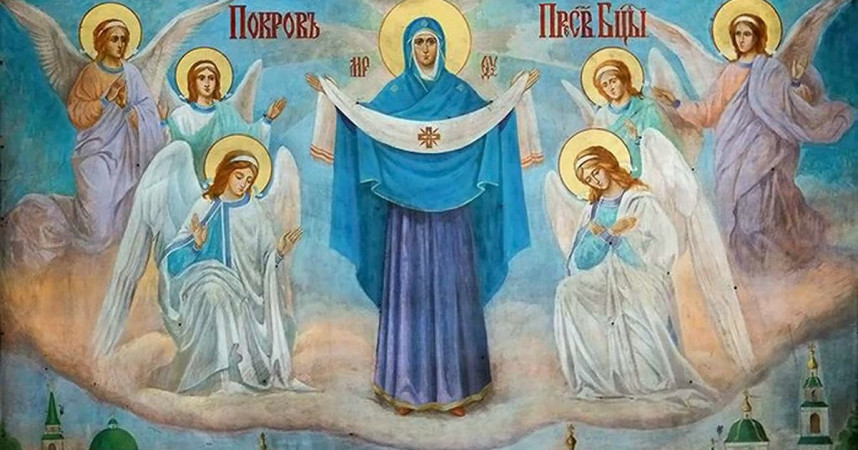
The holiday is based on an event described in the life of St. Andrew, the fool for Christ's sake. During the all-night vigil at the Blachernae Church in Constantinople, Blessed Andrew saw the Most Holy Theotokos. She was accompanied by Saint John the Baptist, the Apostle John the Theologian, and many white-robed saints.
Next to Andrey was his disciple Epiphanius. "Do you see the Lady and Mistress of the world?" the saint asked him. "Yes, my spiritual father," replied the disciple.
An amazing sight opened before them: the Virgin knelt and prayed for a long time, watering Her face with tears. Then She went to the altar, continuing to pray for the people. Having finished it, the Most Pure One took off the veil from her head and spread it over those gathered in the temple. The veil shone with the glory of God.
The last words of this hagiographic story are especially significant. When the vision ended, the veil became invisible, but grace remained with the people. These words reveal the comforting meaning of the holiday: a person does not always see God's help, but this does not mean that he is abandoned.
It is the prayer of the Mother of God that forms the focus of the event. Before spreading the veil, She prays. Her intercession is inextricably linked with conversion to God, with love for her Son and compassion for people. Therefore, resorting to the Mother of God, the Church asks for Her prayerful intercession before the Lord.
In Russia, the feast of the Intercession has received a particularly deep reverence. Its establishment is often associated with the holy Prince Andrei Bogolyubsky and the church life of the Vladimir-Suzdal land of the XII century. However, the exact circumstances of the holiday's appearance remain the subject of research: there are also assumptions about the role of Kiev and Novgorod. Therefore, the connection with Prince Andrew should be understood as a common historical version.
Over the centuries, the Veil has become close to many generations of believers. Its very name combines the image of an outstretched veil with the hope of protection, participation and care. In prayer to the Mother of God, people brought and continue to bring the most precious things: concern for children, pain for loved ones, concern for their native land, and a request for peace.
The veneration of the Intercession was also developed in the Greek church tradition. After the Second World War, a new service was organized there, dedicated to the memory of the Mother of God's help during the war years; the celebration was set for October 28. Despite the difference in historical circumstances, the content of the feast remains common — gratitude to the Mother of God for Her intercession.
What does the Veil mean to us today? First of all, it is an opportunity to turn to the Mother of God with trust. Sometimes a person comes to the temple, unable to find the words for a long prayer. He knows only his own pain, fatigue, or fear for the other. The holiday reminds us that such prayer, simple and sincere, has a place in church life. We do not need to hide our weakness before God.
At the same time, relying on heavenly help does not free you from your own work. A Christian still has to make decisions, correct mistakes, ask for forgiveness, and take care of others. The protection of the Mother of God gives hope and strengthens on this path. Even in the midst of trials, a person can keep faith, not harden himself and find strength for a good deed.
In the hagiographic story, the veil extends over everyone standing in the temple. This image draws us to those who are nearby. When we ask for protection for ourselves, are we able to notice someone else's defenselessness? Can we support the lonely, visit the sick, comfort the grieving, refrain from harsh words? Veneration of the Virgin Mary becomes a part of our lives when prayer brings forth the fruit of mercy.
Therefore, to celebrate the feast of the Intercession means to come to the divine service, turn to the Mother of God with gratitude and supplication, and pray for loved ones and for those who are particularly difficult. And then to take away from the temple the willingness to treat people more attentively and carefully.
The vision in the Blachernae Temple was completed, but it left the faithful with evidence of heavenly intercession. And today, as many centuries ago, the Church turns to the Mother of God with hope.:
Holy Mother of God, save us!
The Protection of the Most Holy Theotokos: a prayer that does not stop
14.10.2026, 06:00






-

The Right Moment
Alyona Bogolyubova
All Authors