Metropolitan Michael is from Syria. In 988, during the Baptism of Vladimirov, he was sent to the Grand Duke in Korsun by Patriarch Nicholas of Tsaregrad Hrisoverg. The metropolitan arrived in Kiev from Korsun together with Grand Duke Vladimir. Michael was a zealous propagator of Christianity; passing through vast countries, he planted the seeds of the faith of Christ. Metropolitan Mikhail is credited with the construction of the Kiev-Zlatoverkho-Mikhailovsky Monastery, and the monks who arrived with him from Tsargrad are credited with the foundation of the Kiev-Mezhyhirsky Monastery. Wherever Michael could build churches, he installed priests and deacons and overthrew idols.
The chronicles say that the people, attached to an ancient superstition, looked with some regret at the destruction of their idols, and when their god Perun was thrown into the Dnieper, the crowd, running after their idol, shouted after them: "Perune, get out!" that is, "swim out." The image, carried by the rush of the waters, allegedly obeying the voice of those crying out to him, landed at the very place where, later, in the XI century, a monastery was built and named Vydubitsky.
St. Michael died in Kiev; his relics rested openly in the great Cathedral Church of the Caves. In the inscription at his shrine on the lattice, it was depicted that this saint reposed in 992, was buried in the Tithe Church; that under the Pechersk abbot Theoktista, his relics were transferred to the Antoniev Cave; and on the recommendation of Archimandrite Roman Kopa and by a nominal decree on July 23, 1730, they were transferred to the great church on October 1 of the same year (Pecherskaya Street).
It is not known when St. Michael was canonized: it is necessary to assume that from the very moment of the transfer of his relics to the caves, for he is listed in the list of saints of St. Anthony's Cave at Kalnofoysky in 1638; and in the book of Akathists with canons, printed in the Pechersk printing House in 1677, in Cantos 9, verse 1 of the Rule of the Venerable Fathers Of the Caves, his name was set, as it is still printed in this canon; but he was not included in the general calendar, as well as other reverend Caves. Already by decrees of the Holy Synod on June 15, 1762, May 18, 1775, and October 31, 1784. It is permitted to print the services of the Venerable Michael, Anthony, Theodosius and other wonderworkers of the Caves in books published by the Lavra Printing House, and by decree of St. Peter the Great. On August 6, 1795, the Synod was ordered to compose a detailed biography of St. Michael for placement in the Holy Mines.
St. Michael is revered as the first Metropolitan of Kiev. Some chronicles call him the second, and the first the Greek Leontius or Leov; in the Novgorod chronicler, the painting of the metropolitans begins with Theopemptus (1037).
Until the 13th century, the metropolitans lived permanently in Kiev. The devastation of this city forced them to move the metropolitan see to Vladimir on Klyazma, and then, at the beginning of the 14th century, to Moscow, where they ruled the Russian Church until the establishment of the Patriarchate (1589). The metropolitans of All Russia were first called Kiev and All Russia. After the establishment of the patriarchate, the Kiev metropolitans, according to their classification into the Russian hierarchy, occupied the first place after the patriarchs.
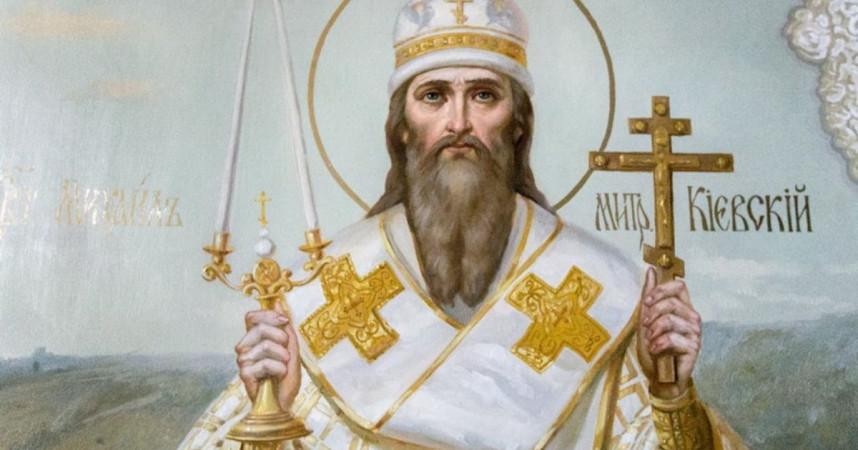
The Church remembers St. Michael, Metropolitan of Kiev
13.10.2025, 06:00


-

What Should We Remember?
Olga Kutanina
All Authors