St. Tikhon of Medyn, the Wonderworker of Kaluga, lived in the 15th century. It is assumed that he was from the "mother of Russian cities" – Kiev.
In his youth, he came to Moscow and took monastic vows, according to legend, at the Chudov Monastery. After some time, for the love of solitude, he retired to a deserted place 17 versts from the city of Kaluga and 15 versts from the city of Medyn, the names of which later became part of his name. The place chosen by the saint was on the right bank of the small river Vepreika, which flows five versts south into the river Ugra.
In the last years of the monk's life, not far from the place of his exploits, the famous "stand on the Ugra" (1480) occurred, which put an end to the Tatar yoke in Russia.
The ascetic settled in a dense forest, in the hollow of a gigantic oak tree, which stood for almost four centuries after the death of the saint. In the early 1830s, the oak was broken by a thunderstorm, and in 1838, the abbot of the monastery founded by the monk Gerontius built a chapel over the preserved mighty skeleton.
The monk's food was "self–grown epics" (wild ones), and his drink was water from a healing well, which he himself had dug at the source of the Vepreika and which is still called the "fount of St. Tikhon." The news of the ascetic's holy life attracted disciples to him. The brethren gradually began to gather around him. The owner of those places, Prince Vasily Yaroslavich (grandson of Vladimir the Brave), discovered the saint's dwelling during a hunt. He ordered the monk to leave his patrimony immediately. Insulting the hermit, the prince swung his whip at him. The hand raised against the saint immediately went numb and remained motionless. Enlightened by God's punishment, the prince repented and asked the monk for forgiveness. Having been healed by the saint's prayer, he began to beg the hermit to stay in his land forever and build a monastery for his disciples here, promising to provide her with everything she needed.
St. Tikhon founded the hermitage, having erected in it the first wooden church in honor of the Dormition of the Most Holy Theotokos. He became the first abbot of the monastery and governed the brethren with humility, meekness and gentleness. The Holy abbot fed the hungry, watered the thirsty, received the strange, and interceded for the offended. St. Tikhon had the gift of tears and was notable for his taciturnity.
According to an ancient monastic tradition, St. Tikhon died in 1492 at a very old age, having accepted the great schema shortly before his death. The year of the saint's dormition was marked in the synod of the Laurentian Monastery, compiled under Tsar Theodore Ioannovich.
During the reign of John the Terrible, the first royal contribution was made to Tikhonov's hermitage, in the records of which the founder of the monastery is called "venerable": "Given to this monastery, in the house of the Most Pure Theotokos of Her honorable and glorious Dormition and the Venerable Father Abbot Tikhon... The Patronal Gospel is written..." The All-Russian celebration of the memory of St. Tikhon was established at the Cathedral in 1584.
Until the Time of Troubles, the relics of St. Tikhon, according to legend, rested "at autopsy" in the Assumption wooden church, after the burning of which they were transferred to the only surviving church in the name of the Three Saints. Devastated by the Polish-Lithuanian invasion of Tikhonov, the desert was restored under tsars Mikhail Feodorovich (1613-1645) and Alexy Mikhailovich (1645-1676) by the zeal of hegumens Gerasim and Theodosius. The wooden Assumption Cathedral was rebuilt, as well as the warm St. Nicholas Church with a refectory. In 1677, the Three Saints Church was moved to the Podmonastrskaya sloboda, and in its place the stone Transfiguration Cathedral was built, in which the holy relics of St. Tikhon were placed under a bushel behind the right choir.
In 1799, the monastery was transferred to the newly founded Kaluga Diocese. On June 15, 1805, the first archbishop of the newly founded diocese, Theophylact (Rusanov), approved the service to St. Tikhon, compiled on the basis of an earlier service by the monastery's benefactor, Kaluzhanin Sergei Vasilyevich Eropkin. The text of the service was printed for All-Russian use in an Additional Version published in St. Petersburg in 1909.
In 1887, a wooden church in honor of the Life-giving Spring was built over the well fossilized by St. Tikhon.
During the 19th century, the church recorded the most significant healings that took place through the prayers of St. Tikhon. Most of the cures were received by patients who were possessed by mental illnesses, and many who suffered from eye and childhood diseases also recovered.
On icons, St. Tikhon of Kaluga, the wonderworker, is usually depicted in a scheming robe praying in front of icons of the Savior and the Mother of God, fortified in the hollow of a large oak tree against the backdrop of the majestic monastery built by the labors of his disciples.
About the appearance of St. Tikhon, the Original Iconography says: "Our Reverend Father Tikhon, the head of the monastery of the Virgin Mary, which is in Kaluga, in the likeness of a nativity, a brade like Vlasiev, a robe of reverence and in the schema."
The memory of St. Tikhon – June 16 – is reverently revered not only in the Kaluga region, but throughout Russia.
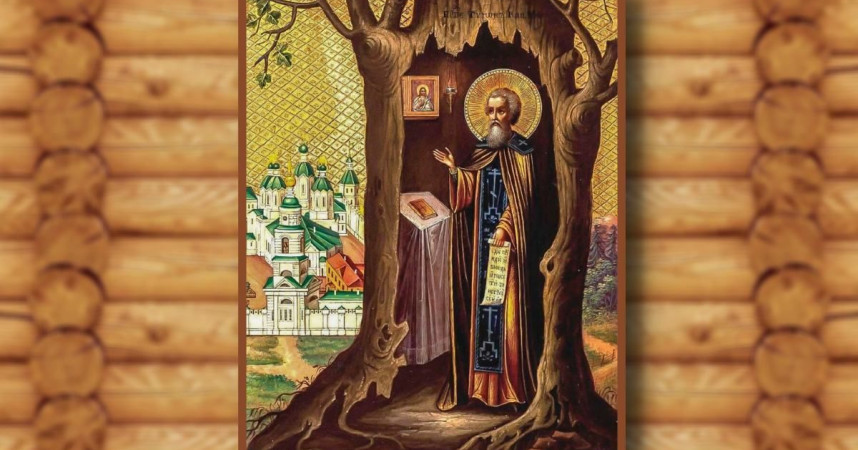
The Church remembers St. Tikhon of Medyn, the Wonderworker of Kaluga
29.06.2026, 06:00


-

What Should We Remember?
Olga Kutanina
All Authors