The Venerable Alexandra Diveevskaya, in the world Agafiya Semyonovna Melgunova, came from the ancient Ryazan noble family of the Stepanovs. She was born into a pious family in the late 1720s and early 1730s. Having lost her father early, Agafia was raised by her mother in the spirit of faith and piety. In her youth, she married Yakov Melgunov, an ensign in the Murom Infantry regiment, but was soon widowed and left with a young daughter. Despite her wealth, nobility and the opportunity to arrange a social life, Agafiya Semyonovna chose the path of serving God.
With the blessing of the elders, she and her daughter went to Kiev and entered the Florovsky Monastery. There she had a vision of the Most Holy Theotokos, who commanded her to go to the north of Russia and look for a place where the great monastery would be founded. Hiding her monastic tonsure, Agafiya Semenovna set off on her journey. In 1760, on her way from Murom to the Sarov desert, she stopped in the village of Diveevo. Here, at the western wall of the wooden church, the Mother of God appeared to her again and pointed out that this was the place intended for her life and future monastery.
The Sarov desert made a deep impression on Agafia Semyonovna with the strictness of the rules, the prayer life and the spiritual order of the monks. The elders of Sarov blessed her to settle first near Diveev, in the village of Osinovka. Soon her young daughter died there, and this event became the final break with worldly life for Agafiya Semyonovna. She sold her estates, distributed a significant part of the funds to monasteries, temples and the commemoration of her relatives, after which she returned to Diveevo.
For about twenty years Agafiya Semyonovna lived in a small cell at the house of the Diveevo priest Vasily Dertev. She led a strict ascetic life, consulted with the elders of Sarov, and helped the poor, orphans, and the needy. With her participation, the wooden Stefanovskaya Church was improved: the main part of the temple was repaired, side chapels in the name of St. Nicholas and the Kazan Icon of the Mother of God were added. Later, by the revelation of the Mother of God and the blessing of the elders, she began the construction of a stone Kazan temple on the site of her Diveevo vision. The church was consecrated in early 1780.
Mother Alexandra was distinguished by her secret charity, humility, and caring for people. She helped poor brides, supported orphans, and instructed peasants after Sunday and holiday services, reminding them of Christian life and the veneration of holy days. She donated a significant part of the capital to the Sarov Desert; according to the testimony of St. Seraphim of Sarov, the Assumption Cathedral in Sarov was built by her zeal.
In 1788, shortly before her death, it became possible to fulfill the main purpose of Mother Alexandra — to establish a female monastic community in Diveevo. One of the landowners donated the land next to the church to her, and with the blessing of the elders of Sarov, three cells with a fence were built there. Matushka herself occupied one cell, designated another for pilgrims, and a third for novices. This was the beginning of the future Diveevskaya monastery.
In June 1789, feeling the approach of death, Agafiya Semenovna accepted the great schema with the name of Alexander. Before her death, she asked the elders of Sarov not to leave her novices and to take care of the monastery promised by the Queen of Heaven. Schema-nun Alexandra died on June 13, 1789, at the age of no more than sixty years.
St. Seraphim of Sarov deeply revered Mother Alexandra, calling her a great and holy wife, a benefactor of Sarov and Diveev. He predicted that eventually her relics would openly rest in the monastery. After the closure of the Diveevo monastery in 1927, her cell and grave were destroyed, but her memory remained among the inhabitants of Diveevo for almost two centuries. In 1991, her burial place was restored, and in 2000, the venerable relics of St. Alexandra were found and transferred to the Church of the Nativity of the Virgin. In the same year, she was glorified as a locally venerated saint of the Nizhny Novgorod diocese, and in 2004 she was canonized as a general church saint.
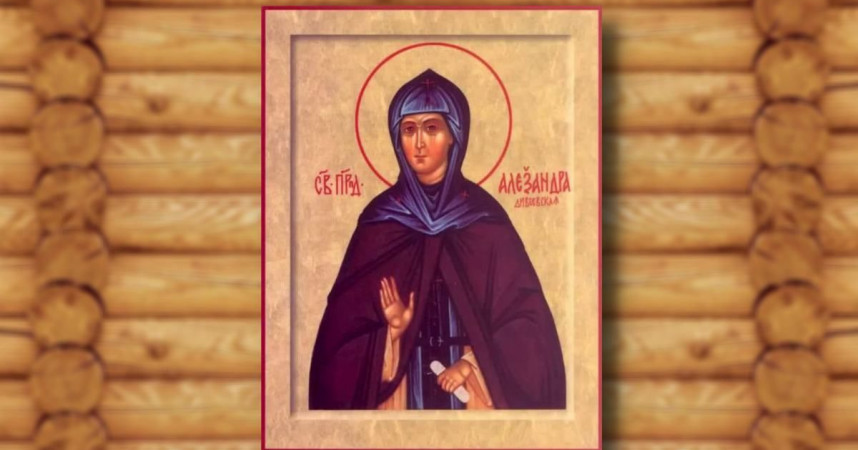
The church remembers the Reverend Alexandra Diveevskaya
26.06.2026, 06:00


-

What Should We Remember?
Olga Kutanina
All Authors