The Monk Serafim Vyritsky (in the world Vasily Nikolaevich Muravyov) was born on March 31, 1866 in the village of Vakhromeevo, Rybinsk district, Yaroslavl province, into a family of peasants Nikolai and Khionia. In Holy Baptism, he was named Basil in honor of St. Basil the New Confessor.
When the boy was ten years old, his father died, and Vasily, thanks to the help of a pious fellow villager, went to St. Petersburg to earn money, where he later worked as an office boy, assistant clerk, clerk and then senior clerk in the shops of Gostiny and Apraksin yards. However, the boy had a cherished dream in his soul – to enter a monastery.
At the age of fourteen, he receives a prophetic blessing from the visionary elder of the Alexander Nevsky Lavra: to remain in the world for the time being, to do godly deeds, to create a pious family, to raise children and, together with his wife, to devote the rest of his life to monastic asceticism. Having accepted the word of the Lavra elder as a divine blessing, Vasily lived the rest of his life as the Lord had ordained for him. It was a feat of obedience that lasted more than forty years...
For almost 20 years, Vasily Muravyov was under the care of the elder of the Gethsemane skete of the Holy Trinity Sergius Lavra, St. Barnabas (Merkulov), and this allowed him to lay the spiritual foundation on which his further growth as a great ascetic of piety took place.
In his daily activities, in dealing with people, and in his prayers, he was based on three main commandments: truth, love, and goodness, which he later bequeathed not only to his spiritual children, but also to all those who needed his help. His favorite reading was the works of St. Ignatius Bryanchaninov, according to which he advised all his spiritual children to study holiness.
The abilities given by the Lord helped Basil in his labors. So, while working in a merchant's shop, he independently learned to read and write, mastered the history of the Fatherland and, having good mathematical abilities, became a senior clerk at the age of seventeen. Vasily sent his entire salary to his sick mother.
Around 1890, he married Olga Ivanovna Naidenova, who also came from the peasants of the Rybinsk district of the Yaroslavl province. Since she was a teenager, she secretly dreamed of becoming a monk, but received the blessing of the schema-nun of the Iversky monastery of the Moscow province, Pelagia, to live in the world, marry a pious man, give birth and raise children, and only then, by mutual consent, take vows. The Lord blessed their marriage with their son Nikolai and daughter Olga, but the girl died in infancy, after which the couple lived by mutual consent as brother and sister.
In 1892, Vasily Nikolaevich, thanks to the support of his master, opened his own business and became a merchant of the 2nd guild. Over time, his office for the harvesting and sale of furs enters the international market.
In 1895, V.N. Muravyov became a full member of the Society for the Dissemination of Commercial Knowledge in Russia, the purpose of which was to provide all possible assistance to the Emperor and the government in the field of national economic development, and in 1897 he graduated from the Higher Commercial Courses organized by the Society.
Living in the world and becoming a very rich man, he never forgot the blessing of the Lavra elder, tried to do good, helped those in need, donated most of his income to the needs of monasteries, temples and almshouses.
It is known that in 1905 V.N. Muravyov was presented for an award for his charitable deeds. In the same year, the pious merchant became a full member of the Yaroslavl Charitable Society, known throughout Russia, which included many famous pastors and public figures of that time, including St. John of Kronstadt.
After the death of St. Barnabas, Bishop Feofan (Bystrov) of Yamburg and the future hieromartyr, Bishop Veniamin (Kazansky) of Petrograd and Gdovsk, became Vasily Nikolaevich's spiritual mentors. The last confessor of Elder Seraphim was Archpriest Alexy Kibardin, who served as rector of the church of the Kazan Icon of the Mother of God in Vyritsa.
The year 1917 arrived. Many of the Muravyovs' wealthy acquaintances are transferring their capital abroad and leaving Russia, hoping to survive the troubled times abroad. Vasily Nikolaevich decides otherwise: with the beginning of the February Revolution, he closes his commercial enterprise and distributes his fortune to employees in need. He donates a significant part of it to the needs of the Alexander Nevsky Lavra and the Resurrection Novodevichy Monastery, as well as the Iversky Vyksa and Holy Dormition Pyukhtitsky monasteries, and finally prepares himself for becoming a monk...
On September 12, 1920, V.N. Muravyov handed over another large donation to the Alexander Nevsky Lavra, and a day later he wrote to the Spiritual Cathedral of the Lavra a petition for his admission to the brotherhood, to which he received a positive response and the first obedience – the ponomarsky.
Already on October 26, Metropolitan Veniamin of Petrograd and Gdovsk blesses the tonsure of novice Vasily at the same time as his wife, who entered the St. Petersburg Novodevichy Monastery and took vows with the name of Christina (in the scheme of Seraphim).
On October 29, Basil was tonsured a monk with the name Barnabas. He was soon ordained a hierodeacon, and on September 11, 1921, he was ordained a hieromonk.
During the years 1920-1926, Father Barnabas carried out a number of responsible and difficult duties: head of the cemetery office of the Lavra, chief candle maker, and then treasurer of the monastery. At the end of 1926, he accepted the great schema with the name Seraphim and was elected confessor of the Lavra by the brethren. Under his pastoral care, a great many spiritual children gather – laypeople, monks, priests and bishops, among them prominent hierarchs: Bishop Gregory (Lebedev), Metropolitan Seraphim (Chichagov), Bishop Nikolai (Yarushevich), Archbishop Alexy (Simansky).
For about three years, Father Seraphim remained in the field of confessor of the Lavra. With fatherly love and heartfelt warmth of prayer, he helped to get rid of the most terrible sins, human hatred and fratricide.
After receiving the eight-hour daily confession, the elder began to experience constant pain in his legs. In early 1933, the disease finally confined him to bed and, according to the recommendation of doctors and at the insistence of Metropolitan Seraphim (Chichagov), he moved to Vyritsa– a village eighty kilometers from St. Petersburg.
Here, on the bed of a serious illness, for almost twenty years he carried out the feat of senile care, receiving several hundred visitors on certain days. But its visitors were not only those seeking their salvation. In the period from 1938 to 1940, the authorities searched his apartment several times at night. During one of these searches, an elder who did not get out of bed called one of the NKVD officers to him. He looked with his kind and affectionate eyes at the man who was entrusted with the task with all rigor, asked his name, took his hand, stroked it, then put his hand to his head and said: "May your sins be forgiven, servant of God..." At this moment, the face of the formidable representative of power softened, and the further conversation took place as if they were the best of friends. In a similar way, the elder cured the rest of those conducting the search from the disease of hatred and cruelty.
In January 1941, Father Nikolai's son was arrested and shot in September. Four years later, the schema-nun Seraphim passed away. Great sorrow entered the father's heart.
During the war, Elder Seraphim, in addition to strict fasting and incessant cell prayer, undertook a special feat: nightly, standing on a stone in front of the icon of St. Seraphim of Sarov, with his hands raised, he prayed for Russia, imitating the feat of his heavenly patron.
During the war years, only one house was destroyed in Vyritsa, to the owners of which the priest said in the early days of the war: "You need to leave Vyritsa." Through his prayers, the Germans occupied the village and housed the Romanian Orthodox unit in it, so that not a single person in the village was injured, and the church continued to operate.
After the war, hundreds of people, eager to learn about the fate of their loved ones, rushed to the priest. And he received them, saying to some: "Your husband is alive, he's already boarding the train," and to others: "If he doesn't come, pray for his rest." The elder's words always came true.
The time of the elder ascetic's ministry fell during the period of bloody theology, the Great Patriotic War, post-war devastation and renaissance. All these years, with his life, the priest testified to Christ, fulfilling the testament of St. Seraphim of Sarov: "Save yourself, and thousands will be saved around you." Many of his deeds are marked by obvious miracles, as witnessed by eyewitnesses.
The elder predicted: "The time will come when not persecution, but money and the delights of this world will turn people away from God, and many more souls will perish than in the days of open God-fighting. On the one hand, crosses will be erected and domes will be gilded, and on the other, the kingdom of lies and evil will come. It will be scary to live up to these times." Shortly before his death, the monk spoke to his cell attendant about the revelation that had come to him: "I have visited many countries. I have not found a better country and I have not seen a better faith. Tell everyone not to deviate from Orthodoxy."
The righteous soul of the elder departed to the Lord on April 3, 1949. After his death in Vyritsa, a fragrance was felt in the air for several days.,
He was talking about himself: "After my death, come to my grave as if you were alive, and talk to me as if you were alive, and I will always help you."
For more than 50 years since the blessed death of the elder, his national veneration has not ceased. A chapel has now been erected over his grave.
At the Jubilee Council of Bishops in August 2000, Elder Seraphim was canonized by the Russian Orthodox Church.
To this day, the holy elder, through his heavenly intercession, does not leave the sorrowful and suffering who flow to his earthly resting place.
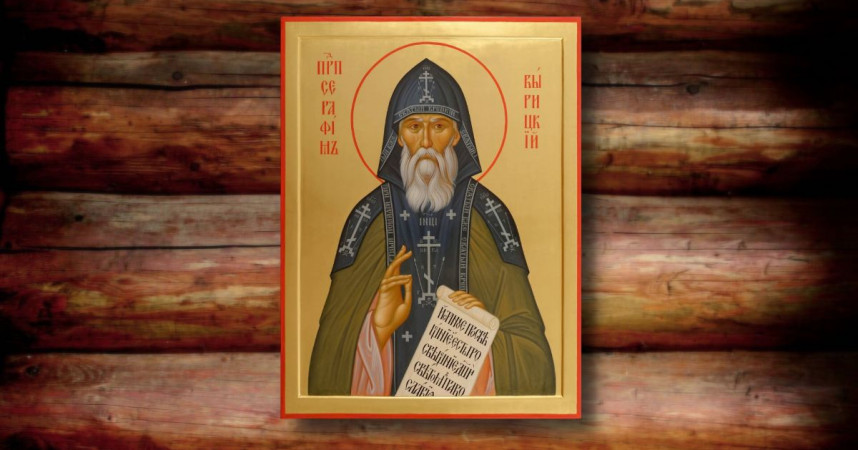
The church remembers St. Seraphim Vyritsky.
03.04.2025, 06:00




-
The Strength of Weakness
Alexey Shirikov
All Authors