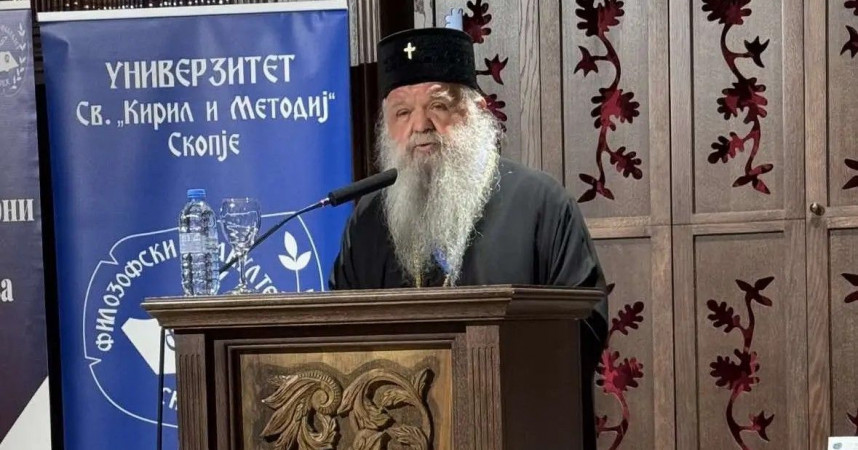
Archbishop Stefan, head of the Macedonian Orthodox Church–Ohrid Archbishopric, called for a deeper understanding of peace rooted in spiritual renewal during the opening of the Fourth World Conference on Religious Dialogue and Cooperation in Skopje.
The international gathering, taking place from June 23 to 26, is dedicated this year to the theme, “Religion as a Weapon of War: Past, Present and Future.” Scholars, theologians, religious leaders, and diplomats from around the world have convened to examine the role of religion in contemporary conflicts and explore pathways toward peace.
In his opening address, Archbishop Stefan emphasized that the Christian understanding of peace extends far beyond the mere absence of war.
“The peace that Christ gives does not depend on external circumstances. It begins with the presence of God in the human heart,” the archbishop said.
According to Archbishop Stefan, efforts to establish peace between nations must begin with inner peace and a willingness to recognize every person as a neighbor. He noted that this principle is reflected in the Church’s liturgical life, where prayers for peace hold a central place in every Divine Liturgy.
The primate also highlighted the responsibility of religious communities during times of crisis. He urged believers to respond to hostility with brotherly love and to overcome divisions through respect, understanding, and dialogue.
“The mission of all religious communities is to be a voice of respect and love for every human being,” he said.
The conference is being held with the support of state institutions, civil society organizations in North Macedonia, and the Macedonian Orthodox Church. Organizers reported that 79 scholars, researchers, religious figures, and diplomats from Europe, Asia, the Americas, and the Middle East are participating in this year’s forum.
Among the key topics under discussion are religious extremism, peacebuilding, interfaith dialogue, human rights, cultural diplomacy, and the role of religious leaders in preventing conflicts.
Organizers say the conference has grown into one of the Balkans’ leading international platforms for promoting cooperation and understanding among different religious and cultural communities. Participants are expected to explore not only the causes of religious conflicts but also the unique contributions faith communities can make in fostering reconciliation, reducing hostility, and strengthening mutual understanding among peoples and nations.


-

What Should We Remember?
Olga Kutanina
All Authors