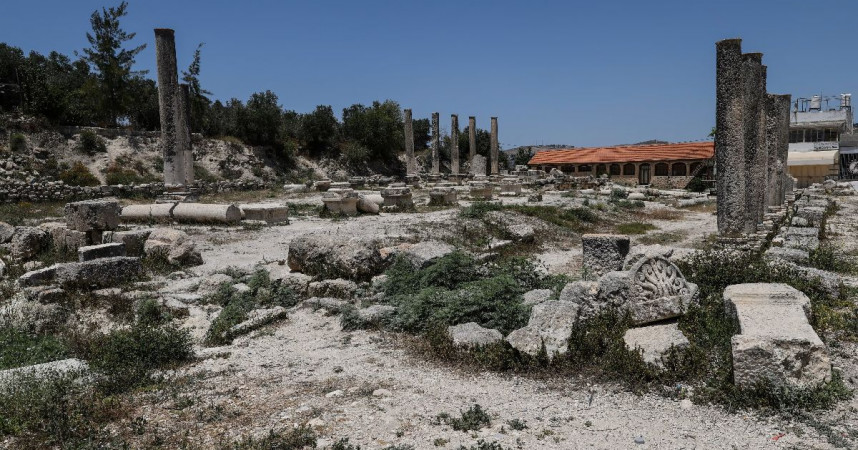
UNESCO has added the Palestinian village of Sebastia in the occupied West Bank, widely identified by scholars with the ancient biblical city of Samaria, to both the World Heritage List and the List of World Heritage in Danger.
The decision was adopted on July 24 during the 47th session of the UNESCO World Heritage Committee in Busan, South Korea.
UNESCO said the site's nomination was processed under an accelerated procedure because of the risks posed by the ongoing conflict in the Middle East. According to the organization, the integrity of the archaeological complex could be threatened by Israel's proposed "Samaria National Park" project, which would involve the expropriation of land and the division of parts of the historic site.
The decision prompted strong criticism from Israel. The Israeli Foreign Ministry said the Palestinian nomination presented the site's history from a one-sided perspective and argued that UNESCO had failed to adequately recognize the Jewish and Christian heritage associated with ancient Samaria. Palestinian officials welcomed the designation, calling it international recognition of years of efforts by local residents to preserve the archaeological site.
Sebastia is regarded as one of the Holy Land's most significant biblical and archaeological landmarks. The site is traditionally identified with ancient Samaria, the capital of the northern Kingdom of Israel, founded by King Omri, as described in the Hebrew Bible. Samaria appears repeatedly in the Old Testament as the political and religious center of the northern tribes of Israel and is associated with the ministries of the prophets Elijah, Elisha, Amos, and Hosea.
The region also holds an important place in the New Testament. Jesus traveled through Samaria, where the Gospel of John records His conversation with the Samaritan woman at Jacob's Well. The Parable of the Good Samaritan further established the region's enduring significance in Christian tradition. Following Pentecost, the Book of Acts recounts that the apostles preached the Gospel in Samaria, where some of the earliest Christian communities were established.
The archaeological complex at Sebastia preserves remains from multiple historical periods, including the Iron Age, Hellenistic, Roman, Byzantine, and Islamic eras. Excavations conducted since the early twentieth century have uncovered the remains of a royal palace attributed to the Israelite kings, massive fortification walls, a Roman colonnaded street, a forum, a theater, a temple dedicated to Emperor Augustus, and numerous Byzantine churches. Christian tradition also identifies Sebastia as the burial place of St. John the Baptist, where a Byzantine basilica was later constructed.
The future of Sebastia has been the subject of growing political debate in recent years. In June, Israel's Knesset approved in a first reading a bill that would transfer archaeological and religious sites in Judea and Samaria to the authority of Israel's Ministry of Heritage. The proposed legislation would also allow for the purchase and expropriation of land containing historical monuments.
Critics argue that the initiative could strengthen Israeli control over disputed territory under the guise of heritage preservation. Israeli officials, however, maintain that the measures are necessary to safeguard sites of exceptional historical and biblical importance.







-

“I Praise You, Brothers”: The Spiritual Art of Recognizing the Good
Alexey Shirikov
All Authors