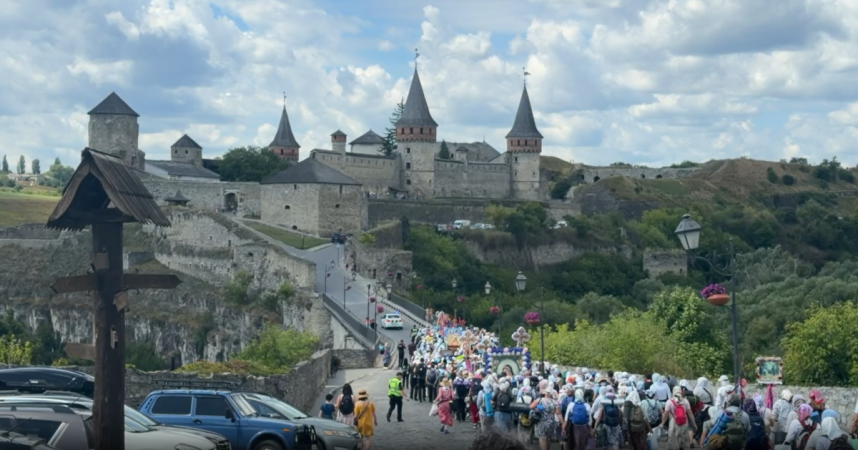
Thousands of Orthodox pilgrims are taking part in a traditional cross procession from Kamianets-Podilskyi to the Pochaev Lavra in Ukraine ahead of the Feast of the Dormition of the Mother of God.
The pilgrims set out on August 19 after the Divine Liturgy for the Feast of the Transfiguration and are expected to reach the monastery on August 27, the eve of the Dormition. Over the course of eight days, participants will cover approximately 250 kilometers.
According to the Union of Orthodox Journalists, the procession has grown significantly this year, with the column stretching for nearly three kilometers in some places. Many young people are among the pilgrims. Police are accompanying the procession, citing the need to ensure road safety and maintain public order.
The pilgrimage is taking place amid strained relations between the Ukrainian Orthodox Church and the Ukrainian authorities. A ban on mass events had previously been in effect in Khmelnytskyi region. Law-enforcement officials, however, said they could not hold the procession’s “organizers” responsible because no organizers could be identified. Pilgrims say they are traveling independently, while others join the group along the route.
The tradition of walking from Kamianets-Podilskyi to Pochaev is associated with an event said to have taken place in 1832. According to church tradition, a blind girl named Anna Akimchukova traveled on foot from Kamianets-Podilskyi to Pochaev with her grandmother to pray before the miraculous icon of the Mother of God. She is said to have regained her sight after praying before the icon.
The pilgrimage has been held annually ever since. Believers walk several dozen kilometers each day, often setting out before dawn.
The Pochaev Lavra is located on Pochaev Hill in the Volhynia region and is one of Ukraine’s principal Orthodox monasteries. Its history spans several centuries. The monastery’s main sacred objects include the Pochaev Icon of the Mother of God and a footprint of the Virgin Mary preserved in stone.
The situation surrounding the lavra remains tense in 2026. Ukrainian authorities are seeking through the courts to return a number of buildings and plots of land associated with the monastery to state ownership. According to the Ternopil Regional Prosecutor’s Office, four related cases are currently under consideration.
The administration of the Kremenets-Pochaev State Historical and Architectural Reserve has also asked police to examine the legality of the current procession. The reserve said that the mass event could affect the preservation of cultural heritage sites and should be coordinated with Ukrainian authorities.
State bodies have additionally called on the lavra’s leadership to reconsider its church affiliations. Ukrainian authorities regard the Ukrainian Orthodox Church as linked to the Russian Orthodox Church and have sought in recent years to reduce such ties.
For the participants, however, the procession remains primarily a religious pilgrimage. The faithful continue their journey to the Pochaev Lavra despite administrative restrictions and the broader dispute surrounding the monastery. The column is expected to arrive on August 27, when pilgrims will attend services held on the eve of the Feast of the Dormition.


-

The Prayers We Say for the Dead Are Also Prayers for the Living
Tatiana Lyubomirskaya
All Authors