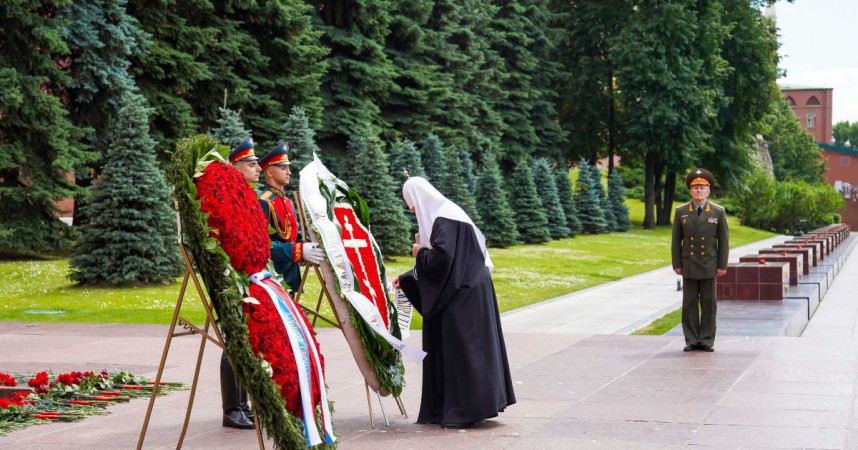
Patriarch Kirill of Moscow and All Russia laid a wreath on behalf of the Russian Orthodox Church at the Tomb of the Unknown Soldier near the Kremlin Wall in Moscow’s Alexander Garden during ceremonies marking the Day of Remembrance and Mourning, which commemorates the beginning of the Great Patriotic War.
The memorial event took place on the 85th anniversary of the Nazi invasion of the Soviet Union in 1941. Senior clergy, monks, representatives of Moscow’s military command, officers, and members of the honor guard from the 154th Independent Commandant Preobrazhensky Regiment joined the Russian Orthodox Church leader at the ceremony.
Following the wreath-laying, participants observed a minute of silence, and the Russian national anthem was played. A memorial service was then held for those who died during the war. The ceremony included prayers for fallen soldiers and all victims of the Great Patriotic War.
The official proceedings concluded with a ceremonial march by the honor guard.
Addressing servicemen, Patriarch Kirill described the Great Patriotic War as the most severe trial in the country’s thousand-year history. He noted that Nazi Germany had enjoyed significant military and economic advantages and expected a swift victory over the Soviet Union.
“Despite the fact that strength was on the side of the enemy, they lost,” Patriarch Kirill said. “We ended the war not at our own borders, but in Berlin itself.”
The Patriarch emphasized that the memory of the war remains deeply personal for millions of Russian families. He shared that his uncle, after whom he was named Vladimir, was killed near the Brest Fortress during the first days of the conflict.
According to the head of the Russian Orthodox Church, preserving the memory of the wartime generation and working for the country’s development are important responsibilities for modern generations. He highlighted the contributions of military personnel, scientists, engineers, builders, and other citizens whose work supports national progress.
Patriarch Kirill also addressed clergy and monastic communities, recalling wartime developments that transformed relations between the Soviet state and the Church. He highlighted the historic 1943 meeting between Soviet leader Joseph Stalin and Russian Orthodox Church leaders as a significant milestone in the nation’s history.
He said that the Church’s current ability to build churches, open monasteries, and expand educational activities is the result of the efforts and sacrifices of previous generations of believers and clergy.
Concluding his remarks, Patriarch Kirill called for continued commitment to moral values, remembrance of historical lessons, and support for the spiritual and social development of the country.




-
The Strength of Weakness
Alexey Shirikov
All Authors