On June 4, 2026, a discussion "Entrepreneurship as a service" was held at the St. Petersburg International Economic Forum. The session participants discussed whether there is a special Orthodox view of economics, how entrepreneurial success and Christian responsibility relate, and what role value-based business can play in the development of society.
Alexander Vedyakhin, First Deputy Chairman of the Management Board of Sberbank, Dmitry Volvach, Head of the Federal Accreditation Service, Sergey Ivanov, Executive Director and Member of the Board of Directors of EFKO Management Company, Galina Izotova, Deputy Chairman of the Accounts Chamber of the Russian Federation, and Chief Economist at VEB took part in the discussion.Andrey Klepach, Chairman of the Synodal Department for Church-Society Relations and the Media Vladimir Legoyda, Minister of Transport of the Russian Federation Andrey Nikitin.
The meeting was moderated by Ilya Kuzmenkov, Deputy Chairman of the Synodal Department for Church-Society Relations and the Media, Editor-in-chief of Radio Vera. Opening the discussion, he noted that interest in the topic of entrepreneurship as a ministry is noticeably increasing — both from the Church and theologians, as well as from society, entrepreneurs, government representatives and the media. According to him, ideological, moral and ethical components are becoming an important part of the conversation about the economy.
The session participants talked about why Christian entrepreneurs call their activities ministry, whether business is responsible for the mental health of the nation and the development of national culture, what is the mission of a Christian leader of a modern company, and how value—oriented business influences the formation of Russia's socio-economic doctrine.
Andrey Nikitin, Minister of Transport of the Russian Federation, spoke about the work of the Ministry of Transport on the implementation of family-centric standards. According to him, the agency has already adopted six such standards. Some of them relate to the Ministry's internal work, including support for young families at transport universities. The other part is related to the interaction of enterprises with employees who have children.
As an example, Andrey Nikitin cited the Delo Group of companies, which has been implementing a corporate family support program for employees since 2022. According to the minister, this experience is used in the formation of corporate standards. He paid special attention to creating a comfortable environment for families with children in airports, multifunctional zones and other public spaces.
Galina Izotova, Deputy Chairman of the Accounts Chamber of the Russian Federation, spoke about the agency's mission, which is to promote fair and responsible public administration. She stressed that the Accounting Chamber sees itself not as an administrative barrier, but as an infrastructure partner and an institutional arbitrator.
According to Galina Izotova, the most important areas of the department's work are evaluating the effectiveness of government support measures, developing assistance programs for small and medium-sized businesses, as well as monitoring compliance with labor and tax laws. She particularly noted the social contract as a measure that helps low-income citizens gain access to an economic elevator.
Alexander Vedyakhin, First Deputy Chairman of the Management Board of Sberbank, spoke about the bank's human-centered approach. He noted that Sberbank builds its products, value propositions and communication around human interests, supporting family values and projects aimed at helping children.
Among such initiatives, Alexander Vedyakhin named the "Superprime Green Marathon", which raised 250 million rubles for charitable purposes — helping children and people in difficult life situations. He also spoke about the volunteer projects of the bank's employees related to child support, environmental actions, the rescue of the Baikal seal and the elimination of the consequences of emergency situations. In addition, the representative of Sberbank suggested that the topic of ethics of new technologies should be included in a separate discussion.
Vladimir Legoyda, Chairman of the Synodal Department for Church-Society Relations and the Media, drew attention to the fact that the understanding of entrepreneurship as a ministry goes beyond the usual conversation about the social responsibility of business, charity and humanitarianism.
"Understanding service implies something more: It means not only that success cannot be the ultimate goal of a person's life, but also that not everyone can achieve such success. And there is nothing humiliating in this from the point of view of human dignity," Vladimir Legoyda emphasized.
He noted that society should not allow poverty, but it is important to remember that people whom the modern world considers to be failed retain their human dignity. According to Vladimir Legoyda, suffering is an important part of human life, and how a person copes with it largely shapes his personality.
Speaking about the ethics of artificial intelligence and new technologies, Vladimir Legoyda supported the proposal to hold a separate discussion on this topic. He stressed that the Church has been dealing with this issue for a long time, but the area remains extremely complex, since the anthropological consequences of using new tools have not yet been fully understood.
The St. Petersburg International Economic Forum is taking place in St. Petersburg from 3 to 6 June. The SPIEF has been held annually since 1997, and since 2006 — under the patronage and with the participation of the President of the Russian Federation. Over the years, the forum has become one of the world's leading platforms for dialogue between representatives of the business community, the government, the expert community and public institutions.
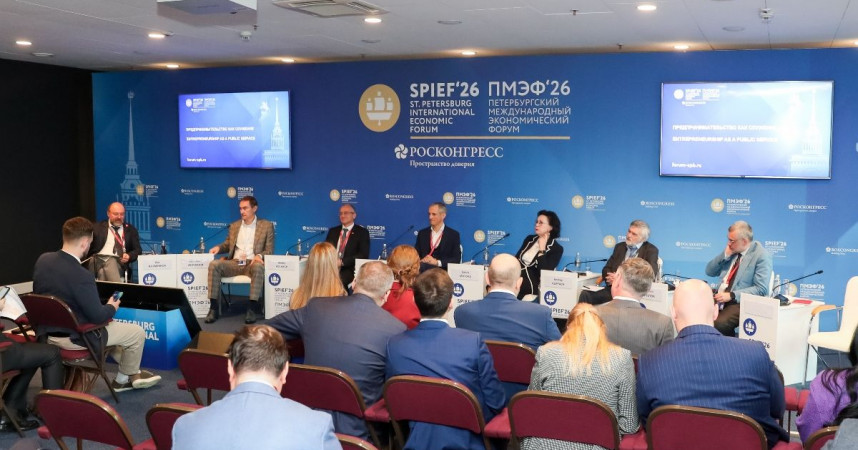
The Orthodox view on entrepreneurship was discussed at SPIEF 2026
07.06.2026, 12:00


-

What Should We Remember?
Olga Kutanina
All Authors