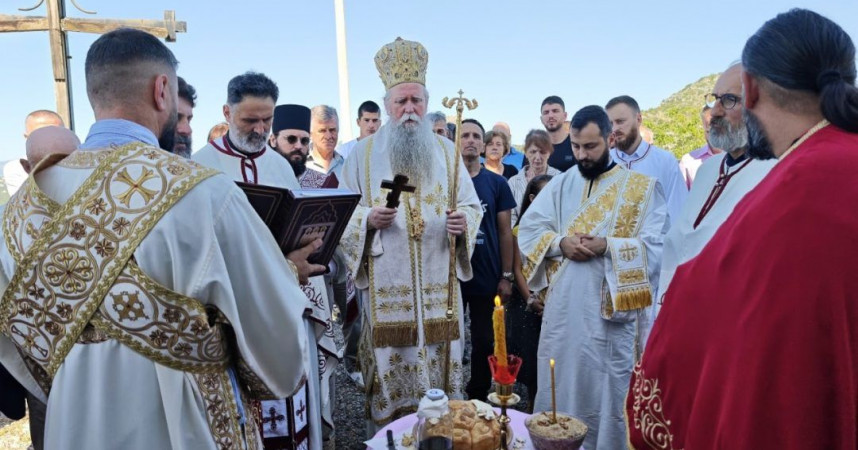
Commemorative ceremonies honoring the Holy Martyr Metropolitan Joanikije of Montenegro and members of the clergy who died during the Second World War and the postwar communist period were held in Montenegro, with church leaders using the occasion to call for historical truth, reconciliation, and remembrance of all victims of political violence.
The central celebration took place at the Church of the Holy Martyr Joanikije in Pardusi, in the historic Lješanska Nahija region near Podgorica. The church is dedicated to Metropolitan Joanikije (Lipovac) and clergy of the Metropolitanate of Montenegro and the Littoral who lost their lives during the final months of the war.
During the Divine Liturgy, Metropolitan Joanikije of Montenegro and the Littoral emphasized the importance of confronting the past while avoiding the revival of old divisions.
“The goal should not be revenge, but the search for truth, which has the power to liberate both individuals and society,” the metropolitan told worshippers gathered for the service.
A major theme of the commemoration was the memory of the events of 1944–1945, when thousands of people from Montenegro, Serbia, and other parts of Yugoslavia fled alongside retreating anti-communist forces, fearing persecution under the incoming communist government. Many died in what are now Slovenia and Austria, while new mass grave sites continue to be discovered decades after the end of the war.
Special attention was given to the legacy of Metropolitan Joanikije Lipovac, who led the Montenegrin Metropolitanate on the eve of World War II. According to the Serbian Orthodox Church, he sought to preserve peace among the population and save lives amid intense internal conflict and political turmoil.
His historical role, however, remains the subject of debate. During the socialist era of Yugoslavia, Joanikije was accused of collaborating with occupying authorities. The Serbian Orthodox Church rejects those allegations as politically motivated and argues that many interpretations of wartime events deserve renewed examination.
In his sermon, Metropolitan Joanikije also drew parallels between the fate of the holy martyr and that of Metropolitan Arsenije Bradvarević, who was convicted by communist authorities after the war and spent years in prison. The metropolitan said that the tragedies of the twentieth century continue to shape public life across the Balkans.
Observers note that the question of wartime victims and postwar repression remains one of the most sensitive historical issues in the countries of the former Yugoslavia. In recent years, research into mass graves has intensified, while civic and religious organizations have increasingly called for open discussion of crimes committed by various sides during the conflict.
Concluding the service, Metropolitan Joanikije argued that lasting social harmony can only be achieved through recognition of the suffering experienced by all victims, regardless of their political affiliation or background.
“There were sins committed on all sides, but today the most important things are repentance, forgiveness, and reconciliation,” he said.
As part of the commemorative events, church awards were presented to individuals who contributed to the construction of the church and to efforts aimed at preserving the memory of those who perished during the war and its aftermath.


-

What Should We Remember?
Olga Kutanina
All Authors