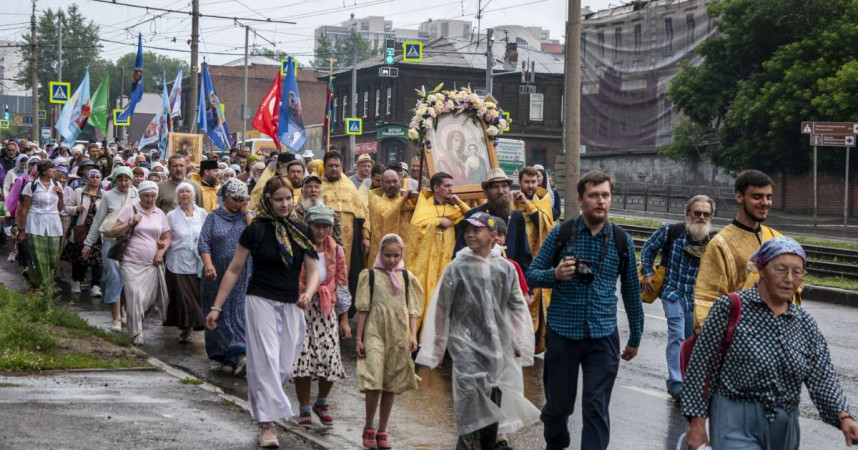
On June 28, 2026, with the blessing of Metropolitan Sergius of Barnaul and Altai, after the early Liturgy, the 28th All-Russian Procession left the Pokrovsky Cathedral for Korobeynikovo village to the miraculous image of the Kazan Mother of God. It will last until July 5th.
The proposed route is Barnaul – Buranovo – Kalmanka – Beloyarovka – Aleisk – Ust-Pier – Yelbank – Korobeynikovo.
A religious procession is a search for a lost paradise, it is a unique opportunity to suffer, to suffer inconveniences for the benefit of the salvation of the soul. The procession represents an incomprehensible unity of ecclesiastical celebration and national repentance.
Divine Liturgies will be served daily along the route of the procession, akathists of the Mother of God will be read, and prayer services will be held.
The history of the procession
At the beginning of the 20th century, a stone church was built in the village of Korobeynikovo (Ust-Pristansky district of the Altai Territory) in honor of the Kazan Icon of the Mother of God. The icon became a temple image. Before the revolution, there was even a local tradition: in dry weather, believers went out with a procession around the village, and after prayers it rained in front of the icon.
The turning point was 1938: the temple was closed, looted and turned into a grain warehouse. Precious vestments were removed from the icons, many images were destroyed or used for household purposes. The Kazan temple icon was violated: it was placed face down at the entrance, and it served as a floor block.
Saving the Icon
According to legend, the blind woman Olga Gavrilovna Peregudova (nicknamed "Olushka the Dark") from the neighboring village of Nizhneozernoye saw the Virgin Mary twice in a dream with the words: "Olya! Take Me. I'm being trampled on!" Olyushka told about the visions to the locals. As a result, the niece and the neighbor sewed a bag, entered the former temple (there were no guards that night) and took out a heavy icon.
The image was badly damaged: the faces of the Virgin and Child were barely discernible, the paint layer was crumbling, and there were cracks and scratches on the board. But over time, a gradual renovation of the icon began. It was finally updated on Easter Night in 1972: the surface became smooth, the images became clear and colorful. Believers continued to gather around the icon, chanting akathists and reciting prayers. In the 1960s, Olga Peregudova and her sister moved to Barnaul, taking the image with them. Later, a nun became the guardian of the icon.
The return and birth of tradition
In 1982, the restoration of the temple began in the village of Korobeynikovo. By 1994, the work was completed. In June of the same year, the Orthodox of Barnaul said goodbye to the miraculous image. On July 2, 1994, a crowded procession brought the icon back to the restored church. A few days before that, the image was in the Intercession Cathedral of Barnaul, where thousands of believers could worship it. The next day, Bishop Anthony (Masendich) of Barnaul and Altai solemnly consecrated the church. In the same year, a monastery was established at the temple in honor of the Kazan Icon of the Mother of God.
In memory of the icon's return, with the blessing of Patriarch Alexy II of Moscow and All Russia, a special holiday was established — the first Sunday of July. At the same time, the tradition of the annual seven-day procession from Barnaul to Korobeynikovo was born. The first such move took place in 1999. Over time, the tradition has strengthened, and the march has received the status of an All-Russian one: pilgrims from various regions of Russia (St. Petersburg, Moscow, Omsk, Tomsk, Novosibirsk, etc.), as well as from abroad, participate in it.





-

The Right Moment
Alyona Bogolyubova
All Authors