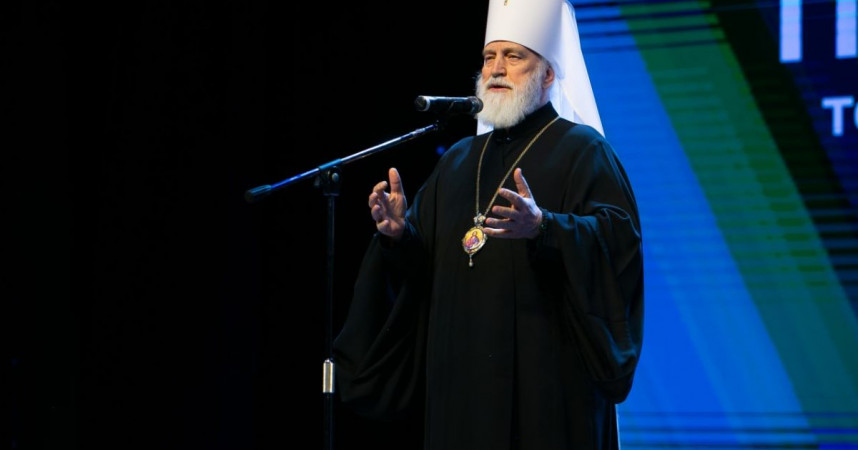
“The Current Problems and Challenges of the State Policy in the Upbringing and Education of Children and Youth” conference was held on August 18th, 2022 at the recently constructed Church of the Resurrection complex in Patriot Park under the International Military-Technical Forum’s “Army 2022” initiative, and brought together many high-ranking officials; from both the Church and the State, including Metropolitan Paul of Krutitsy and Kolomna.
As Patriarchal Deputy of the Moscow Metropolis and Rector of the Russian Orthodox University, Metropolitan Paul has incredible influence in the Orthodox Church in Russia and by extension in Russian society as a whole. Speaking at the conference, Metropolitan Paul called for cooperation between Church and State in the education of the young Russian citizens.
Below is a translation of his address; initially published on the third most visited Orthodox website Pravoslavie.ru. As this article is machine translated, we apologize in advance for any errors.
_______________________________
Dear participants of the conference, dear friends!
Addressing you from this podium today, I will try to express my position on the need to combine the maximum joint efforts of the Church and the State in upbringing and education of the children and young people in order to ensure the strong spiritual and national security of our Motherland.
One of the key factors in the successful implementation of the national priorities of the Russian Federation in the field of national security (outlined in Russian Presidential Decree № 400 of July 2, 2021) is the protection of traditional, spiritual, and moral foundations of Russian society. It is spiritual and moral ideals and cultural and historical values that are the foundation for the development of the country and its defense capability.
The events of recent months show us very clearly that the main technologies of modern military conflicts are the technologies of so-called mental warfare, which are very diverse and often difficult to identify for ordinary citizens. As Patriarch Kirill of Moscow and All Russia noted in his sermon after the Divine Liturgy at the Holy Trinity St. Sergius Lavra on July 18, 2022:
“They are trying to deprive the citizens of Russia of their national identity, faith, and sense of patriotism. Today Russia is a powerful state, and it is unlikely that anyone will try to deprive us of our freedom and independence by force of arms. But in our wicked age there are many other ways to crush people, to deprive them of their national consciousness, to deprive them of their faith, to deprive them of their sense of patriotism. We know that today many forces are working to influence our people and our country in this way. And why is that? Because we continue to be different.”
Education, of which upbringing is an integral part, is the fundamental basis for maintaining the integrity and national identity of the state. Children and young people are the most vulnerable in terms of the technologies of mass mental attacks used in the modern world through various sources. The ability to withstand these threats must be formed from birth and nurtured throughout life. First of all, the parents in their family, then the school, society, and the state should educate the child.
Today it is obvious that only the consolidation of the efforts of the Church and the State in the educational sphere, in the sphere of the formation of the personality of the citizen of the Russian Federation can bring tangible results.
Currently certain work in this direction has been done: the course of the Basics of Orthodox culture was introduced in the schools, theological components in educational programs of the leading Russian universities were intensively developed, and the demand for theological knowledge as a spiritual basis of the personality of the citizens of the Russian Federation steadily grows.
One of these institutions of higher learning is the Russian Orthodox University, which I have been entrusted to head. It occupies an important place among other educational institutions of higher learning in the Russian Orthodox Church. The university implements programs for training lawyers, journalists, and theologians, with the fundamental aim of training and educating future citizens of the Russian Federation in the best traditions of Russian education, inseparably connected with Orthodoxy.
University graduates are in demand in a wide variety of fields: government and corporate management, business, mass media, science, culture, and education. Our university also pays attention to the military-patriotic education of future graduates.
One of the most promising areas for our further development is expanding cooperation with the Defense Ministry's educational institutions. What is the reason for this interest?
The military-patriotic education of Russian Orthodox University graduates is one of the main priorities of our institution. Patriotism must be effective. It must manifest itself in readiness to defend the homeland from various external and internal threats.
The Righteous John of Kronstadt said: “Remember that the Motherland of the earth with its Church is the threshold of the Fatherland of heaven, and therefore love it fervently and be ready to lay down your life for it, in order to inherit eternal life there.”
We are trying to form this attitude in our students, to instil in them a sense of responsibility for the future of Russian statehood.
Today among the Orthodox priests there are many former officers of the Russian Army, conscripts. Many of them are well aware of what it means to be not only a physically strong and courageous soldier, but also a strong spirit capable of standing up for themselves and their neighbors not only on the battlefield, but also in the so-called mental war, since it concerns the spiritual security of our homeland.
Graduates of educational institutions of the Russian Orthodox Church are becoming more and more in demand in the positions of assistant commanders of formations and military units, responsible for work with the faithful servicemen; military psychologists, and deputy commanders in charge of military and political work. At the same time, the range of tasks entrusted to them is expanding day by day, which undoubtedly requires constantly upgrading their qualifications.
The study of technologies and the development of measures to counter the threats and consequences of mental warfare should become one of the priority areas of applied interdisciplinary joint research.
That is why I would like to propose closer cooperation between the Russian Orthodox University and the educational institutions of the Ministry of Defense at all levels, from cadet corps and Suvorov schools to academies.
Our university is open to joint projects in various spheres.
In particular, one of the joint educational projects could be a project to study Moscow's military history, which is steeped in spiritual and sacred meanings. Not only students, but also cadets and juniors could take part in this project. Visiting the churches of military glory in Moscow is an important part of shaping the identity of students of Moscow's military higher education institutions.
Such churches, built in different years, cover most of the national military history. For example, on the site of the mass grave of the heroes killed in the Battle of Kulikovo stands the Church of St. George the Victorious in Kolomenskoye. The Church of All Saints in Kulishki is also associated with the Battle of Kulikovo. The heroes of this battle, Peresvet and Oslyabya, the monks sent to help the holy Prince Dmitry Donskoy, are buried in the church of the Nativity of the Most Holy Mother of God in Old Simonovo. Their tombstones are now restored and the church has been improved.
The Sretensky Monastery, founded on the site where the miraculous Vladimir Icon of the Mother of God was revealed, became a monument of gratitude for the miraculous rescue of the city of Moscow from the invasion of Tamerlane in 1395.
To commemorate the victory over the Tatar prince, named Mazovsha, in July 1451, in the Moscow Kremlin, the house metropolitan church of the Deposition of the Robe of the Most Pure Mother of God in Blachernae was built, since the prince, after a fierce battle fought on the day of that Feast, at night suddenly fled from the walls of Moscow.
St. Basil's Cathedral dedicated to the Intercession of the Theotokos, was built in honor of the capture of Kazan by Tsar Ivan IV.
A striking unifying symbol of our Motherland is the Kazan Cathedral built in the Red Square, at the end of the Time of Troubles to commemorate the victory over the Polish invaders and the restoration of Russian statehood.
To commemorate the victory of Peter the Great at Poltava, the Church of the Martyr John the Warrior was built on Bolshaya Yakimanka Street.
The Memorial Museum of the 1812 Patriotic War ("Kutuzov's Hut") operates a church in honor of Archistratigus Michael.
The chapel-monument to the heroes of Plevna was built in memory of the Russian-Turkish war of 1877-1878, which freed the Slavs from the Ottoman yoke.
Of course, the most magnificent monument to the Russian army in Moscow is the Cathedral of Christ the Savior, built to commemorate the victory in the Patriotic War of 1812.
There is a church in Moscow built to commemorate the victory in the Great Patriotic War of 1941-1945; called the Church of the Great Martyr George the Victorious on Poklonnaya Hill.
And of course, a special place among the above-mentioned churches belongs to the majestic Church of the Resurrection of Christ in the Patriot Park, recently built and consecrated by His Holiness Patriarch Kirill of Moscow and All Russia, where today we hold this conference dedicated to the most important topic: "The current problems and challenges of public policy in the upbringing and education of children and youth".
The study of military history will help foster a sense of national self-consciousness, responsibility, and love for our Motherland in the hearts and minds of future soldiers.
In conclusion of my speech I would like once again to remind you that the pledge of victories of our people in any wars has been and always will be the holistic outlook based on a firm foundation of our identity, firmness, and fortitude, faith in God, love and devotion to our Motherland.
Thank you for your attention!


-

Invisible Wings
Yana Kapaeva
All Authors