The Orthodox Church honors the memory of St. John of Rila, a great ascetic of the Bulgarian Orthodox Church and the heavenly patron of the Bulgarian people.
The future saint was born around 876-880 in the village of Skrino near ancient Sredets — modern Sofia. Orphaned at an early age, he was forced to serve as a shepherd. According to the life, already in his youth, the Lord performed a miracle through him. One day, while searching for a lost cow and calf, John found himself in front of the overflowing Struma River. After praying, he put his outer garment on the water, drew a cross on it and crossed to the other bank, carrying the calf in his arms. Amazed by what had happened, the owner generously rewarded the young man and released him.
Having distributed the received property, John left his native village and chose the path of monastic service. Seeking solitude, he settled on a high deserted mountain, where he lived in a hut made of brushwood and fed on wild plants. After the robbers attacked, the ascetic retreated into a deep cave. Here, for some time, his young nephew Luke worked with him, who also sought to dedicate his life to God.
St. John spent twelve years in a cave, and then moved to the Rila desert. His new home was the hollow of a large tree. The saint remained in unceasing prayer, strict fasting and penitent crying. According to legend, the Lord grew beans near the place of his exploits, which for a long time served the hermit as the only food.
It was thanks to these fruits that people learned about the monk. One day, a flock of sheep, frightened by something in the mountains, ran to his place of solitude. The shepherds following the animals saw the elder, who kindly offered them to satisfy their hunger with beans. One of the shepherds secretly took some pods with him, but on the way he discovered that they were empty. When he returned, he repented, and the monk forgave him, explaining that these fruits were sent by God to feed the hermit.
The fame of the prayer book began to spread rapidly. The sick and suffering began to come to him, receiving healing through his prayers. Not wanting human glory, the saint left his former home and retired to a high, inaccessible cliff. Here he spent seven years in the open air, continuing his spiritual exploits.
The rumor about the Rila hermit reached the Bulgarian tsar Peter, who ruled in 927-969. The emperor wanted to meet with the monk, but he humbly declined the meeting and sent a message with spiritual instructions to the tsar.
Over time, the disciples gathered around the saint. Under his leadership, they built a monastery with a temple in the cave where the monk had previously labored. This marked the beginning of the famous Rila Monastery, which became one of the main spiritual centers of Bulgaria.
The Monk John of Rila died peacefully on August 18, 946, having reached about the age of seventy. Five years before his death, he wrote The Testament to the Disciples, an outstanding monument of the Old Bulgarian script. In it, the saint called on the brethren to keep faith, humility, like-mindedness and non-greed, not to seek earthly glory and to put their trust in God in everything.
In the following centuries, the relics of the monk were repeatedly transferred. They stayed in Sredets, Hungarian Esztergom and Tarnovo. In 1469, the shrine was solemnly returned to the Rila Monastery, where it remains today.
The name of St. John of Rila has been revered in Russia since ancient times. It is assumed that part of his relics — his right hand — was brought to the Russian city of Rylsk, where a temple was built in the name of the saint. It is in the Old Russian written sources that the evidence of the date of his repose has been preserved.
The life of St. John became an example of deep faith, humility and complete dedication to God. Through the prayers of the saint, believers today ask for spiritual strengthening, help in trials and healing from diseases.
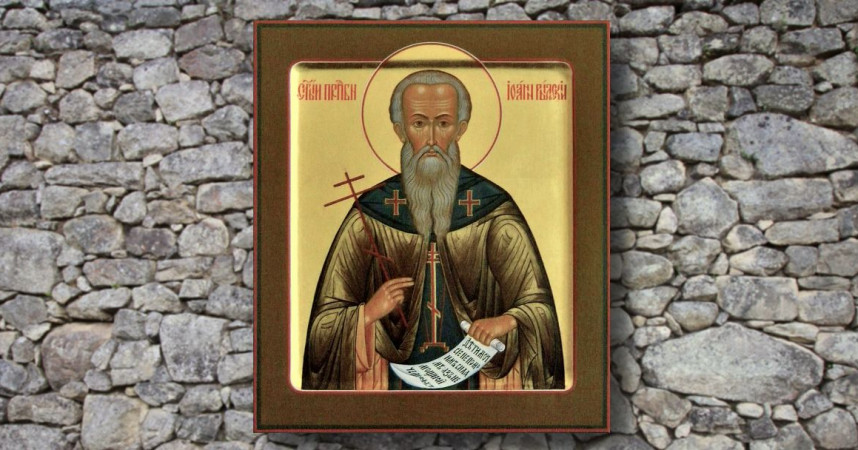
The Church remembers St. John of Rila
31.08.2026, 06:00





-

The Strength of Weakness
Alexey Shirikov
All Authors