Saint Blessed Basil, the Wonderworker of Moscow, was born in December 1468 on the porch of the Elokhovo church near Moscow, dedicated to the Vladimir Icon of the Most Holy Theotokos. His parents were of humble origin and sent their son to learn the trade of shoemaking. During the blessed man’s apprenticeship, his master witnessed an amazing incident and realized that his pupil was an extraordinary person. One merchant brought bread to Moscow by barge and went to a workshop to order boots, asking them to make them so well that he wouldn’t wear them out in a year. Blessed Basil shed tears and said: “We’ll make you boots that you won’t wear out.” In response to the master’s bewildered question, the apprentice explained that the customer wouldn’t wear the boots — he would soon die. A few days later, the prophecy came true.
At the age of 16, the saint came to Moscow and began his arduous feat of holy foolishness. In the scorching summer heat and the biting, fierce cold, he walked naked and barefoot through the streets of Moscow. His actions were strange: sometimes he would knock over a tray of kalaches, sometimes he would spill a jug of kvass. Angry merchants would beat the holy fool, but he gladly accepted the beatings and thanked God for them. And then it would turn out that the kalaches had been poorly baked and the kvass had been poorly prepared. The veneration of the blessed Basil grew rapidly: he was recognized as a holy fool, a man of God, and an exposé of injustice.
One merchant decided to build a stone church on Pokrovka in Moscow, but its vaults collapsed three times. The merchant turned to the blessed one for advice, and he directed him to Kyiv: “Find there the poor man John; he will give you advice on how to complete the church.” Upon arriving in Kyiv, the merchant found John, who was sitting in a poor hut and rocking an empty cradle. “Whom are you rocking?” the merchant asked. “My dear mother, I am repaying an inexhaustible debt for her birth and upbringing.” Only then did the merchant remember his mother, whom he had driven out of the house, and it became clear to him why he could not finish building the church. Returning to Moscow, he brought his mother back home, asked for her forgiveness, and finished building the church.
Preaching mercy, the blessed man helped above all those who were ashamed to ask for alms, yet needed help more than anyone else. There was an instance when he gave rich royal gifts to a foreign merchant who had been left without anything and, although he hadn’t eaten anything for three days, couldn’t turn to anyone for help because he was wearing fine clothes.. The blessed man sternly condemned those who gave alms with mercenary motives — not out of compassion for poverty and misfortune, but hoping to easily attract God’s blessing to their own endeavors. Once, the blessed man saw a demon that had taken the form of a beggar. He sat by the Prechistensky Gates and provided immediate assistance in matters to everyone who gave alms. The blessed one unraveled the cunning trick and drove the demon away. For the sake of saving his fellow men, the blessed Vasily also visited taverns, where he tried to see the seed of good even in the most fallen people, to support them with kindness, and to encourage them. Many noticed that when the blessed one passed by a house where people were wildly rejoicing and drinking, he would embrace the corners of that house with tears. The holy fool was asked what this meant, and he replied: “Sorrowful angels are standing by the house and lamenting over people’s sins, and I, with tears, begged them to pray to the Lord for the conversion of sinners.”. Having purified his soul through great ascetic deeds and prayer, the Blessed One was also granted the gift of foreseeing the future. In 1547, he predicted the great fire in Moscow; he extinguished a fire in Novgorod by prayer; once he rebuked Tsar Ivan the Terrible for being preoccupied with thoughts of building a palace on the Sparrow Hills during the service.
The blessed Basil died on August 2, 1557. Metropolitan Macarius of Moscow, together with a council of clergy, performed the burial of the saint. His body was buried near the Trinity Church, which stood on the moat, where the Intercession Cathedral was added in 1554 to commemorate the conquest of Kazan. Blessed Basil was glorified by the Council on August 2, 1588, which was headed by His Holiness Patriarch Job.
The description of the saint’s appearance preserved characteristic details: “naked, holding a staff in his hand.” The veneration of Blessed Basil has always been so strong that the Trinity Church and the attached Intercession Church are still known today as the Church of Basil the Blessed.
The saint’s chains are kept at the Moscow Theological Academy.
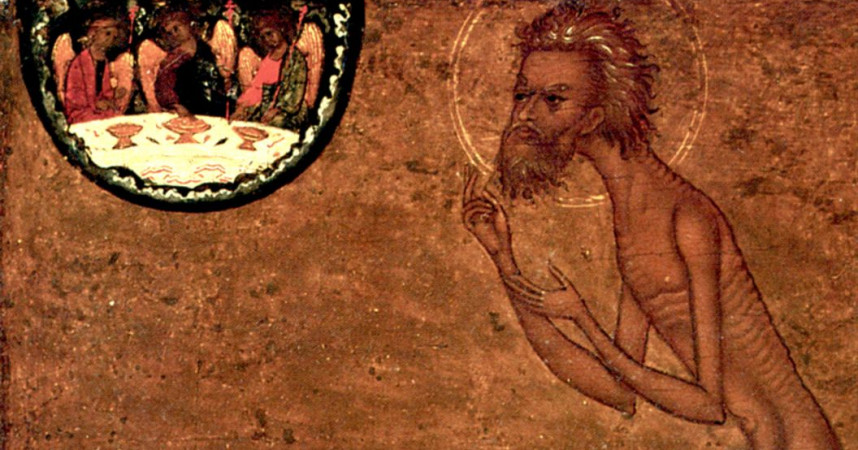
The Church commemorates the blessed Basil, the Wonderworker of Moscow.
15.08.2026, 06:00





-

The Strength of Weakness
Alexey Shirikov
All Authors