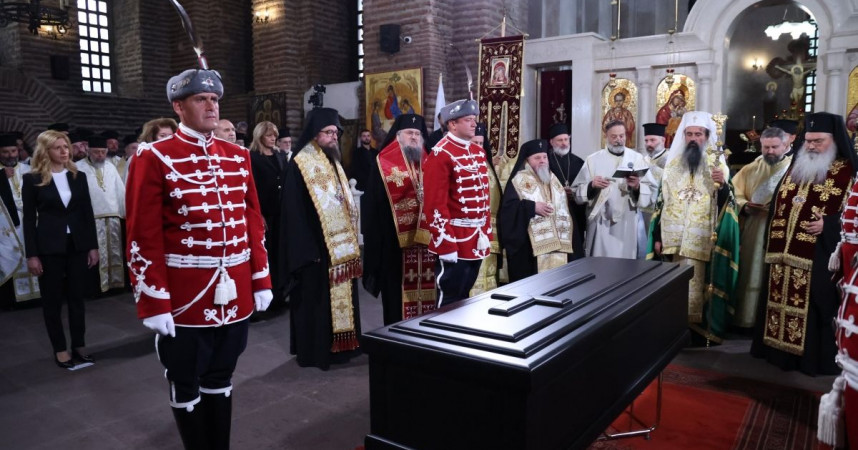
The remains of Tsar Samuel, the medieval Bulgarian ruler who led the country during its prolonged struggle with the Byzantine Empire, were formally returned to Bulgaria and reinterred in Sofia on October 3.
A state ceremony was held in the Bulgarian capital to mark the return of the ruler’s remains. Bulgarian Patriarch Daniel presided over a memorial service at the Basilica of St. Sophia, joined by metropolitans, bishops and clergy of the Bulgarian Orthodox Church.
The remains were handed over to the Bulgarian side earlier that morning at the Museum of Byzantine Culture in Thessaloniki, Greece, before being transported to Sofia aboard a military transport aircraft. Bulgarian fighter jets escorted the aircraft through the country’s airspace, while an artillery salute was fired as the remains arrived in central Sofia.
A funeral procession then carried the remains to the Basilica of St. Sophia, where Patriarch Daniel conducted a panikhida, an Orthodox memorial service. Following the ceremony, the remains were placed in a specially commissioned marble sarcophagus.
“With reverence and filial honor, we welcome the sarcophagus containing the remains of one of the most worthy and great rulers of the Bulgarian people,” Patriarch Daniel said. He described Samuel’s remains as a “sacred treasure of state, church and national memory,” emphasizing that, more than a millennium after his death, the ruler had returned to the country to which he devoted his life.
The patriarch also highlighted the significance of the Basilica of St. Sophia, which gave its name to the modern Bulgarian capital. According to church tradition, Samuel was baptized there and attended services at the church in his youth.
Daniel also cited the medieval Synodicon of Tsar Boril, written roughly two centuries after Samuel’s death, which lists him among the ancient Bulgarian rulers who, according to the text, inherited both an earthly and heavenly kingdom. The Church, the patriarch said, continues to commemorate them with the words “Eternal Memory.”
Asked about the possibility of canonizing Samuel as a saint, Patriarch Daniel said the matter would require careful study. He stressed that patriotism and achievements as a ruler are distinct from the criteria for sainthood, which concern spiritual qualities, purity of heart and love of God.
The patriarch thanked Greek archaeologist Nikolaos Moutsopoulos, who identified the remains, as well as Bulgarian and Greek officials and representatives involved in arranging their return.Samuel ruled during the final period of the First Bulgarian Empire, when Bulgaria was engaged in a decades-long conflict with the Byzantine Empire. After the eastern territories of the Bulgarian state weakened, Samuel consolidated his power in the west, with Prespa and Ohrid emerging as important centers of his rule.
The conflict with Byzantium continued for nearly three decades. Samuel died in 1014, and four years later Bulgaria was incorporated into the Byzantine Empire.
Because of his role during this turbulent period, Samuel has become an important figure in modern Bulgarian historical memory and is widely associated with the struggle to preserve the Bulgarian state.
The remains identified as those of Samuel were discovered in 1969 by Nikolaos Moutsopoulos at the Basilica of St. Achillius on the island of Agios Achillios in Lake Little Prespa. The identification subsequently became the basis for efforts to return the remains to Bulgaria.
The transfer in 2026 followed an agreement between Sofia and Athens. Under the arrangement, Bulgaria handed over 48 church relics to Greece in exchange for the return of Samuel’s remains.
The reinterment in Sofia marks the culmination of decades of archaeological, historical and diplomatic efforts surrounding the remains of one of Bulgaria’s most prominent medieval rulers.





-
“I Praise You, Brothers”: The Spiritual Art of Recognizing the Good
Alexey Shirikov
All Authors