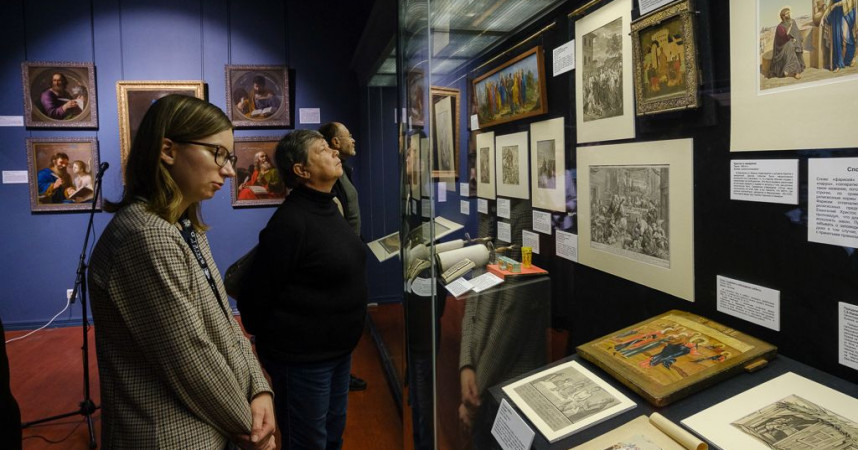
The exhibition "The Earthly Life of Jesus Christ" opened on September 10 at the Museum of the History of Religion.
The exhibition tells about the peculiarities of the veneration of Christ in various faiths. There are more than a hundred exhibits: icons, paintings, engravings and sculptures by Russian and Western European masters of the XVII - XXI centuries, works of decorative and applied art (liturgical utensils, church souvenirs, fabrics), photographs of the Holy Land, antique coins dated abroad. Some exhibits are being exhibited for the first time, some have been restored.
"The exhibition is illustrative, but that's the way the gospel text itself is - it's deep and multifaceted, and we're following it," said Ekaterina Teryukova, director of the museum. - We presented the life of Christ as it was depicted on their canvases by European artists, and on icons by Russian icon painters, as these subjects were reflected in decorative and applied art. We thought about the symbolic meanings and meanings that theologians had given to the subjects described in the Gospels, tried to approach the topic as religious scholars and focus on what Christ had said to His contemporaries, in which He contradicted the Pharisees, with whom He entered into disputes. This is a complex story that requires explanations that our guides will give at the exhibition."
The author of the exhibition, Svetlana Klimenko, added that the organizers had a task to show the life of Christ included in culture. Judea was under the rule of the Roman Empire, so the first section is dedicated to Rome. Jesus Christ lived among Jews and accepted Jewish traditions, which is also reflected in the exhibition. Special attention is paid to His disagreements with the Pharisees regarding the enforcement of the Law. It is given, it cannot be canceled, but if suddenly on Saturday it is necessary to save a human life, it is more valuable than prohibitions. The Pharisees could not accept this approach. The organizers of the exhibition made an attempt to trace how Christianity was born in the Jewish environment as a result of the preaching of the Savior.
The sections of the exhibition tell about the idea of the Incarnation of God, the period from Christmas to the first sermon, the teaching of Christ, the crucifixion and Resurrection. """"Christ in the Desert" by Viktor Vasnetsov, sculpture "Christ before the People" by Mark Antokolsky, watercolors by Solomon Yudovin, painted in Leningrad in the 1928-1930s, as well as works of Russian and Western European paintings and graphics based on rare iconographic subjects. """"The Seven Sorrows of Mary", "The Work of the Holy Family", and the porcelain light plate "Christ among the Teachers" are among them. Several watercolors by Vasily Spassky from the series "Scenes from the life of Christ and the Virgin" are on display.
Photo – Andrey Petrov, IA "Water Alive"




-
Woe to You, Actors
Alexey Shirikov
All Authors