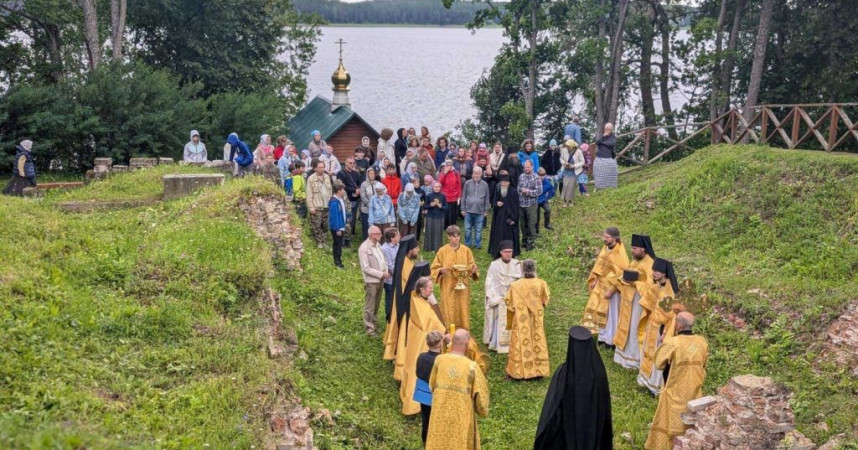
On the feast of the Nativity of the honorable and glorious Prophet, Forerunner and Baptist of the Lord John, Abbot Gabriel (Baglay), abbot of the Nilo-Stolobenskaya Monastery, celebrated the Divine Liturgy in the Epiphany Church of the monastery. He was served by the brethren in holy orders.
After the Liturgy, a procession was held to the ruined church dedicated to the Baptist John.
***
On the western elevated shore of Stolobny Island there was a stone two-storey quadrangular five-domed church in the name of the Holy Prophet John the Baptist and Baptist, built in 1777-1781 with the blessing of Archbishop Platon of Tver, a dependent of landowner Ivan Sergeyevich Chelishchev and consecrated in 1781 on December 27 by Archimandrite John of the monastery.
The church stood on the very spot where the cave of St. Nile was, dug out by him in the first days after his arrival on the island for shelter for the first winter, and where in 1766 Bishop Gabriel of Tver had the blessing to build a stone chapel.
On the lower floor of this church there was a temple in the name of the Intercession of the Most Holy Theotokos, built and consecrated in 1798. In the north-western corner of this lower temple, in the place where the aforementioned cave of St. Nile was located, a recess representing the cave itself was left. The cave site, previously known by legend, was discovered in 1777, while digging ditches for the foundation of this temple.
The saint's cave was a particularly revered place among pilgrims. It was in this recess that the first sculptural image of St. Nile was installed "in His perfect image and age"; and many, turning to the saint, received help and healing through him. The rector of this temple, I.S. Chelishchev, was also buried under this church, who did not live long before the consecration of the temple he built. The monastery's fraternal cemetery was located at this church.
Under Soviet rule, the temple was razed to the ground. Already in our days, through the efforts of volunteers from the Orthodox youth movement, the ruins of the temple and the foundation have been excavated and cleared.




-
Woe to You, Actors
Alexey Shirikov
All Authors