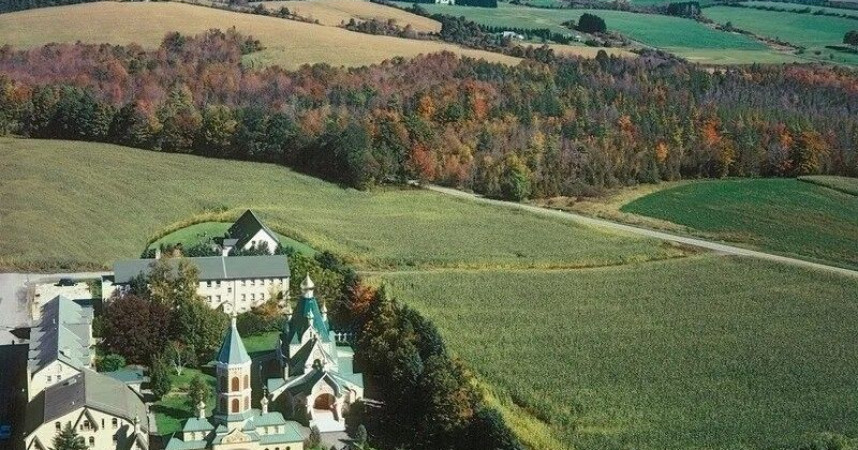
The Holy Trinity Monastery of the Russian Orthodox Church Outside Russia (ROCOR) has launched a campaign against a proposed large-scale wind energy project in central New York, arguing that the development could threaten the monastery’s spiritual mission and historic character.
According to the Eastern American Diocese of ROCOR, Rolling Hills Wind, a subsidiary of energy developer Terra-Gen, is seeking to build a wind farm with a generating capacity of up to 250 megawatts in the region. The project would include as many as 74 wind turbines spread across approximately 75,000 acres in Herkimer and Otsego counties.
Monastery officials say some of the turbines could be located near the historic monastic complex, which is listed on the U.S. National Register of Historic Places. The brotherhood argues that the project would fundamentally alter the atmosphere of silence and seclusion that has defined the monastery since its founding nearly a century ago.
“How can a monastic community dedicated to prayer in silence and stillness continue its life if it is constantly surrounded by the noise of operating turbines?” the monastery said in a public appeal urging supporters to oppose the project.
Bishop Luke of Syracuse, the monastery’s abbot, warned that the development could negatively affect not only the spiritual life of the monastery but also the theological seminary located on the grounds. He added that the project could diminish the experience of pilgrims who travel to Jordanville seeking prayer, reflection, and spiritual retreat.
The monastery has called on believers and supporters to sign a petition and contact local, state, and federal officials to request a review of the project plans.
In addition to concerns about religious life, monastery representatives raised environmental objections. They pointed to the potential impact on birds and bats whose migration routes pass through the Mohawk Valley, as well as possible effects on local ecosystems.
The appeal also highlights concerns about neighboring Amish communities, whose traditional way of life, like that of Orthodox monastics, depends on a degree of separation from urban and industrial development. Monastery officials argue that the project could alter the rural character of the region and affect communities that value a quiet and traditional environment.
The statement further cites potential quality-of-life issues for nearby residents, including noise and vibration from the turbines. Monastery leaders also questioned the project’s economic benefits for local communities, arguing that much of the financial return would ultimately flow to the company behind the development.
Holy Trinity Monastery in Jordanville is widely regarded as the spiritual center of the Russian Orthodox Church Outside Russia in North America. The site includes a monastery, seminary, major Orthodox publishing house, and one of the largest collections of Russian ecclesiastical archives outside Russia.
New York state authorities are expected to make the final decision on permits required for the project. As the review process continues, monastery leaders say they will remain active in advocating against the wind farm and in defense of what they describe as a unique spiritual and historical landmark.


-

Faith vs. Fitness? The Real Battle Isn’t Where You Think
Alyona Bogolyubova
All Authors