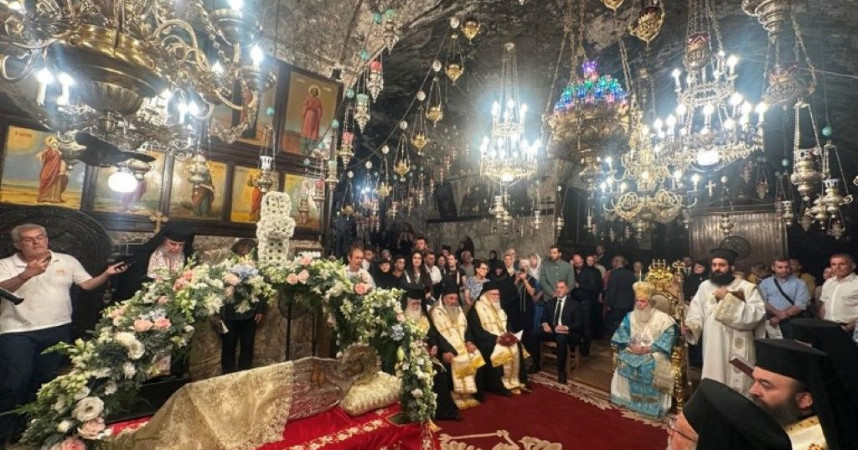
The Patriarchate of Jerusalem held celebrations marking the Dormition of the Most Holy Theotokos at her tomb in Gethsemane, one of Jerusalem’s principal Orthodox holy sites. The services were led by Patriarch Theophilos II of Jerusalem, according to the Jerusalem Patriarchate.
The observances began on August 27 with the Rite of the Burial of the Mother of God. A patriarchal procession walked from Jerusalem’s Old City to Gethsemane along the Via Dolorosa. At the church, the shroud of the Most Holy Theotokos was brought out, after which the clergy celebrated the Rite of Praise for the Dormition.
Hieromonk Philotheos (Artyushin), a representative of the Russian Ecclesiastical Mission in Jerusalem, took part in the service. The prayers and hymns were offered in Greek and Arabic, while Orthodox pilgrims from several countries joined the worshippers.
On August 28, a Divine Liturgy was celebrated in Gethsemane. Patriarch Theophilos presided, concelebrating with bishops and clergy of the Patriarchate of Jerusalem. Clergy from Russia, Romania, and Georgia also attended the feast.
In his homily, the patriarch emphasized the central importance of the Dormition of the Theotokos to the Orthodox faith. He said the Church does not view the Virgin Mary’s death as a cause for sorrow, but as a “holy falling asleep” and a passage to eternal life.
“Your death became a passage to eternal and better life,” Patriarch Theophilos said, recalling words addressed to the Theotokos by St. John of Damascus.
According to the patriarch, the tomb in Gethsemane itself bears witness to the Christian hope of resurrection. Orthodox tradition holds that the body of the Mother of God did not remain subject to corruption after her burial; her earthly death became her Dormition and transition to heavenly life.
“Let us honor the Mother of God and, together with John of Damascus, call out to her: ‘Rejoice, predestined Mother of God,’” Patriarch Theophilos urged.
The Dormition of the Most Holy Theotokos is one of the major feasts of the Orthodox liturgical calendar. It holds particular significance for the Church of Jerusalem because the celebrations take place at a site associated with the final days of the Mother of God’s earthly life. Each year, pilgrims gather there to venerate her tomb and participate in





-

Woe to You, Actors
Alexey Shirikov
All Authors