Greece’s Ministry of Culture has handed two restored Byzantine-era monuments to the Orthodox Church in Kastoria, following the completion of conservation works in the city and its surrounding areas.
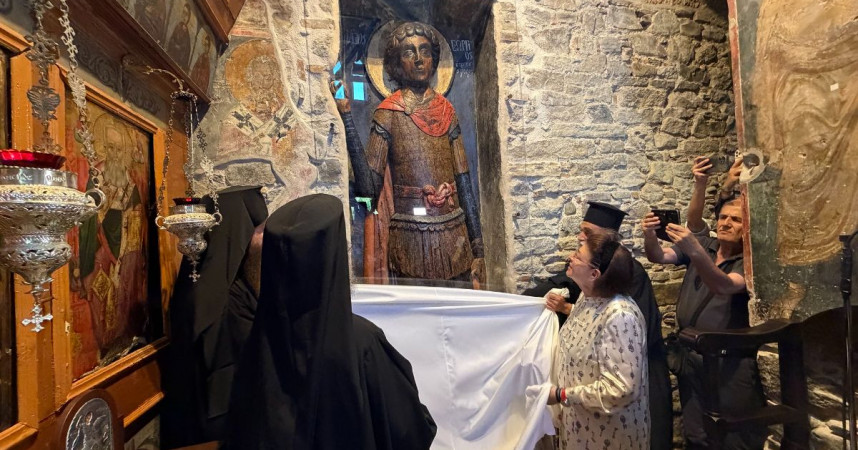
The transfer ceremonies were attended by Greece’s Minister of Culture Lina Mendoni, according to the website of the Kastoria Metropolis. Among the key events was the unveiling of a restored carved icon of Saint George the Victorious, dating back to the 13th century, in the Byzantine church of Saint George in the settlement of Omorokklisia. The restoration and preservation of the artwork were carried out by the Ephorate of Antiquities of Kastoria.
In Kastoria itself, celebrations followed for the reopening of the Church of the Archangel Michael (Taxiarches Mitropoleos), which was restored after conservation efforts. One tradition holds that the church was originally built as early as the 9th century and later renovated in the 14th century by Simeon Uroš Palaiologos, ruler of Epirus. The monument is associated with the Palaiologos dynasty and, through family ties, the Serbian Nemanjić lineage. Simeon is also known—according to historical accounts—for declaring himself “king of the Serbs and Greeks” and ruling for decades over an independent state centered in Epirus.
The church is further connected to a notable episode in the life of Simeon’s son, Ioannis Uroš Palaiologos, who was reportedly proclaimed regent at a young age before later becoming the monk Ioasaph, one of the founders of the famous Meteora monastery complex. By the end of the 14th century, the Serbian-Greek realm collapsed, and much of the territory was conquered by the Ottoman Turks.
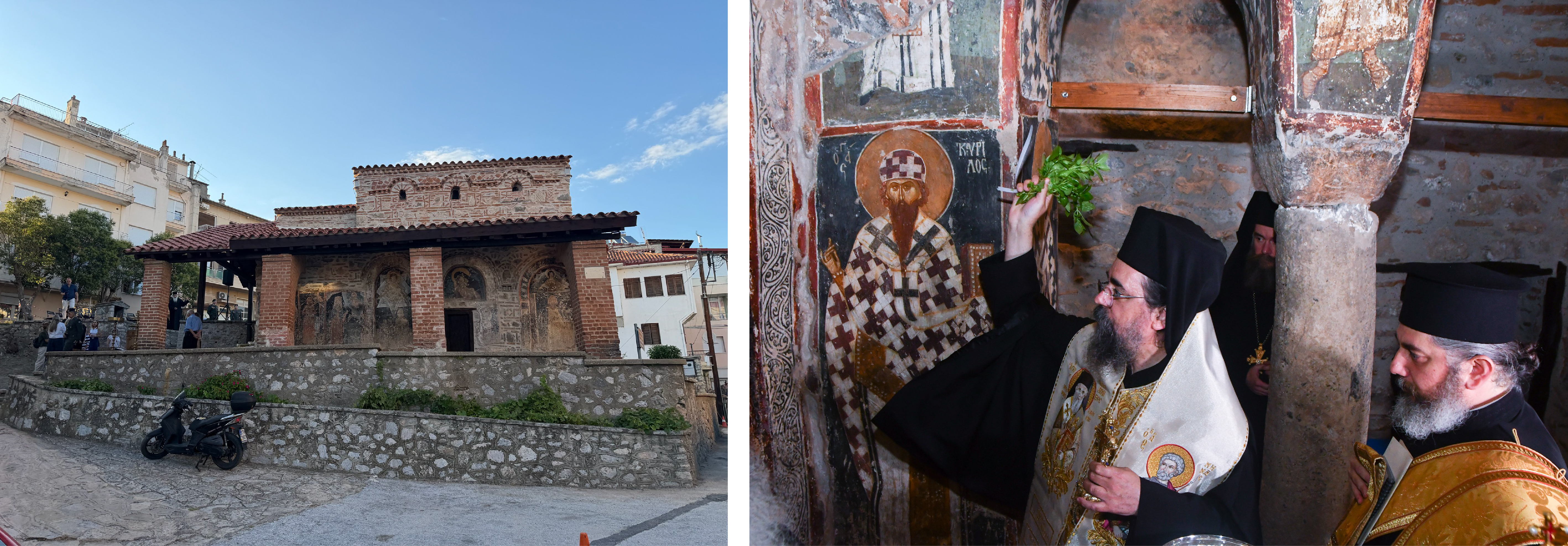
During the ceremonies, the Bishop of Kastoria, Kallinikos, thanked the Ministry of Culture for safeguarding the monuments and urged Minister Mendoni to “adopt Byzantine Kastoria,” calling for continued systematic support for the city’s historical heritage.
“Kastoria possesses immense cultural, historical and spiritual wealth that requires careful and responsible management,” the bishop said.
Mendoni stated that Byzantine monuments in Kastoria are already among the priorities of the ministry, emphasizing that preserving and promoting them forms part of the state’s responsibility.
She added that Kastoria—together with Mount Athos and Meteora—belongs to the three most important centers reflecting the continuation and grandeur of Greece’s Byzantine tradition.
As part of the broader events, an archieral service was held in the Church of the Archangel Michael, along with a memorial service at the grave of Pavlos Melas and his wife Natalia, both buried at the church and remembered as figures in the struggle for the liberation of Macedonia.
Local authorities and church representatives said restoring Byzantine churches is expected to support cultural tourism while protecting Kastoria’s historical legacy, a city often described as a “Byzantine aristocrat” of Greece.




-
The Strength of Weakness
Alexey Shirikov
All Authors