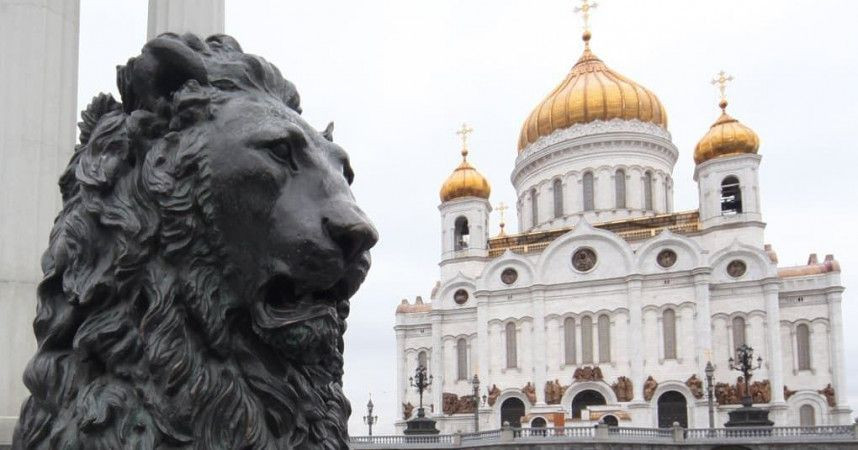
Passengers at the Moscow metro stations "Kropotkinskaya" or "Okhotnyy Ryad" will certainly be very surprised if they are told what kind of marble the lobbies of these stations are lined with. The fact is that this is the marble of the Cathedral of Christ the Savior, blown up in 1931. After the order given personally by Stalin to demolish it and build the Palace of Soviets on this site, it was decided to transfer the "building material" of the main cathedral of Russia for various economic needs.
The first floor of the “Moskva Hotel”, still memorable to many, was faced with red granite from the stairs of the cathedral. And marble benches were installed at the Novokuznetskaya metro station.
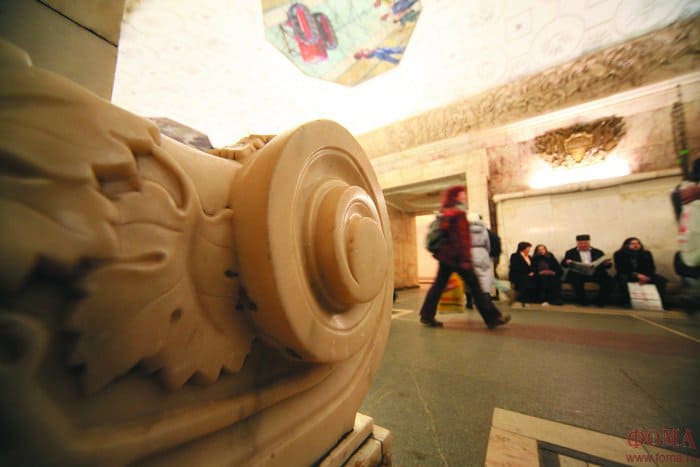
Bench from the Cathedral of Christ the Savior at Novokuznetskaya metro station
One of the church bells was moved to the tower of the Northern River Station in Khimki. And in one of the rooms of the main building of Moscow State University on the Vorobyovy Hills, there are still several columns that were once taken from the altar of the temple.
In the Donskoy Monastery, where the new authorities opened the Anti-Religious Museum, several high reliefs from the facades of the temple were transferred. There are still fragments of the statue of St. Georgiy the Victorious and the Old Testament prophetess Deborah, as well as the bas-relief “Sergiy Radonezhskiy blesses Dimitriy Donskoy for the Battle of Kulikovo”, which was damaged by the explosion.
At the Vernadskiy Geological Museum, authentic fragments of the iconostasis from the Cathedral of Christ the Savior were found: these are small columns made of black veined marble, other columns with capitals made of bluish-gray marble, etc.
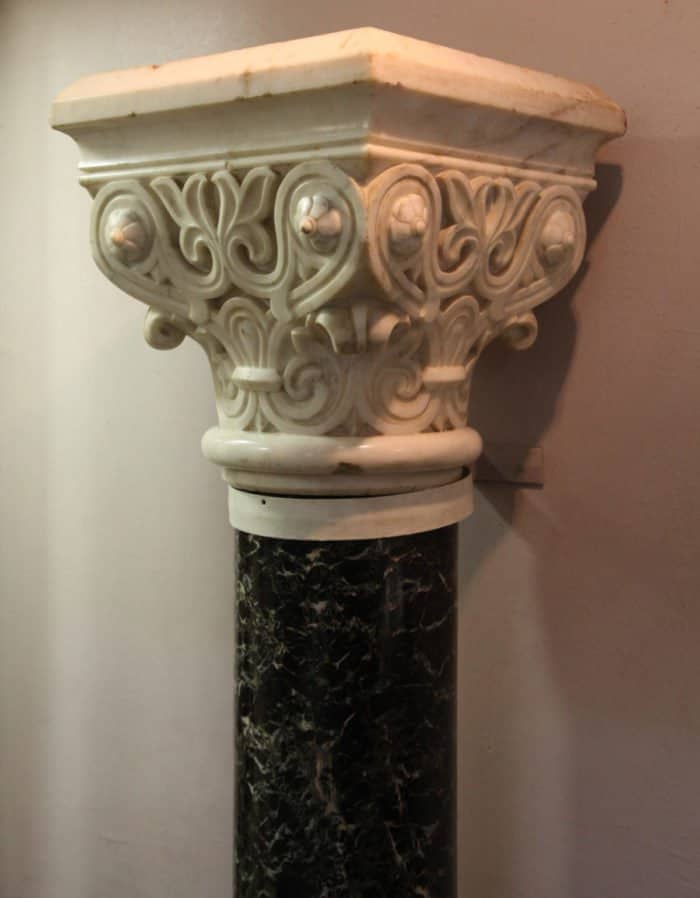
Photo by Vladimir Yeshtokin
There are facts that are completely amazing: when the Tretyakov Gallery was overhauled in the late 1990s, they began to change the worn-out marble steps that led to the wardrobe. What was the surprise of the workers, when they saw the engraved names of the heroes of 1812 on the reverse side of the dismantled steps. The steps to the cloakroom were made of marble from the memorial plaques of the temple. The memory of the heroes of the spirit, the warriors, who laid down their lives for their faith and Fatherland, has been trampled underfoot for decades by the unknowing visitors of the Tretyakov Gallery. These steps are now in the temple museum. In addition, part of the memorial plates with the names of heroes from the district gallery of the temple were crushed into small gravel and sprinkled with it on the paths in the Gorkiy Central Park of Culture and in other metropolitan parks. The meaning of this action was definitely not economic, but symbolic. So in the 1930s, on a still fresh revolutionary wave, they wanted to forever destroy the memory of old Russia and its great victories.
In memory of a miracle
On December 25, 1812, on the day of the Nativity of Christ (according to the old style), the last Napoleonic soldiers crossed the Neman River on ice, leaving the borders of Russia forever. On the same day, the Supreme Manifesto of Emperor Alexander the 1st was issued on the construction of the Cathedral of Christ the Savior in Moscow* "in commemoration of gratitude to the Providence of God, which saved Russia from the death that threatened her." It so happened that the most critical ordeals that have befallen Russia over the past two hundred years turned out to be connected in one way or another with the Cathedral of Christ the Savior. Our country has been on the verge of death more than once in the last two centuries, but has risen again, no matter what. And every time it looked like a real miracle.
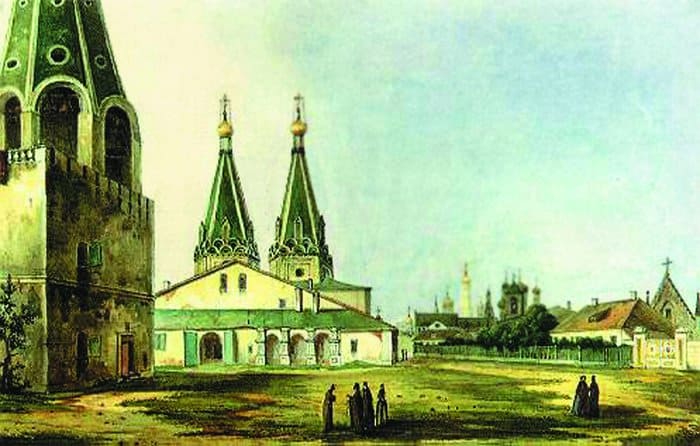
St. Alekseyevskiy Monastery, on the site of which the Cathedral of Christ the Savior was later built. Painting by Karl Rabus, 1838. According to a popular but unreliable folk legend, they were forced to move to a new place against the wishes of its inhabitants. The abbess of the monastery, not wanting to move, allegedly first tied herself with chains to an oak tree in the monastery courtyard, and then cursed this place. They also say that when Nikolay the 1st came to the monastery and began to personally convince the nuns of the need to move, then at the end of the unsuccessful persuasion, the same abbess suddenly prophesied to him: “Sir, you will get a puddle here.” However, there was apparently no curse at all. It is not supported by any historical documents or evidence. Such stories are rather myths, with which, post factum, they tried to explain the subsequent tragic fate of the temple.
It was a miracle that Russia was saved from an enemy invasion in 1812, when Russia was initially able to oppose the 600,000-strong Napoleonic army with less than 200,000 of its soldiers and officers. In memory of this miracle, they decided to erect the Cathedral of Christ the Savior. The real miracle was the salvation of Russia in the Great Patriotic War. By the way, it was precisely its beginning that prevented the completion of the communist Palace of Soviets on the site of the blown-up temple. It was also a miracle that the temple, seemingly lost forever as a result of the October Revolution, was restored in just a few years after the fall of communist power.
But the first time it was built for a very, very long time. Between the decree of Emperor Alexander the 1st on the temple construction and its consecration in 1883, seventy years passed.
Unsuccessful attempt
Few people know that at first the Cathedral of Christ the Savior was planned to be erected on Vorobyovy Hills, a kind of “crown of Moscow”, from where it would tower over the capital and be visible from everywhere.
Its construction was entrusted to the young architect Karl Magnus (after the adoption of Orthodoxy - Alexander Lavrentiyevich) Vitberg. He designed a three-tiered building with three thrones. The first temple, the lowest one, was supposed to become the tomb of Russian soldiers, where requiems would be constantly held. After reviewing Vitberg's project and addressing the architect, Alexander the 1st exclaimed: "You have made the stones speak!"
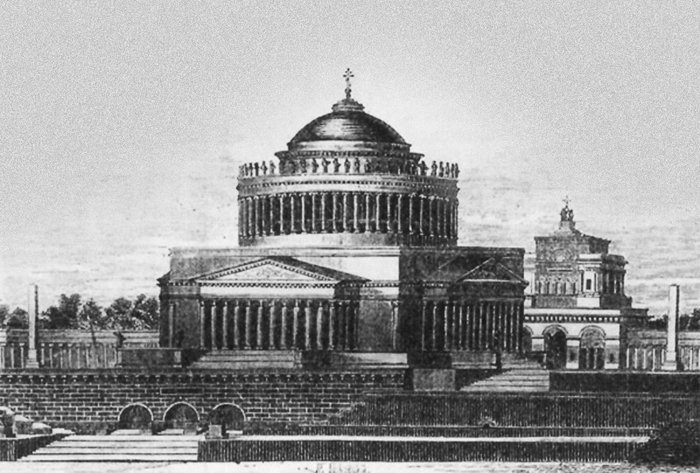
This is how the Cathedral of Christ the Savior was supposed to look according to the project of A.L. Vitberg
Exactly on the fifth anniversary of the expulsion of the French from Moscow, on October 12, 1817, the solemn laying of the Cathedral of Christ the Savior took place on Vorobyovy Hills between the Smolenskaya road (the enemy entered Moscow along it) and the Kaluga road (he left the capital along it).
However, Vitberg, a favorite of Alexander the 1st (it was not without reason that he was his godfather at baptism and gave him his name), after the death of the emperor, was undeservedly accused of embezzlement and, after lengthy proceedings, was exiled to Vyatka.
They also refused to build a temple on Vorobyovy Hills. Firstly, due to subsidence of soil on the banks of the Moscow River and the danger of a landslide. Secondly, fears were expressed that due to the remoteness from the center of the capital, the magnificent building would be empty most of the time. In addition, Vitberg's project was full of mystical symbolism, very close to the worldview of Alexander the 1st, but alien to the views of the new Russian tsar, who did not share the mystical passions of his brother.
The first life of the temple
Nevertheless, Nikolay the 1st did not forget the “vow” of Alexander the 1st. The design of the new church was entrusted to Konstantin Andreyevich Ton, the famous author of the Moskovskiy and Nikolayevskiy twin stations in both Russian capitals, the embankment in St. Petersburg with the famous sphinxes in front of the Academy of Arts, and the Armory in the Kremlin.
The emperor approves a hill next to the Big Stone Bridge for new construction. The place was chosen because of its proximity to the Kremlin, and also because from it the Cathedral of Christ the Savior would be visible from all parts of Moscow. The Alekseyevskiy convent located here is transferred to Krasnoye Selo (now it is the area of the Krasnoselskaya metro station).
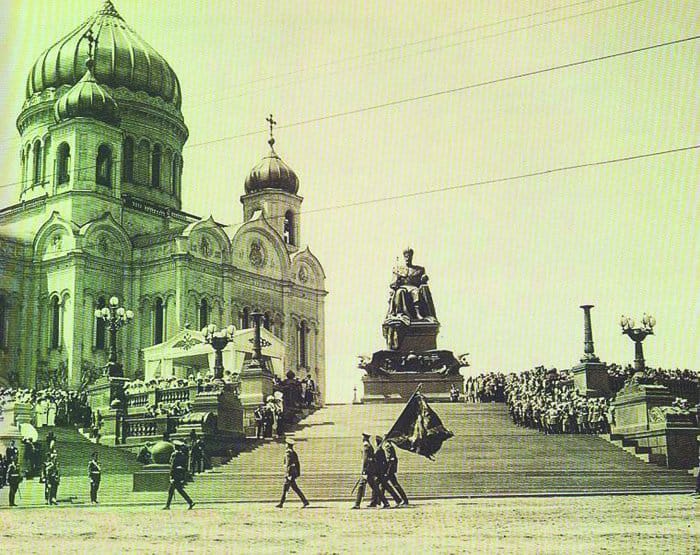
Grand opening of the monument to Alexander the 3rd in 1912 (destroyed in 1918). The military parade is hosted by Emperor Nikolay the 2nd
On September 10, 1839, the solemn laying of the new church took place. It was performed by St. Filaret of Moscow himself, whose relics now rest in the church.
It has been being built for almost 44 years. The whole of Russia collected money for it. In the churches, there were mugs with the inscription "To build a temple to the Savior Christ in Moscow."
Twenty years after the start of construction, the outer scaffolding was removed from the building, and for the first time the temple appeared before Muscovites in all its grandeur and splendor. It truly reigns over the capital - its golden domes are visible even dozens of miles from the center of Moscow.
By 1881, work was being completed on the interior painting of the temple, as well as on the construction of the embankment and the square in front of the temple. It was painted by the best artists of Russia - V. Surikov, F. Bruni, I. Kramskoy, V. Vereshchagin, and others. The authors of facade sculptures based on scenes from the Old Testament and Russian history were baron P. Klodt, A. Loganovskiy, N. Ramazanov. The theme of the paintings of the most important parts of the building - the main dome and its belt, small vaults, and the iconostasis - was personally approved by St. Filaret, Metropolitan of Moscow.
And on the day of the Ascension of the Lord, May 26 (June 8), 1883, the consecration of the Cathedral of Christ the Savior takes place, specially timed to coincide with the coronation of Alexander the 3rd. In the northern corner of the temple there are a few veterans of the Patriotic War with the Orders of St. Georgiy on their chests. There sounds P.I. Tchaikovskiy’s overture “1812” for the first time, specially written for this festival.
The temple received the status of a cathedral, and its clergy were equated with the clergy of the capital's St. Isaac's Cathedral. Since then, many important historical events have taken place under its arches. It celebrated, for example, the 100th anniversary of the Patriotic War and the celebration of the 300th anniversary of the Romanov dynasty.
After the February Revolution, in August 1917, the All-Russian Local Council opened in the temple, which elected Metropolitan Tikhon of Moscow as Patriarch of Moscow and All Russia two months later. Then the Russian Church, after a 200-year break, regained its Patriarch.
But already three months later, in November 1917, at the insistence of Patriarch Tikhon, prayers were performed here for the appeasement of Russia. At the end of the funeral of the victims of revolutionary battles in the Cathedral of Christ the Savior, a Cathedral prayer was served for all those who died in bloody clashes.
"Farewell, keeper of Russian glory!"
After the October Revolution, the fate of the temple was sealed. Back in December 1922, at the First Congress of Soviet Deputies, which proclaimed the creation of the USSR, S.M. Kirov proposed to erect a "new palace of workers and working peasants" instead of the "palace of bankers, landlords, and tsars." It should appear, Kirov said, in Moscow "on the most beautiful and best square" and become "an emblem of the coming power, the triumph of communism not only here, but also there, in the West."
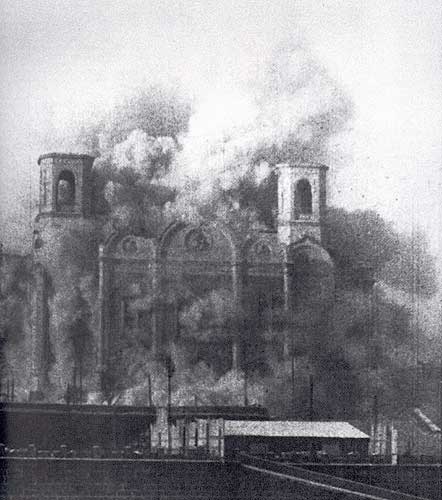
Explosion of the Cathedral of Christ the Savior, 1931. They planned to destroy not only the Cathedral of Christ the Savior. According to the general plan of Moscow in 1935, they were going to demolish almost all the buildings in the district and create around a huge square that would connect the Palace of Soviets with the Kremlin. Neither the church of Iliya the Obydennyy near Ostozhenka, nor the “fairy tale house” in Soimonovskiy passage, nor other remarkable buildings should have remained. However, they all remained intact and survived to this day. Together with the temple, only two churches were destroyed - the Pokhvaly Bogoroditsy (Praise of the Virgin) (next to it) and the Svyatodukhovskaya (Holy Spirit) (in Gogolevskiy Boulevard). Photo xxc.ru
In March 1924, the “Pravda” newspaper received a letter from a certain student Balikhin from the Association of New Architects with a proposal to demolish the Cathedral of Christ the Savior in order to put a monumental building in its place, which would also be a monument to Lenin. From this moment has begun countdown time before destruction of the temple.
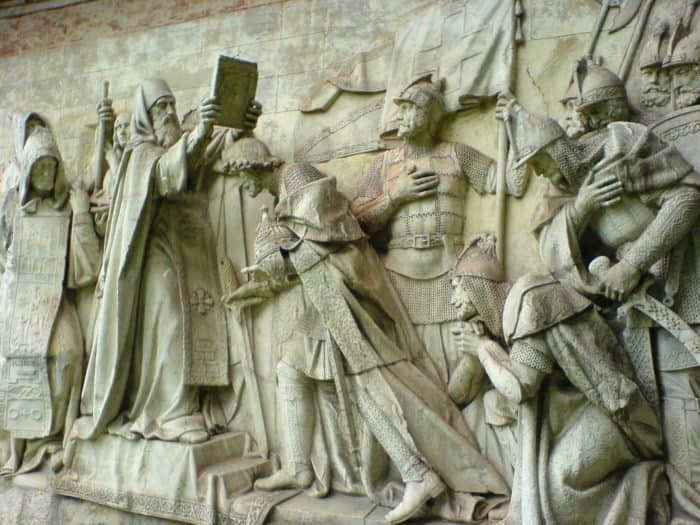
Saint Sergiy blesses Prince Dimitriy Donskoy for the Battle of Kulikovo. High relief of the destroyed Cathedral of Christ the Savior Sculptor A. Loganovskiy. Photo xxc.ru
The press, led by the League of Militant Atheists, is unleashing a wild campaign to discredit the architectural merits of Russia's main cathedral. It is pejoratively compared with a samovar and Easter cake; they claim that it allegedly “does not represent artistic value”, that the temple is a “thick poisonous mushroom”, “eating juices” of Zamoskvorechye, created to “glorify mass human extermination (meaning the war of 1812. — Ed.), in which the workers and peasants did not show any unparalleled zeal.”
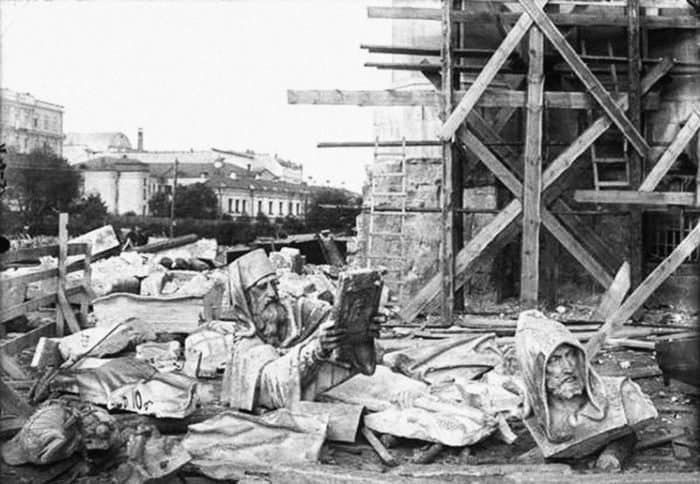
In August 1931, work began on dismantling the temple and clearing the surrounding area. And at noon on December 5 of the same year, the first powerful explosion was heard, then the second. But the Cathedral of Christ the Savior continued to stand almost unscathed. Only the third explosion finished it off.
Less than 50 years passed from the consecration of the temple to its destruction.
Unfulfilled utopia
Two years after the explosion, the project of the Palace of Soviets by architect B.M. Iofan was adopted (co-authors V.A. Shchuko and V.G. Gelfreikh). Its scale can amaze the imagination of any person. A gigantic building 420 meters high would be crowned by a huge statue of Lenin (twice as high as the American Statue of Liberty). For comparison, the height of the Cathedral of Christ the Savior was 104 meters (that is, the temple was four times lower than the planned "miracle palace"!). Thus, on the site of the temple to the God-man, a communist universal “temple” was supposed to appear symbolically opposed to it, which instead of a cross would be crowned with the figure of a man-god.
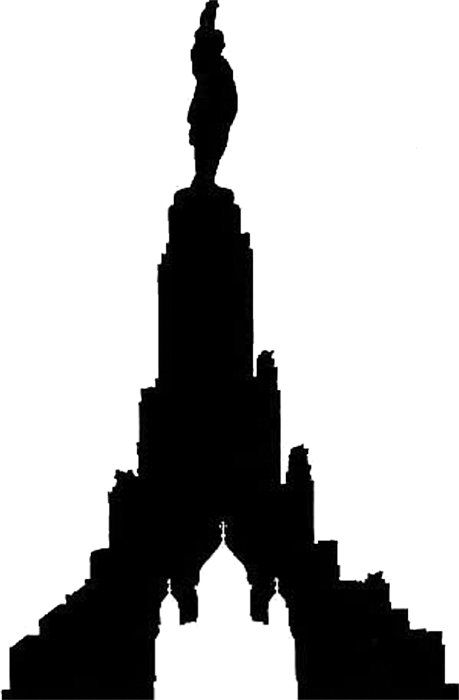
According to the project, the Palace of Soviets was supposed to be 4 times higher than the Cathedral of Christ the Savior. They planned to destroy not only the Cathedral of Christ the Savior. According to the general plan of Moscow in 1935, they were going to demolish almost all the buildings in the district and create around a huge square that would connect the Palace of Soviets with the Kremlin. Neither the church of Iliya the Obydenny near Ostozhenka, nor the “fairy tale house” in Soimonovsky passage, nor other remarkable buildings should have remained. However, they all remained intact and survived to this day. Together with the temple, only two churches were destroyed - the Pokhvaly Bogoroditsy (Praise of the Virgin) (next to it) and the Svyatodukhovskaya (Holy Spirit) (in Gogolevskiy Boulevard).
The Palace of Soviets was to become the tallest building in the world. It was supposed to be the center of the new Moscow - the capital of world communism, a utopian paradise on Earth. Its two halls - the Big and the Small - were supposed to accommodate 15,000 and 6,000 people, respectively. It was planned to place a library in the giant head of Lenin, the size of a 5-story building, and the index finger of the statue of the leader of the world proletariat was 4 meters long. The Palace of Soviets began to be built in the first half of the 1930s, but they only managed to lay the foundation. During the Great Patriotic War, there were other things to worry about than the construction of the giant Palace of Soviets. In the autumn of 1941, when the Germans were rushing to the capital, metal structures from the construction were used to manufacture anti-tank hedgehogs for the defense of Moscow.
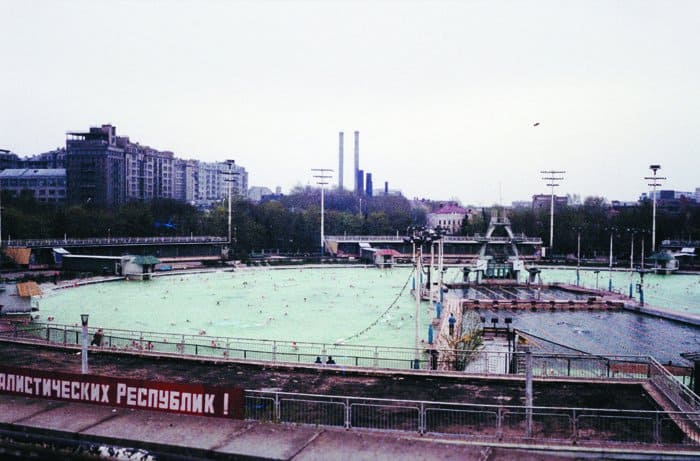
The outdoor swimming pool "Moscow", built on the site of the Cathedral of Christ the Savior
After the war, the project is frozen due to lack of funds in a country recovering from a war of extermination. The idea of the Palace of Soviets, together with the belief in a more or less near victory of communism throughout the world, was gradually fading away. As a result, the authorities decided to limit themselves to the construction of the Palace of Congresses in the Kremlin, and in 1958, on the site of the unbuilt palace, they built the outdoor swimming pool "Moscow" according to the project of architect D.N. Chechulin. By the way, if something more serious, let’s say, residential buildings, were built on the site of the destroyed temple, then it would be very difficult to restore the temple in the post-Soviet period.
New life for the temple
In the late 1980s, there started a public movement for the restoration of the temple. The writers Vladimir Soloukhin, Vladimir Krupin, and Valentin Rasputin, composer Georgiy Sviridov did a lot for its revival.
In February 1990, the Holy Synod of the Russian Church blessed the revival of the temple and turned to the Government of Russia with a request to allow it to be rebuilt in its original place. And four years later, the builders dismantled the pool and began installing the foundation of the temple.
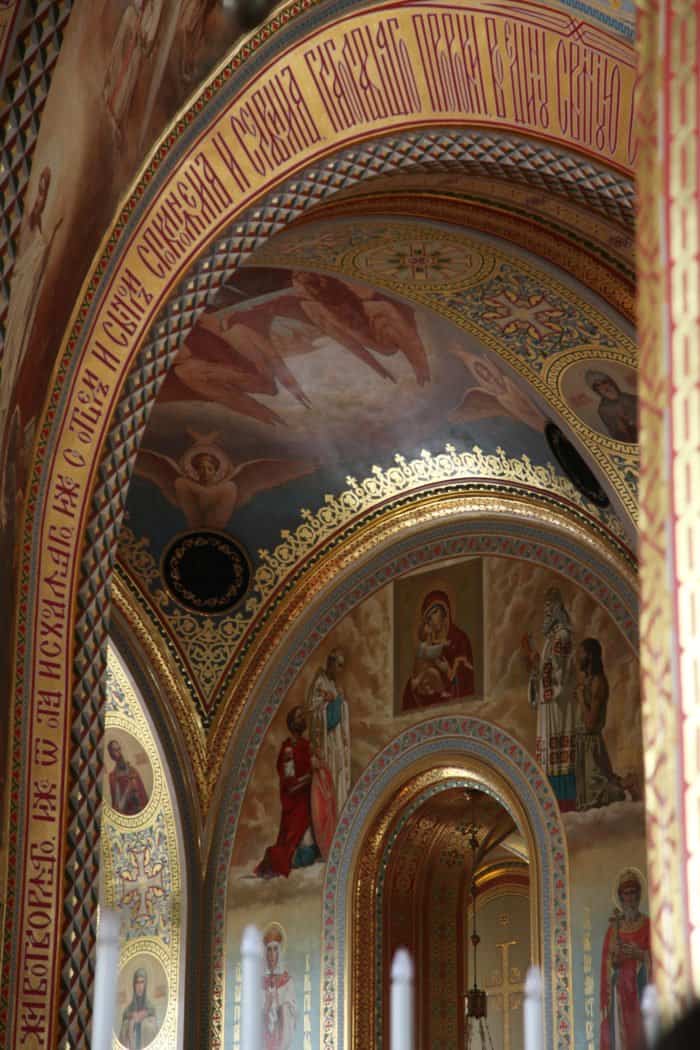
Photo by Vladimir Yeshtokin
Since the Church alone, despite numerous donations from parishioners, was unable to build the temple, the Moscow Government took an active part in its construction. An agreement was reached that it would be transferred not to the ownership of the Church, but to the municipal property, in which it is still located.
Already in April 1996, crosses were hoisted on the heads of the temple, and bells cast at the “ZIL” automobile factory rang on the domes. On August 19, 2000, His Holiness Patriarch Alexiy the 2nd performed the great consecration of the temple. That is, less than six years passed from the beginning of construction to the consecration of the temple.
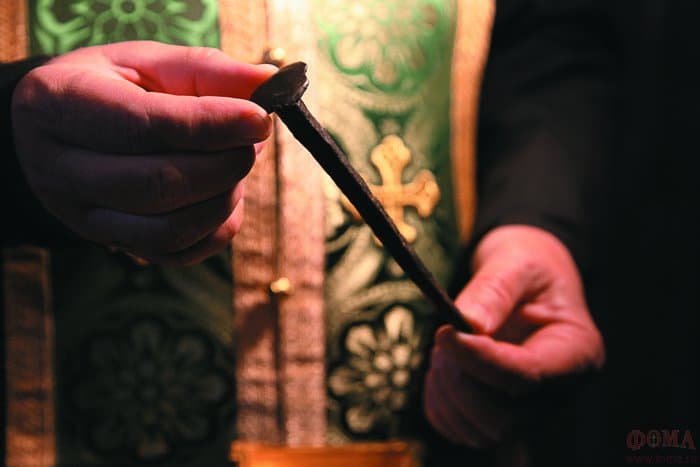
Photo by Vladimir Yeshtokin
Unique shrines are kept in the Cathedral of Christ the Savior: a particle of the robe (tunic) of the Lord Jesus Christ, a particle of the robe of the Most Holy Theotokos, and a nail from the Cross, on which the Savior was crucified. In the temple, there are also particles of the relics of John the Baptist, the Apostle Andrew the First-Called, the Monk Mary of Egypt, John Chrysostom, Gregory the Theologian, Basil the Great, Equal-to-the-Apostles Prince Vladimir, Prince Alexander Nevskiy, Metropolitan Filaret (Drozdov) of Moscow, as well as the relics of other saints and ascetics of the Church.
The Cathedral of Christ the Savior is the main cathedral of Russia. It accommodates several thousand people. The height of the temple is the same as in the last century - 104 m, and the thickness of the walls is 3.2 m. Its rector is the Patriarch of Moscow and All Russia (the representative of the Patriarch in the temple is the dean of the temple, Archpriest Mikhail Ryazantsev). Patriarchal services are held here at Christmas, Easter, and other Great Holidays of the Russian Orthodox Church. Here, at the Council of Bishops in August 2000, Nikolay the 2nd and his family were canonized as Holy New Martyrs of Russia. Here, the relics of the Apostle Andrew the First-Called were exhibited for veneration (June 2003) and the Tikhvin Icon of the Mother of God returned from America (June 2004). Here, in November 2011, the Holy Belt of the Most Holy Theotokos was put up for worship to numerous pilgrims. Moreover, the election of a new Patriarch of Moscow and All Russia and his enthronement took place in the Cathedral of Christ the Savior at the Local Council in 2009.
In preparing the article, materials from the book "Temple of Christ the Savior" were used, St. Petersburg, Publishing House "P-2", 2011, 157 p.
Source: Foma.ru




-

The Right Moment
Alyona Bogolyubova
All Authors