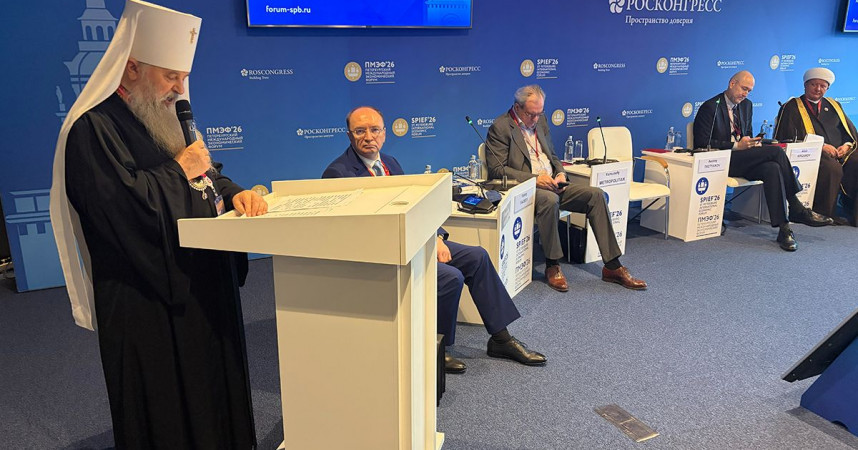
On June 4, 2026, Metropolitan Varsonofy of St. Petersburg and Ladoga spoke at the session "Religion and Economics: Common Goals, potential for interaction" within the framework of the XXIX St. Petersburg International Economic Forum, held on June 3-6 at the Expoforum Convention and Exhibition Center.
In his report, the bishop emphasized that economics is just a tool, not the purpose and meaning of life. The material dimension itself leaves the soul in a state of semantic and spiritual hunger, does not bring happiness. Material goods are not good or evil, the question is how to dispose of them: think only about personal enrichment or the welfare of others.
"The very word "economy" is translated from Greek as "house building," said His Eminence. — In patristic theology, this term has a high meaning: the whole Divine plan for the world is called oikonomy, the economy of salvation. God acts as a Master, giving man resources not for chaotic consumption, but for the transformation of the created world. Therefore, in the original sense, economics is not only the extraction of profit or the satisfaction of material needs, but the responsible management of wealth entrusted by God. Therefore, a great responsibility lies with those who allocate resources to do this fairly, taking into account the real interests and needs of people."
"Economics and religion have common goals here — the desire for a person to live with dignity, well, and fully," the bishop continued. — Poverty, social problems, and the stratification of society into rich and poor relate more to the sphere of economics. But it's not just financially that a person can be oppressed and poor. The Church is struggling with spiritual impoverishment. After all, one can possess untold riches while remaining spiritually poor, and then all earthly goods lose their meaning, and the pursuit of new sensations leaves the heart empty. Christ said: "Do not lay up for yourselves treasures on earth, where moth and rust destroy, and where thieves break in and steal, but lay up for yourselves treasures in heaven" (Matthew 6:19-20). In the words of King and prophet David, "Unless the Lord builds houses, those who build them labor in vain" (Ps. 126:1). No matter how perfect an economic model is created, if it is not based on the stone of faith and the moral law, the builders work in vain. The goal of any morally oriented economy is not abstract gross product growth, but overcoming poverty and social problems as a humiliation of human dignity."
"Similarly, the goal of the Christian mission is to bring a person out of a state of spiritual alienation and spiritual death. We agree in our goal—setting — we strive to create a system where a person can not survive, but live a full-blooded life, both financially and spiritually. Either a person works only for his own well-being, which is an expression of extreme selfishness, or for the well—being of something more — the state, society, family - of those who need us. The greatest benefit for the Church is saving as many people as possible, bringing them to God, and teaching them the Orthodox faith. But this is possible only in active love, about which the Holy Scriptures speak so much. The Apostle John the Theologian asks: "But whoever has wealth in the world, but sees his brother in need and shuts his heart away from him, how does the love of God abide in him? My children! let us love not in word or tongue, but in deed and in truth" (1 John 3:17). Caring for the suffering is a necessary condition of Christian life. St. John Chrysostom instructs: "The benefactor should not investigate the life of the poor, but help the poor and satisfy the need. One excuse for the poor is lack and need; ask him nothing more; but if he needs the necessary food, then we will satisfy his hunger." Is it possible to have a truly Christian society consisting only of the poor and the suffering? No, because a person consisting of spirit, soul, and body must take care of everything that makes up his nature," said Metropolitan Varsonofy.
His Eminence noted that material prosperity in the Orthodox understanding is not an end in itself, but it can be an expression of active love for one's neighbor when the economy "works" for the benefit of the family, the city and the country. Nowadays, there are associations of Orthodox entrepreneurs who interact with the Church, engage in charity and spiritual education.
The potential of such collaboration can be revealed at three levels: at the personal level (the formation of a Christian figure in economic and entrepreneurial activities), at the corporate or community level (the development of parish social entrepreneurship, when profits from activities are directed to charity and social service), at the state level (the promotion of morally responsible business standards).
The bishop emphasized that just as an economy without a religious component and spiritual content reduces a person to the level of a consumer, religion, as a social institution without an economic horizon, risks remaining inactive.
The discussion focused on how to identify the potential of religious values in stimulating economic activity, what role values and religious traditions play in the development of modern economic systems, to what extent religion and economics as two spheres of human activity are currently open to each other and what is the potential for their successful interaction.
Photo: Deacon Ilya Andrianov


-

Faith vs. Fitness? The Real Battle Isn’t Where You Think
Alyona Bogolyubova
All Authors