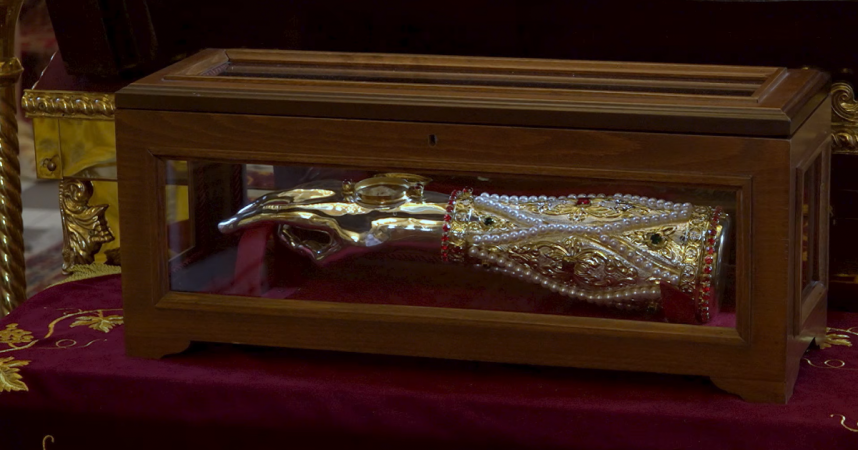
A fragment of the relics of Saint Gorazd, a disciple of Saints Cyril and Methodius and believed to have been their successor on the Moravian see, has returned to Moravia for the first time in more than 1,200 years. On August 8, Bishop Isaia of Olomouc-Brno brought the shrine from Albania to the Cathedral Church of Saint Gorazd in Olomouc, the Olomouc Diocese reports.
Along with the Gorazd relic fragment, the cathedral received the relics of Saint Angelar, another of Cyril and Methodius’ disciples.
For Orthodox Christians in the Czech Republic, the return carries special significance. Gorazd is regarded as one of the early continuers of the Cyril and Methodius mission on Great Moravia, and his name is closely linked to the history of Slavic Christianity in Central Europe.
Saint Gorazd lived in the ninth century and was among the closest students of Cyril and Methodius. According to tradition, in the year of his death in 885, Methodius named Gorazd a worthy successor, describing him as “a free man, from your land.” Tradition further holds that Gorazd came from Moravia and knew Slavonic, Greek, and Latin.
After Methodius’ death, however, the situation for his disciples changed dramatically. Supporters of the Latin church tradition pushed to replace Slavic worship, and Methodius’ followers were expelled from Great Moravia. Some of them—Clement, Naum, Gorazd, and Angelar—went to the Balkans. Clement and Naum preached in Ohrid, in today’s North Macedonia, while Gorazd and Angelar ended their earthly lives in Albania, where their relics are believed to remain to this day.
The transfer was preceded by Bishop Isaia’s visit to Albania. As noted by the Olomouc-Brno diocese, the relics were kept in a church that currently has museum status. During decades of state atheism, access for Church representatives had been difficult.
Eventually, Albanian authorities approved the transfer of a small fragment of the relics to the Czech Republic. Today it is housed in the Cathedral Church of Saint Gorazd in Olomouc.
“We see this as a truly extraordinary event. We feel not only the spiritual support of Saint Gorazd, but now also his bodily presence,” Bishop Isaia said.
In modern-day Czechia, Gorazd is seen as a symbol of an ancient Slavic Christian tradition connected with Great Moravia and the mission of Cyril and Methodius. His return to Moravia is viewed as restoring ties to a period when worship and Christian education were conducted in the understandable Slavic language. Researchers note that after Methodius’ death, Frankish clergy strengthened their position again in Moravia, while his disciples continued their work in other Slavic lands.
In Albania, Gorazd is part of a wider Balkan tradition of honoring Cyril and Methodius’ disciples. Together with Clement of Ohrid, Naum, Angelar, and others, he is counted among the educators associated with spreading Slavic literacy and Christian culture across the Balkans. The Albanian Orthodox Church also emphasizes the historical importance of the Cyril and Methodius mission for the Slavic world.


-

Invisible Wings
Yana Kapaeva
All Authors