St. Seraphim of Sarov, one of the most revered Russian saints, was born on July 19, 1754 in Kursk into the pious merchant family of Isidore and Agafia Moshnin and was baptized Prokhor. Since childhood, his life has been marked by special signs of God's Providence. One day, a boy fell from a high bell tower, but remained unharmed. Another time, when he was seriously ill, he saw the Mother of God in a dream, promising to heal him. Soon, Prokhor venerated the miraculous icon of the Sign of the Most Holy Theotokos and began to recover quickly.
From an early age, he loved church services, the Holy Scriptures, the lives of saints, and solitary prayer. Deciding to dedicate his life to God, Prokhor received his mother's blessing and went to Kiev, where Elder Dositheus showed him the way to the Sarov desert. In 1778, the young man entered the Sarov monastery. Here he diligently performed various obediences, worked in the bakery, millet and carpentry, served as a sexton and devoted all his free time to prayer.
After eight years of novitiate, Prokhor took monastic vows with the name Seraphim, and was subsequently ordained a hierodeacon and hieromonk. During the divine services, he repeatedly received blessed visions. One day, during the Divine Liturgy, the monk saw the Lord Jesus Christ surrounded by Heavenly Powers and blessing the worshippers.
In 1794, St. Seraphim retired to a forest cell, where he devoted himself to severe labors, prayer, fasting, and reading the Holy Scriptures. He cultivated a small vegetable garden, kept a bee garden and ate the simplest food. For about three years, his only food was snyt grass. Wild animals were not afraid of the saint: there was a legend about a bear, which he fed with bread from his hands.
The feat of praying on the stone for thousands of days became especially difficult. Day and night, the monk prayed with his hands raised, repeating: "God, be merciful to me, a sinner." One day he was attacked by bandits. Although the elder could defend himself, he put the axe on the ground and offered no resistance. The robbers severely beat him, but found nothing in the cell except an icon and a few potatoes. The monk survived, but remained permanently bent. He forgave his abusers and asked them not to punish them.
After fifteen years of hermitage, the monk returned to the monastery and accepted the feats of silence and seclusion. In 1825, the Mother of God ordered him to come out of seclusion and serve people. From that time on, the elder began to receive all those in need of guidance, comfort, and healing. He greeted everyone who came with the words: "My joy!" The Monk taught that the purpose of Christian life is to acquire the grace of the Holy Spirit. He said to one of his disciples: "Acquire the spirit of peace, and then thousands of souls will be saved around you."
St. Seraphim took special care of the Diveevo convent, of which he became the spiritual father. The sisters turned to him with all their sorrows and difficulties. The saint's conversation with Nikolai Motovilov about the purpose of Christian life has become one of the most famous spiritual instructions of the Russian Church.
The monk knew in advance about his death. On January 1, 1833, he took communion of the Holy Mysteries of Christ for the last time and said goodbye to the brethren with the words: "Be saved, do not be discouraged, watch." The next morning, the saint was found in his cell kneeling before the icon of the Mother of God. He peacefully went to the Lord during prayer.
The life of St. Seraphim of Sarov became an example of boundless love for God and people, humility, mercy and forgiveness. Even today, his instructions remind Christians of the need to preserve inner peace, not to be discouraged, and to see the image of God in every person.
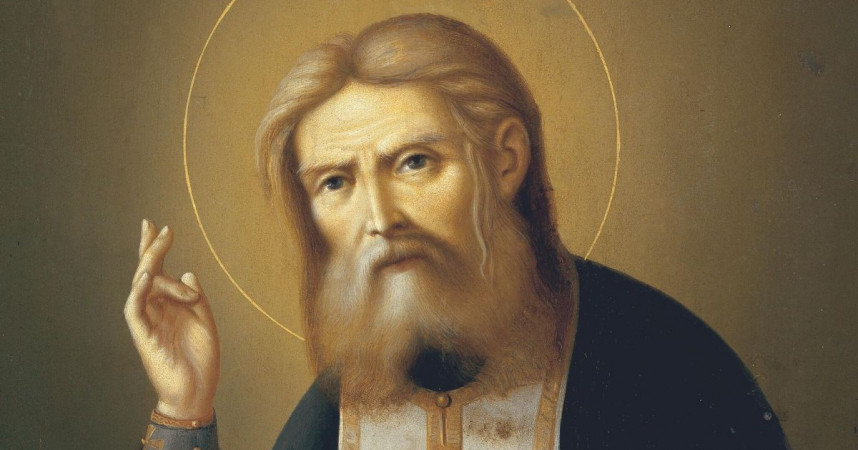
The Church remembers the finding of the relics of St. Seraphim of Sarov
01.08.2026, 06:00


-

Invisible Wings
Yana Kapaeva
All Authors