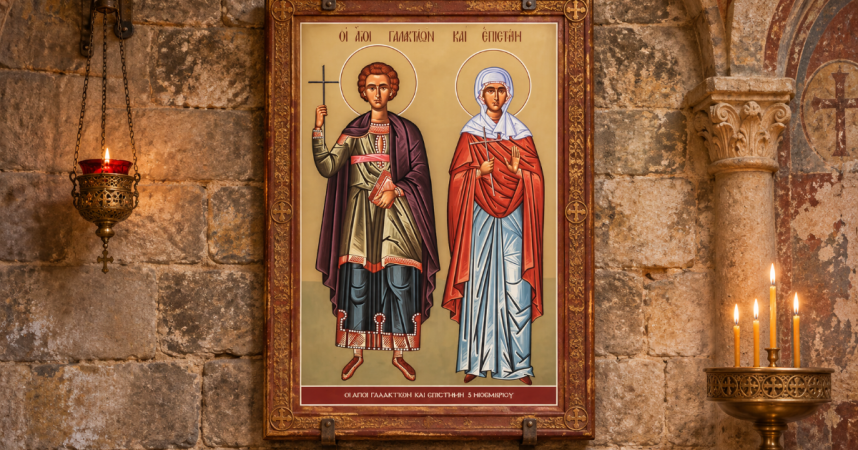
The rich and noble couple Clitophon and Leucippia lived in the city of Ephesus in Phoenicia, and were childless for a long time. The spouses gave a lot of gold to pagan priests, but remained barren. In the 3rd century, the city of Emes was ruled by the Syrian Secundus, appointed by the Roman Caesars. He was a ruthless and zealous persecutor of Christians, and to intimidate them, he ordered sophisticated instruments of torture to be put up on the streets. The slightest suspicion of belonging to the "sect of the Galileans" (as the pagans called Christians) was enough for a person to be captured and tortured. Despite this, many Christians voluntarily surrendered themselves to the executioners, wanting to suffer for Christ.
An old man named Onufriy, who hid his monastic and presbyterian dignity under the rags of a beggar, went from house to house begging for alms. Wherever he saw an opportunity to turn people away from pagan error, he preached about Christ. One day he came to the rich house of Leucippia. Accepting alms from her, the monk felt that the woman was sad, and asked her about the reason for this sadness. She told the elder about her family misfortune. Comforting her, Onufriy told her about the One True God, about His omnipotence and mercy, and that He always gives what He asks to those who turn to Him with faith. Hope filled Leucippia's soul. She believed and received Holy Baptism. Soon after, it was revealed to her in a dream that she would give birth to a son who would become a true follower of Christ. At first, Leucippia hid her joy from her husband, but when the baby was born, she revealed her secret to her husband and convinced him to be baptized. The baby was named Galaktion. His parents raised him in the Christian faith and gave him an excellent education. He could have had a brilliant career, but Galaktion aspired to an immaculate, monastic life – solitude and prayer. When Galaktion was 24 years old, his father decided to marry him and found a bride, a beautiful and noble girl named Epistimia. The son did not resist his father's will, but by God's Providence the wedding was postponed for a while. Visiting the bride frequently, Galaktion gradually revealed his faith to her, converted her to Christ, and secretly baptized her himself. Together with Epistemia, one of her slaves, Eutolmius, was baptized. The new converts decided to follow Galaktion's example and devote themselves to the monastic life. After leaving the city, they hid on Mount Publion, where there were two secret monasteries, one for men and one for women. The new monks had to take on all the necessary physical work, since the inhabitants of both monasteries were old and infirm. For several years, the monks labored, fasted, and prayed.
One day, Epistimia had a vision in her dream: she and Galaktion stand in a wondrous palace in front of the Bright King, and the King presents them with golden crowns. It was a harbinger of their imminent martyrdom. The pagans became aware of the existence of monasteries. A squad was sent to capture their inhabitants. However, the monks and nuns managed to take refuge in the mountains. Only Galaktion did not want to run away and stayed in the cell, reading the Holy Scriptures. When Epistemia saw that the soldiers were leading the bound Galaktion, she began to beg the abbess to let her go, because she wanted to receive torments for Christ together with her betrothed and teacher. The abbess tearfully blessed Epistemia for the feat. The saints endured the most severe tortures, praying and glorifying Christ. They were quartered by order of the judge. Eutolmius, a former slave of Epistemia, her brother in Christ and companion in monastic work, secretly gave the bodies of the holy martyrs to honest burial. He also wrote their lives for the edification of his contemporaries and descendants.







-

Too Much Freedom?
Alexey Shirikov
All Authors