Blessed Laurentius, the fool for Christ's sake, the Kaluga wonderworker lived at the beginning of the XVI century. There is little information about his earthly life. The name of the saint is revealed by the ancient synod of the Khitrov family of boyars, kept in the Przemysl Buttercup Monastery. This and some other evidence suggest that the blessed one came from an ancient noble family.
For some time, the righteous Lawrence lived at the court of Prince Simeon Ioannovich of Kaluga, the son of Grand Duke John III. However, the saint spent most of his life in solitude near Kaluga, near the Church of the Nativity of Christ. Here, on a forested mountain, was his small hut. According to legend, an underground passage was built from it to the temple: the blessed one secretly came to worship, hiding his prayer labors from people.
The saint performed the feat of foolishness for Christ's sake. In winter and summer, he went barefoot, wore a simple shirt and a sheepskin jacket. The outward strangeness of his behavior concealed deep humility, unceasing prayer and love for people.
The most famous lifetime miracle of St. Lawrence dates back to 1512, when the Crimean Tatars attacked Kaluga. Prince Simeon, along with the townspeople, marched towards the enemy. Lavrenty, who was in the princely house, suddenly exclaimed: "Give me a sharp axe, the dogs attacked Prince Simeon, we must defend him!" Taking the axe, he hurriedly left.
At that time, Prince Simeon was fighting on the Oka and was surrounded by enemies. Suddenly, Blessed Lawrence appeared next to him and strengthened the soldiers with the words: "Do not be afraid." The Russian army was victorious and put the enemy to flight. Returning to Kaluga, the prince told about the miraculous appearance of the righteous man and about the help received through his prayers. Therefore, the ancient icons of St. Lawrence were often depicted with an axe on a long handle.
The saint passed away on August 10, 1515. The Monastery of the Nativity of Christ was founded on the site of his exploits, later named after Lawrence of Kaluga. The relics of the saint of God rested under a bushel at the left choir. Already in the XVI century, the saint was widely revered: in a charter of 1565, Tsar John the Terrible mentioned "the monastery of the Nativity of Christ, where Laurentius, the fool for Christ's sake, lies."
Through the prayers of the miracle worker of Kaluga, many healings were performed. In 1621, boyar Lev Kologrivov, who could not control his arms and legs and could not speak, was healed at his tomb. During the prayer service, he uttered the first words, raised his hand, made the sign of the cross over himself, then got up and walked independently to the tomb of the saint. There are also preserved testimonies about the deliverance of people from mental and physical ailments, eye diseases and fever.
Kaluzhans also turned to their heavenly patron during the years of military trials. The veneration of St. Lawrence acquired special significance during the Patriotic War of 1812. The inhabitants of the city attributed the retreat of the enemy after the battle of Maloyaroslavets to the grace of God, the intercession of the Most Holy Theotokos and the prayerful help of St. Lawrence. The image of the Kaluga Icon of the Mother of God was placed on the banners of the Kaluga Militia on one side, and the image of Blessed Lawrence on the other. The militia went through the entire war under this banner.
The memory of Blessed Lawrence of Kaluga is celebrated on August 10 according to the church calendar — August 23 according to the new style. The saint is still revered today as a prayer book, wonderworker and heavenly defender of Kaluga.
Blessed Lawrence, for Christ's sake, you fool, pray to God for us!
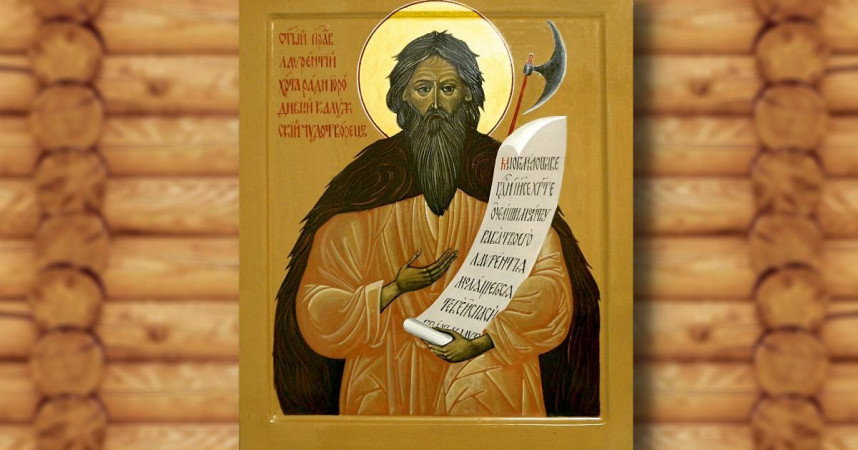
The Church commemorates St. Lawrence of Kaluga
23.08.2026, 06:00


-

The Prayers We Say for the Dead Are Also Prayers for the Living
Tatiana Lyubomirskaya
All Authors