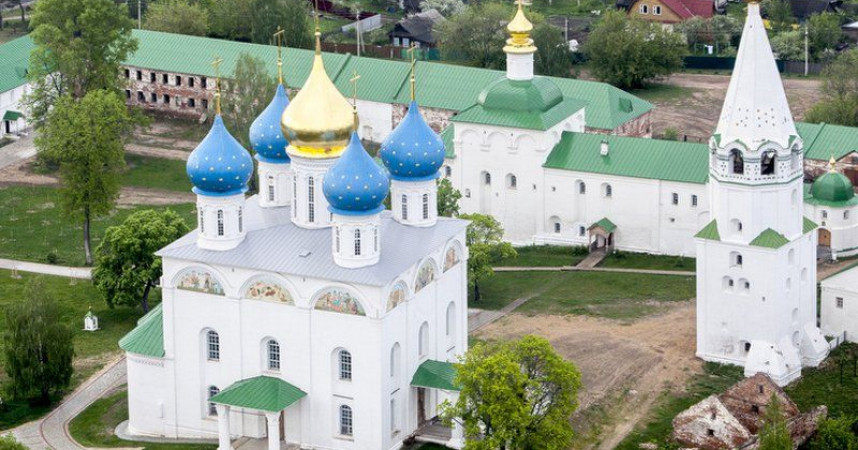
What was once a booming pilgrimage site, with crowds of the faithful and even some tsars visiting the monastery, is now a hard to reach location out in the middle of seemingly nowhere and only accessible by small rail buses known colloquially as “cuckoos”. But even as it has lost its accessibility and to some extent its popularity, the Florishcheva monastery remains one of the most beautiful monasteries in Russia. The article translated below first appeared on Foma and exquisitely captures the spirit of the place. As it is machine translated, we apologize in advance for any errors.
Image: Florishcheva Monastery
The hermitage stands on a hill called Red - perhaps because of the reddish hue of the sand, or perhaps because of the amazing beauty of the place; itself on the banks of the winding Lukh River. Today our "Road to the Temple" leads to the Florishchev Desert.
Men's monastery Florishcheva hermitage
At the best of times, thousands of pilgrims came to this monastery, who considered the Florishcheva hermitage "the second Lavra" after the Lavra of St. Sergius of Radonezh. And today you can get here by a rather exotic way - by rail bus otherwise known as a "cuckoo".
The monastery chronicles mention a certain woodcutter Flor, who long before the monastery was founded, while being in these woods, heard a wonderful chime on Krasnaya Gorka. The name Florishcheva wilderness is associated with his name.
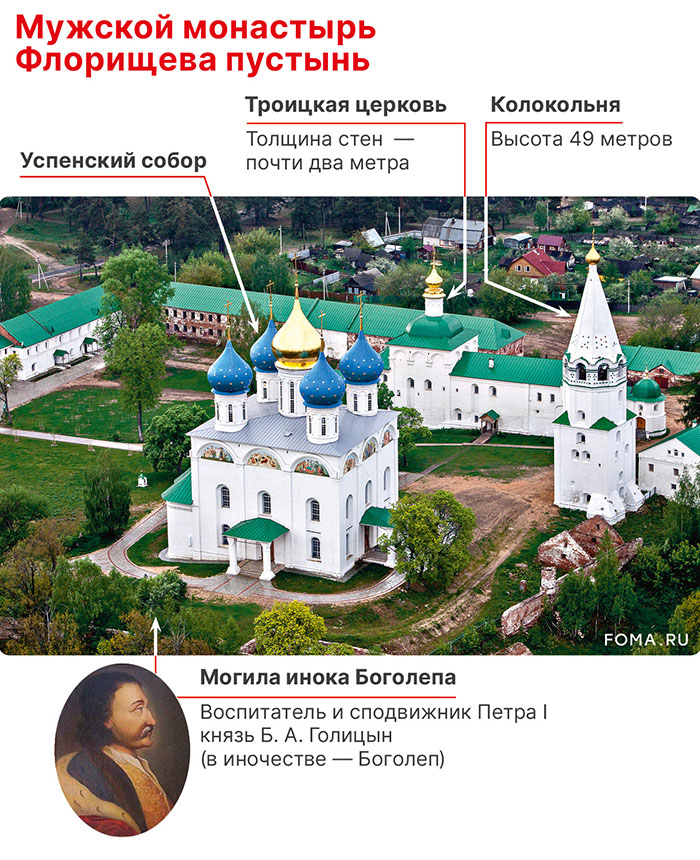
The first monastic community formed here in the middle of the 17th century under the guidance of schema monk Methodius but was unfortunately destroyed by the plague. Hieromonk Hilarion, the future Metropolitan of Suzdal and Yuryev and the confessor of Tsar Fyodor Alexeyevich, continued the work. Hilarion wrote the charter of the monastery, which many Russian cloisters later used as the basis for their charters. Under St. Hilarion the entire architectural ensemble of the Florishchev Monastery was built, and which has survived to this day.
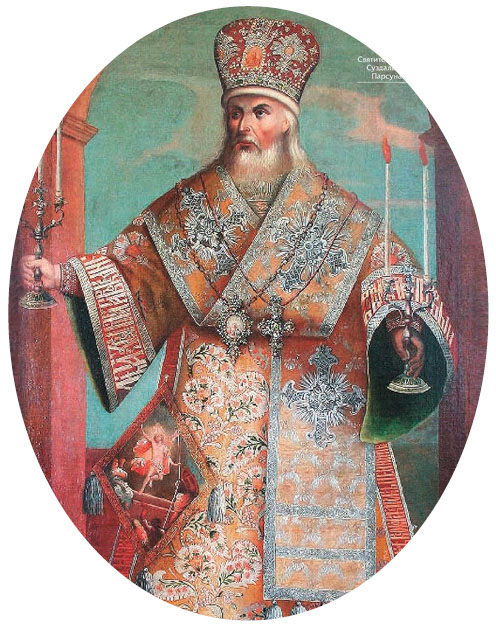
Hieromonk Hilarion, the future Metropolitan of Suzdal and Yuryev
The heyday of the monastery was during the reign of Fyodor Alexeevich. The young tsar himself came to the hermitage of Florishche in search of people of the true faith and holy wonderworkers. For this purpose, a special Tsar road was built from Moscow through Vyazniki and through the forest to the monastery. The Tsar liked the hermitage so much that he compared it to the "Eden of Edens”.

Tsar Fyodor Alexeyevich
For a long time, the hermitage was considered one of the most beautiful in the Russian Empire.
In 1923, the Florishcheva Hermitage was closed and later partially destroyed. Spiritual life in the monastery began to resume in 1992, and in 2005 it was transferred to the Church.
The shrine
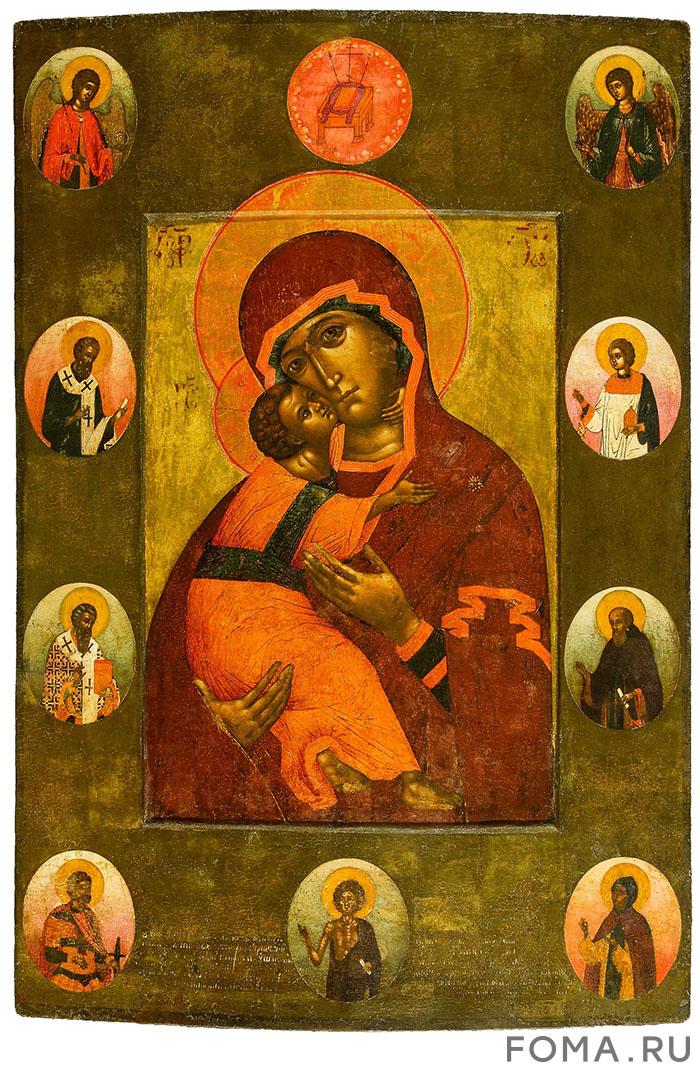
The famous iconographer Simon Ushakov and his pupils painted icons for the hermitage's cathedral temple under Hegumen Hilarion. The most famous is the Vladimir Florishchev icon of the Mother of God (1660), which is kept in the Vladimir and Suzdal Museum.
"Square cloister".
In plan the monastery is almost a square with the "axis" in the center, on which the gate Peter and Paul Church and the bell tower are located.
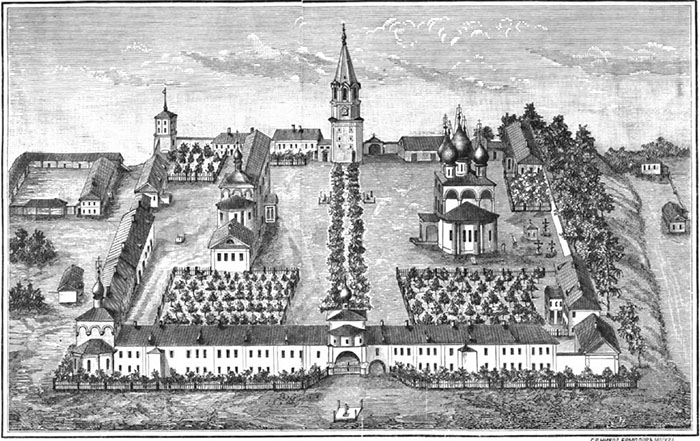
The wilderness in Florishcheva Desert. 19th century engraving
The monastery walls of the Florishchev Desert are a city with a multitude of buildings for different purposes: treasury, storeroom, hospital, household, abbot's office... And also within its walls are the monastery cellar, smithy and monks' cells. One of the buildings is called Golitsynsky after the educator and associate of Peter I prince B. A. A. Golitsyn. At the end of his life he went to the hermitage of Florishchev and was tonsured a monk with the name Bogolep.
The road to the hermitage can be an interesting adventure, if you choose an unusual mode of transport – the "cuckoo", a rail bus.
Once you arrive at the Moscow railway station in Nizhny Novgorod, then you get on the "cuckoo". It has two routes - directly to Frolischy or with a transfer through Ilyino.
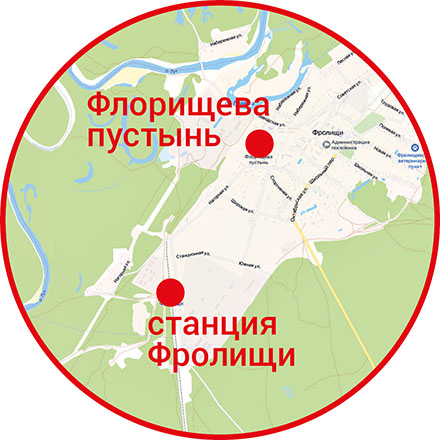
By the second route the "cuckoos" go much more often. Total travel time is 2 hours.
A "cuckoo" travels very leisurely: in summer from the window you can even watch the mushrooms that grow along the road. And the places are picturesque - forests, hills, swamps...
Frolishchi is a dead-end station. From it to the desert you have to walk a couple of kilometers through the woods.
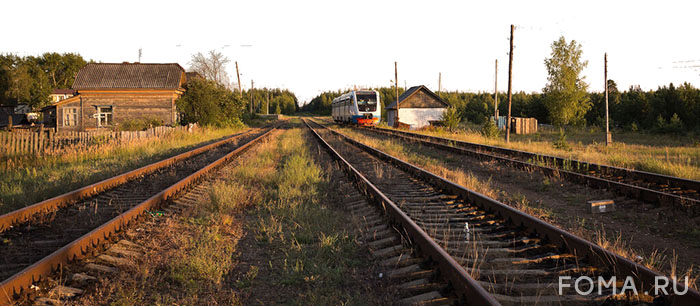
What is a "cuckoo"? This is a rail bus, or otherwise known as autotransit. This type of transport is specially adapted to move along the non-electrified sections of the railroads. It makes no sense to run long trains with diesel locomotives, that's why small diesel trains with one or several cars run over the rails. Such railroads are mostly single-track and have no U-turns at end stops: the driver simply switches from the head cab to the tail cab - and the "cuckoo" can already go in the opposite direction.


-

What Should We Remember?
Olga Kutanina
All Authors