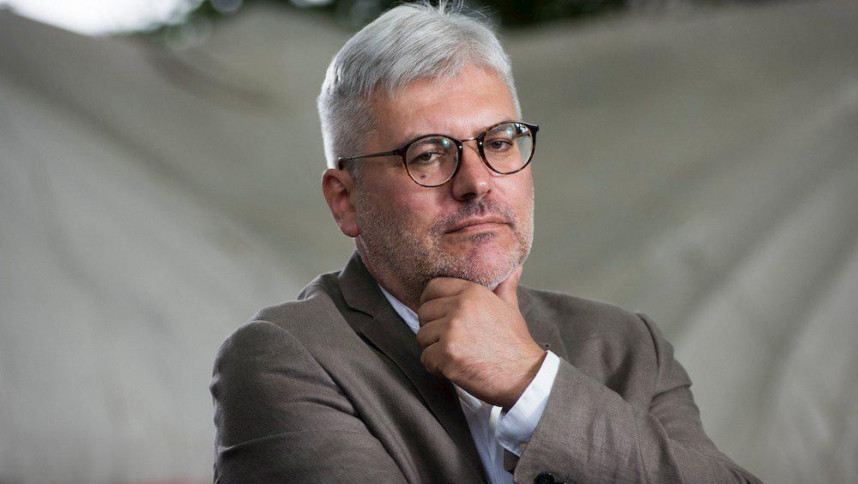
Welcome to our distinguished audience. This is the next one in our series of interviews Parsuna. Joined us today is Eugene Vodolazkin. Eugene, good evening.
Good evening, Vladimir.
Thank you so much for being here. Many times I have been asked to invite you here, and you know, this is exactly the case when my wish coincides exactly with that of our audience.
Thank you.
Thank you, too. Each interview has five sections, just to remind you, they are Faith, Hope, Patience, Forgiveness, and Love. They relate to the last words of the prayer of the Optina Pustyn Monastery elders. But first, in keeping with our tradition, I would like to ask you to introduce yourself, that is, to say something that you find important and essential to say here and now, to reveal about yourself today.
You know, briefly, if I would look for what connects all the parts of my life together, it would be words. My life is about words, it is built around words. At first, these were words that I studied as a philologist, because I was majoring in the Old Russian literature, studying Old Russian texts, though not only them. Then I had the audacity to produce my own texts, so my life is still closely connected to words.
Faith
Once, a lecturer in my university wanted to illustrate the history of Christianity by varying the word stress in the phrase “I pray to God”. He said that the accent on “God” corresponded to the early Christianity of Late Antiquity. The stress on “pray” corresponded to the Middle Ages. Even hesychasm, albeit meaning silence, is still about praying. On the contrary, in the phrase “I pray to God”, the Modern Age and protestantism are described through the stress on “I”. So, if we were to apply this method, where would you put the stress in the phrase to illustrate our times?
Well, apparently, there is something in this “I”. Whay? What is the Modern Age if we compare it to the Middle Ages? Modern Ages was marked by the development of individualism. Berdyaev said that in the Middle Ages personality was less personalized, but it was much stronger. Because it was fueled by the energy of the common truth, common faith, common ideology. And in the Modern Age, personality evolves by becoming more sophisticated, more individualized. However, it has lost the power of the common things it possessed earlier. So as you can see, in the Middle Ages, with a monastery being in the center of society and God being the heart of the spiritual world, there were no atheists. There were those whose beliefs violated the established practice, i.e. heretics, but everyone was a believer. On the contrary, today, as we know, many do not believe at all, therefore, God was put at the background of social consciousness, and He seems not to exist. Thus, every time one reaches Him, it looks like an act by this huge Self, like a personal act. So yes, I think the focus here is on “I”.
While listening to you, I have been thinking that maybe in this case there is only “I” left, even without “pray” and “God”? What do you think?
Well, yes, unfortunately, that happens too. On the other hand, you know, I remember this old musical anecdote about a composer who used to say: “When I was 16, I used to say ‘Me’, at 25, I used to say ‘Me and Mozart’, at 40, I changed it to ‘Mozart and me’, and now I say humbly ‘Mozart’.” So, it’s a more common logic of a human life. You know, I really love this phrase from the Bible: “You have been weighed in the balances, and found wanting.” It takes a lifetime to understand the meaning of it.
But a human lifetime, not that of a civilization, or...
Yes, we speak of a human lifetime here, not that of a civilization. Civilization is a special concept, it is a metaphysical entity, in my opinion. And humans, or to be more precise, their contribution, are rather insignificant. Indeed, when you hit fifty, you start to say humbly: “Mozart.”
It would be good, if it is “Mozart”. Let us move on to the next question. Once in your interview you said that... As far as I remember, the conversation was about prayer and about what to ask for in a prayer, and you said: “I’m a man, I have to act, and not ask, and still I would ask, and with tears in my eyes I ask for what I can’t give myself, I ask for health, for example, for myself and my loved ones.” These are your words, as I remember them. So, I have had a thought about it, and, therefore, a question. Look, on the one hand, people are responsible for their health, our lifestyle choices affect our health. Especially This idea is extremely popular now, with the current healthy lifestyle agenda in society. And on the other hand, according to the Christian worldview, we have to ask for everything, because we are not able to do anything without Him. Yet, it appears that most rarely we ask for the most important thing, which is to become stronger in our faith. What do you think about it?
I think we shall ask for things that we really need but cannot achieve through our own efforts. It seems to me that when you are writing, to a certain extent, it is not right to ask for a good text. For example, when I start writing a novel, I pray; I also pray when I am about to finish it, I do a thanksgiving service. But in between... You see, God gave me what today is called “creativity”. He gave it to me once, so why should I continue asking? And I am supposed to perform deeds, I ask for support and help, but asking for anything beyond that would not be fair, since I have been already given certain things. And as for my other pleas to God... It seems to me that people shall assume more responsibility for themselves. There are things that I cannot change, as I have said, they relate to health, life, etc. With regard to these things, I rely on the Lord, as a child, and simply ask Him to stretch His hand over me and protect me. As for the rest... If I start to ask for other things, I feel like a dependant. So I try to avoid asking them.
Once you said that your writing is like messages addressed to Him. Would you describe them as incoming or rather outgoing messages?
You know, it’s a two-way street. In fact, I believe that any creative work that is taken seriously is like an act of communication with Him. But some people do not put it right; people who do not believe in God see it as an act of communication with their own conscience. In any case it is an objective truth seeking process. Once Andrey Bitov made a good point about Nicolai Gogol, my favorite writer. He said that it seemed to him that Gogol had some kind of a long, endless conversation with God, and that all his writing was no more than notes in the margins. And I thought that was a very accurate comparison, because people cannot live without communication. A non-believer, apparently, communicates with their own inner world and its deepest things that, in my opinion, are God-given anyway. Do you remember this amazing song by Galich? It begins with the words: “‘Good morning, Bach!’ says God. ‘Good morning, God!’ says Bach.” This is that very kind of relationship that has a completely transcendent and metaphysical nature. Only then can you produce something on paper.
Hope
You often refer to your public position, if one can put it like this, as the philosophy of personalism. And I remember that Vladimir Pozner in his program said that this attitude drives nails in the coffin of the social activism which is hoped to make a difference. Never mind this social activism, my question is about a different hope. Clearly, you have made up your mind. But what are your hopes about this philosophy of personalism in our modern society?
I have huge hopes, these are my main hopes. And, you know, I have this kind of self-made philosophy. I’m no philosopher; I’m more of a philosopher through my writings, according to the Russian tradition. Because basically, our philosophy is literature, not the science of philosophy. At some point I started to read about it and I discovered a like-minded person who put it in the same way. It was Rowan Williams, former Archbishop of Canterbury. His position is also built around the philosophy of personalism. And basically, by the way, he often expresses perfectly orthodox views. I can say that I was really pleased when in one of his interviews he was asked about the best book published in England in 2016, and he mentioned the English translation of Laurus. Hearing him say it, made me tremendously pleased. So, it is personalism that I see in the famous words by Seraphim of Sarov: “Find your inner peace, and thousands around you will be saved.”
That was my next question. Am I right to think that you attribute it to... But you didn’t read the script.
No, I didn’t read it, I wrote it.
You win, I give up! So, to you it’s exactly about it?
Yes, this is about it. It’s not about following your self-vested interests, not that you do not care about others, it is not about it; because if you do nothing but admiring yourself for your own beauty and spirituality, what are you good for then? Still, I think it’s very dangerous to begin to “rule the nations”. It is very dangerous to start some kind of mass preaching, especially if you are an artist who easily develops obsessions, and who had not been given blessings for preaching. You should not focus on the people and the state in your activities. Your should focus on individuals. You see, I’ve met a lot of people, and as a historian, I know many situations when the outreach was nation-wide, country-wide, which led to revolutions and riots; nothing good has ever come out of it, because these events changed everything except for the human nature.
There is another topic, but I really want to address it in the Hope section. I would like to refer to an image, created by you, only in my interpretation. There is a dialog in Laurus. “A city of saints, whispered Ambrogio, following the play of the shadow. [When they were in the Kiev Monastery of the Caves, remember?] They present us the illusion of life. No, objected Arseny, also in a whisper. They disprove the illusion of death.” While your idea about art is completely true, it seems to me that art rather represents the illusion of life. And religion disproves the illusion of death. Wouldn’t you agree?
Yes, I would probably agree with that, and even elaborate on that in some way. So, what is art? Briefly, as I see it, art is the description of the undescribed. It is the expression of the unexpressed. And this is where I come back to your question about the difference between... Religion and art have things in common, but there are also differences between them. I like to say that there are only two areas of life that deal with human beings, i.e. art and religion. There is no other areas that deal with human beings, that deal with their periphery, their life, and so on. But they do it in different ways. No doubt, I see a hierarchical relationship between them. Because religion is superior to art. Art is always inferior, and I am totally comfortable with this, I am not saying this out of even slightest jealousy, because only religion deals with human beings per se. But art discovers the undiscovered and studies the unknown. You see, there are things that we can feel only vaguely. And literature gives names to them. It’s like Adam, who gave names to animals. All of a sudden, literature gave names to things. And what does it mean, to give a name? It means to put it into practice, to give reason for reflections, as it is difficult to reflect on something you can’t name. And in that respect, even atheistic literature can be very helpful. Nabokov is the example I like the best. How can one describe the human fear, the fear of death without the hope for eternal life? “The hollow hum of blank eternity”. One could not put it better. It was said by Nabokov who reveals and gives a perfectly clear name to this dreadful feeling. While literature... You cannot even say that it leads us somewhere.
I beg your pardon, but religion also gives names. What is an icon if not an image of the unimaginable?
Yes, it is.
Although you can argue that icon paining is art. But still...
Yes, it’s where art and religion meet. But, you see, religion is not limited to icon painting. Religion is also about practice. That’s why it leads our way. Basically, art does not lead our way, nor should it; it should reveal... In the end of the day, it also leads us somewhere, because, after all, different writers call to different shores. Nevertheless, you see, if a writer does this by way of declarations... As I always say, for example, this one leads the way, while this one does not... Take me, for example, I am a leading researcher. Leading where? Yes, and who am I leading? It’s a ridiculous title. Now, literature is... If it’s helpless, if it’s poorly written, where will it lead to? There's a difference between fiction and preaching. I always say that fiction writing shall not be turned into preaching. First, because no one gave you blessing for this preaching, and second, because preaching is a great genre, but it has its own objectives and its own context. The manner of storytelling in literature makes it is the exact opposite of preaching. It reveals things, not points them out. If we take many Russian writers of classical literature, i.e. Tolstoy, Leskov, Gogol, we’ll see that at the end of their lives they switched to preaching. And as a result, we get neither one thing, nor another. Their preaching was not always meaningful from the religious point of view or from the Church’s perspective, and they lost their strong points, too. One must obediently follow the given commands, and must produce descriptions of what they see. If those descriptions are good enough, if you are able to depict this ‘eidos’ that is in Heaven, then you do some noble work. Lecturing will only ruin everything.
I totally agree with you, although about Gogol I would like to...
No, Gogol stands out, you are absolutely right. The rest switched to preaching, but Gogol is different.
Patience
When you ask an artist about criticism, they say that constructive criticism is good and unconstructive criticism is bad. What is your criterion of genuinely constructive criticism?
I am open to any criticism that was not meant by a criticizing person as a way to have a blast, forgive me my slang. Yesterday Oleg Pavlov died. He was a writer and a complicated person, a hot-tempered man, because a writer cannot be a cold person. He wrote a few brilliant novels. Once he told me that his daughter always got upset after reading critical articles on him. He said: “Honey, it is not me he is writing about, he is writing about himself.” When I feel that a person is writing about themselves I just tune out. There are a few really fair and good critics. I could not say that we are friends. Generally, critics try to avoid being friends with writers, and it’s the right thing to do. But I understand that in some cases they rightly point out my mistakes. I couldn’t say I am happy about it. But I admit it. And it happens often. I am always open to criticism.
Does it hurt you when you have to admit your mistakes?
Sometimes it does. Especially when you are young. It hurts if you are young. But with the age, you consider all that you do as a job in the name of God, thus, you see criticism as a team work in the name of God. And in this sense I have stopped taking any criticisms personally. I would think: “OK, here is where it is not perfect”. You know, basically, I have a harsh inner critic because I see my writing as my work for... As my note to... I have a harsh inner critic, so when, for example, I get angry letters with all kinds of criticisms, or a critics writes to me: “What is your Laurus about? What is it about? It is good but what is it about?” And when they say to me: “Read it here, just read it, it’s funny”. I answer: “No, it’s not. It means, I did not do it right.” If a person, gesticulating wildly, tells me that they did not get what my writing was about, it is my fault. Ultimately, it is my fault, because when you as an author write something, you do not so much create your book as create buttons to be pressed by readers, depending on what buttons they need to press on. If a reader fails to find a single button, it means the writer did not do it in a professional way.
Speaking about age, you mentioned that young people are oversensitive. I read or heard in one of your video interviews that all the things associated with one’s rise to fame are more important when you are young. But when you are done with the vanity fair, in general, when, if we put it in more conversational style, it’s time to think about the hereafter, then the rest is not as important. Correct me if I am wrong, but I believe that with age comes this understanding that all of it is not really important. But understanding does not turn into action automatically. So, you seem to realize that you’re done with the vanity fair, and it’s time to think about hereafter, but you continue to enjoy these delusions of self-grandeur out of force of habit. So, there is no strong correlation between one’s age and the ability to act, however, the correlation exists between age and understanding. Am I right?
It depends on your experience and whether you take seriously your future according to eschatology. You know, I experienced a severe crisis at the age of 14-16 that brought me to faith. That is, I suddenly realized that... You see, it was not just an abstract idea of being mortal. Many people set their thoughts of death aside and just live their lives buying houses with white picket fences. But I did not manage to put these thoughts aside. I am working on a new novel now, Brisbane, where I further develop this matter. A boy drops out of music school. His grandfather asks him: “Why did you drop out of music school?” He responds: “Because I will die.” And he takes him to the priest, and he says: “You’re absolutely right to think that if you are definitively going to die, why do you need this music school at all?” But then he continues: “What if you won’t die? What if you have eternal life? In this case you really need music.” The boy says: “Does music mean eternity?” And the priest answers: “No, but it leads you to eternal life.” Only then did I sort it all out, when I became a believer... Well, I wouldn’t say that it was the moment that made me a believer. I became a believer even earlier. It is a very interesting story. Being an adolescent, I had this pagan period, as I call it. I used to ask somebody, I did not even know who I was addressing to. I used to ask (in plural): “Help me”. And then I made a life. So, I didn't manage to set aside my thoughts of death... But it wasn’t death that frightened me. It was the meaninglessness of all my actions that scared me. I’m not afraid of death, I was not then, and I am not now. I’m afraid of meaninglessness. And it’s exactly the same now, when you feel it coming. You see it everywhere, when your colleagues and friends die... You know, we’ve already hit the age when we have more and more experiences with death. And this scent of death, you feel it stronger as years pass. And this feeling is so strong... So, you almost do not care about how your fame will affect your life, or what will affect your fame. That being said, I was not at all indifferent to this issue as a youngster. I wanted... I saw it as my ambition. And now I can’t say that I’m totally indifferent to it; sometimes I can play along in some way, make a face pretending to be a classic celebrity with high demands... But actually, you know, this is not the same for everyone... It depend on how easily you get impressed... But I worked for Dmitry Likhachev for 15 years. I have already talked about how he influenced me, how he was a role model for me and my wife. We met in his department. He was himself in every situation, whether in front of a camera or in the institute. And I realized that... Well, you know, I once wrote about him, about his attitude towards fame. It wasn’t that he didn’t notice it at all—he did, but he embraced it with great dignity.
Forgiveness
We are moving on to the Forgiveness section. I think this topic is really important to you.
Yes, it is.
You tackle this matter in your books and interviews. I have a theory that it is partly related to the fact that it is a very personal issue to you. You confessed that there were people in your life whose forgiveness you have never had a chance to ask.
Yes, on the one hand, there are people whose forgiveness I have never had a chance to ask; on the other hand, there are people whom I found hard to forgive.
You were having hard time forgiving them?
Exactly. That is to say, it is a rather complicated matter for me. Again I somehow... We have already mentioned Likhachev, but since he may be the only truly great person I have ever seen... OK, maybe also Father Anthony of Sourozh, whom I... Well, not maybe, but definitely he was a great person—this is a person who has played a very important role in my life and for whom I had the greatest respect. Likhachev used to say, even in his diaries and in his notes: “Always remember about your old age.” He said: “Nobody wants to feel regret in their old age”. When you’re old, you do not want to regret about “youth being wasted on the young”, as the saying goes. So, he used to say this, and would regularly mention in his writings, and to be honest, to me it sounded if not trite, but obvious. And he used to say that old people feel this intense pain. He wrote this being an old man himself. Ha said, that it’s too late to fix anything, and it hurts, and it’s painful to live knowing it, and the pain persists as you near the end of life. He said: “If I were to warn anybody, I would advise to try to ensure that...” And he wasn’t appealing to any great moral values or power, he wouldn’t say that the soul is the only... He used to say that this “too-late-to-be-fixed” kind of pain of the old age is unbearable. And he said to remember about it. And indeed, as I enter this age now, I reminisce on some things that bring tears to my eyes, and I am surprised about how cold-hearted I could be at times and completely... Not cruel, it was worse... How I didn’t even realize that I caused immense suffering to some people. I remember these situations, and all those people, they are gone or have disappeared out of my life. In my head, I ask them to forgive me, but it doesn’t work like that. And, let's say, I have these sins absolved at my confession. But I remember a sermon of Father Anthony of Sourozh that impressed me...
You told me about a man who shot his wife...
...about a White Army officer who shot his wife. He said: “I had this sin absolved, but it didn’t make me feel any better.” And then Bishop Anthony says a non-obvious thing: “You asked forgiveness from God, whom you didn’t kill, but why wouldn’t you ask forgiveness from your wife?” Then the man asked his wife’s forgiveness, and he said: “Yes, I feel better now”. In my head, I try to ask people I have hurt for their forgiveness. In my spirit-nurturing phase, I remember being completely insensible towards other people who were crushed in my presence, gladly they were crushed mentally, and not physically. Not only did I not defend them but I thought it was funny and hilarious, and I was part of it, at least as a witness. That’s the kind of thing I’m very ashamed of.
Eugene, isn’t there some sort of fine trick by the Evil One, when we do not want to let go of our sins, and fathers warn against it. And the second point. When you focus on the past, maybe when we focus on the past, we might miss something here and now. Right? Isn’t there such a risk?
There is such a risk. You know, hardened criminals sometimes go to jail on petty cases just to break the circle...
That’s a very good example.
Me too, sometimes I feel like such a criminal, digging into some earlier... And then, all of a sudden, let’s say, rather serious sins appear. That’s true, that’s the risk of it. Also, there’s a risk to start admiring your own remorse, you have to keep that in mind, too. But in this case, you know, I hope that the human conscience is a self-adjusting system that tightens up things if they start sagging down. And I hope to find a reasonable balance between two extremes of self-condemnation and self-exculpation. But this system of checks and balances, I think it works, although maybe it’s a bit presumptuous to say that, too.
Love
Love is the last section of our interview. We’ve already talked about Dmitry Likhachev today. Allow me to quote what you said about him and love. You write that his love was never contemplative. You repeatedly use the word “responsibility” as a synonym to his love. And if one’s love does not imply this active dimension, if it is purely contemplative and complacent, is this not love?
It is love. Moreover, for some people it is the only possible way of loving. Let’s say, when a grandmother loves her grandson. It might be her way of loving... But I recall the way my grandmother loved me. I was not a child any more, I already lived in St. Petersburg, and she would worry about what and when I ate. It wasn’t active love, but it was above any other type of love. Love is all that you can give, in one way or another. So, my grandmother could only give me her love, she could not share anything else, and that was the only thing she could do. But a man like Likhachev could do a lot thanks to his social status. In various situations he just had to put in a good word. I will give a simple example, off the top of my head. When he offered me a job at the Pushkin House, he was told that to take me in he would have to retire someone. Not the best way to start my work there. Neither of us agreed to that. So, Likhachev called the President of the Academy of Sciences of the Soviet Union, and the Pushkin House got one extra full-time position. This went beyond the laws of everyday life, but he managed to do it. You see, not everybody would do it. If one is able to do something, for them, merely showing love and affection would not be enough. Likhachev understood that he loved his employees, it was quite obvious. You know, he was a passionate man, whether he loved or disliked someone. I saw him refuse deliberately to shake hands with certain people. He wasn’t a cold person, he was passionate in his dislike of someone; similarly, he would passionately express his love using all his power, administrative capabilities, etc. He knew who to call, what to say, which words he should choose. He almost never said no.
So, this leads to my next question. Do you remember... What could make him say no to a person?
He almost never said no; he knew that if one asked for something, they really needed it. He gave his help, unless it contradicted his beliefs in an obvious way. On the other hands, he dealt with two types of requests: whether he signed unconditionally what he had been given if it was in line with his ideas of decency, or, if he wanted to give his feedback, he would leave handwritten notes. That’s how it was. I think many power holders knew that. They knew that he automatically accepted everybody and almost never said no. That is, there were situations when he said no, but only if he saw the absurdity of a it... But when he wanted to influence the situation somehow, he would always handwrite a few words, and that was a sign of his interest in the case. And when he wanted to resolve an issue, he would either make a call or write the whole letter by hand on his letterhead.
It was a sign.
It was a sign that this time there is no walking away. He helped so many people, saved so many lives, and, you know, he could have become extra cautious after doing time in prison camp. He was reasonably cautious, but there was this case when he refused to sign the Soviet Letter on Andrey Sakharov. Only two people refused to sign it, he and Peter Kapitza. He got beaten up after that. He never looked for trouble with the government, he was no dissident, because, as awful as it may seem, dissidents were part of the system, only with the negative sign. He was beyond the system, he was not against it, he was outside of it. But in some situations he could not overstep this notorious mark. He would never let himself take part in death sentence voting that was a common process in the 1930s. He said: “Since I did my time in prison camp, if said no, I would have been sentenced to death as a former inmate of the Solovki prison camp.” He added: “But to vote ‘yes’...” Although, as he recalled, often it was the same Bolsheviks who were tried, same loathsome supporters of the Terror. He said: “But the fact that we had to vote on a death penalty...” He would learn about these voting gatherings beforehand and would make an appointment at hospital to get a medical sick-leave certificate. It was the only thing he could do. But once he got a call from a member of the Academy of Sciences Khrapchenko who told him: “You might be allowed to travel abroad.” When he asked what he had to do for that, Khrapchenko answered: “You need to sign a letter.” He responded, without any pathetic words or actions: “I have never met Andrey, so how could I sign any letters on him?” He said: “Khrapchenko didn’t try to talk me into it. He told me: ‘Just as you please, but do not ever tell anyone about our conversation’.” And he never did, until Khrapchenko passed away.
In the Love section I often refer to famous words of Paul the Apostle from the First Epistle to the Corinthians. I would like to ask you a question to this regard. You might remember those words: “Love bears all things.” What do you think this “bears all things” mean?
You know, Nikolay Leskov liked a similar expression: “Perfect love drives out all fear.” Unfortunately, the word “love” has been devalued to a certain extent. There is this short story On Love by Daniil Kharms where he tells about an artist who loved his mistress and his mother. He gave all the money to his mistress, and his mother often had nothing to eat, as he gave her nothing. When she died, he cried, and when his mistress died, there were no tears in his eyes. So, this word may stand for completely different feelings. So, to a great extent, love gives you the possibility to give something away, whatever form it may take, or at least to open up which is also important. If you have a not so decent person in your life, but you love them, your love fills and covers their sin. Like a dentist filling a cavity, you try to fill their gaps with your qualities and your energy. Perhaps, later it will become a part of this person. That’s how I see it. Love is a blazing furnace melting small wires and bent nails into a light and shining mass. This is true love. It is not easy to feel true love towards certain people. It is a big temptation. Being a writer, I tell you what. Even if your character a jackass, you must love them. Because if you create a character without love, it will be flat from the artistic point of view, and besides, you do not give any chance to find something human in it neither to your character themselves, nor to your readers. You automatically lead your reader to believe that there is scrap metal that it is no good for anything at all and that there are people who could become something decent one day, and there are those who simply...
I feel like we have just began our conversation, but, unfortunately, we have ran out of time. And as I told you earlier, to conclude, I would ask you to put a full stop in a sentence. This topic appears to have nothing to do with our previous conversation; it is the use of the Church Slavonic language in worship. You know very well that there are different points of view on this matter; some think that since many people don’t understand what is going on during a service, it has to be translated into Russian. However, the Church is strongly opposed to it. First, one can learn the language, second, this language was created specifically for worship services, it is the sacred language. Where would you put a full stop in the sentence “Translate impossible to preserve”?
I would place c comma after “translate impossible”. Most probably I would place it there. However, since the reality in which we exist is not a “yes—no” paradigm, I would like to add a few words. For those who struggle continuously with understanding of the Church Slavonic language I would have erected a church for each or several parishes where you can attend a service in Russian. As we mentioned Dmitry Likhachev, let me wrap up the conversation by saying a few words about him. He was strongly opposed to the translation of religious services. He said: “Why would we cut the only string that connects us to the past?” If a person objected to it and said that they would not understand the language, he used to say: “Spare four hours to read and learn all unknown words in a service. You will get their meaning. On the other hand, those who do not speak neither Russian, nor Chinese, will not listen to service celebrations, as they have no such intentions, and, therefore, they use incomprehensibility and other things only as a pretext.” He also said: “Make it your fair share of contribution, make an effort and learn the language.”
Thank you.
Thank you, too.
That was Eugene Vodolazkin whose life is built around words.





-
“I Praise You, Brothers”: The Spiritual Art of Recognizing the Good
Alexey Shirikov
All Authors