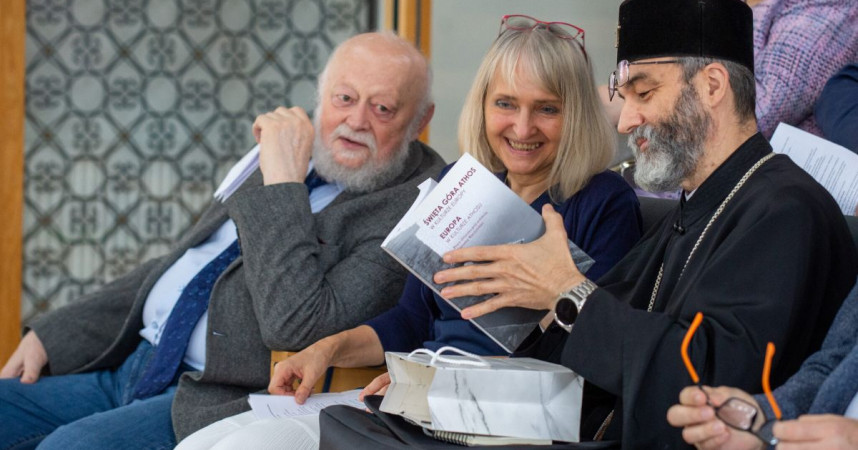
An international academic conference examining the legacy of the Orthodox Church in the former and present-day Polish-Lithuanian Commonwealth is underway in Supraśl, bringing together researchers from Poland and abroad to discuss the history, theology, art, architecture and liturgical traditions of Eastern Orthodoxy.
The three-day conference, titled “The Heritage of the Orthodox Church in the Former and Contemporary Polish-Lithuanian Commonwealth,” opened on September 17 and will run through September 19 at the Supraśl Academy. It is organized by the Oikonomos Foundation in cooperation with the Supraśl Academy, according to the Polish Orthodox Church’s website.
The academic program was preceded by a prayer service at the Church of the Annunciation in the Supraśl Monastery. The conference was then officially opened at the Academy’s assembly hall. Academy Chancellor Father Jarosław Jóźwik welcomed participants, while Archbishop Jacob (Kostiuczuk), head of the Białystok-Gdańsk Diocese, delivered the opening lecture.
The conference program features dozens of presentations exploring Orthodox heritage across territories associated with the history of the Polish-Lithuanian state, the Polish-Lithuanian Commonwealth and modern Poland.
On the first day, scholars discussed the history of the Supraśl and Jabłeczna monasteries, ancient liturgical books, relations between Orthodox hierarchs and Eastern patriarchs, the role of icons in Christian identity and Cyrillic publishing. Other presentations examined the influence of Eastern Christian traditions in the writings of Adam Mickiewicz and the development of Orthodox church architecture.
The September 18 sessions focus on the cultural heritage of the Zhyrovichi Monastery, the history of Orthodox communities in Warsaw, the activities of the Orthodox Metropolis of Warsaw during the interwar period and developments in contemporary Orthodox theological thought in Poland.
Church music and liturgical traditions occupy a significant part of the program. Researchers are examining the history of Orthodox chant from the 17th to the 19th centuries, early liturgical collections, akathists, Church Slavonic manuscripts and locally venerated saints of the Metropolitanate of Kyiv.
The final day will address the transformation of Orthodox liturgical traditions in the 16th century, Orthodox organizations in interwar Poland, theological education during the German occupation and developments in Orthodox theology at the turn of the 21st century. Several presentations will also examine the translation of liturgical texts into Belarusian.
A separate panel for young scholars will feature research on Orthodox music, iconography and religious memory.
Organizers say the conference seeks to examine Orthodox heritage from a broad perspective, treating it not only as a part of church history but also as an important element of the region’s cultural, literary, artistic and intellectual heritage.





-

The Strength of Weakness
Alexey Shirikov
All Authors