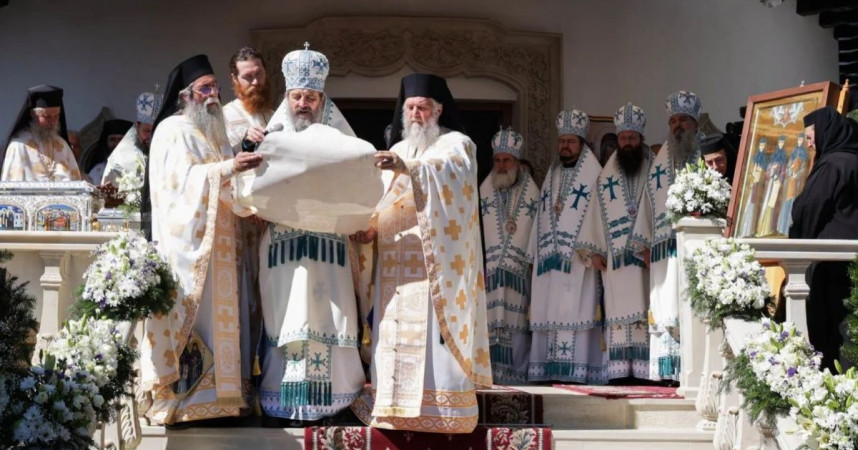
Romania has locally proclaimed the canonization of three new saints—Venerable Nazaria, Olympiada, and Elizabeth (Safta) Brynkovyanu—whose spiritual legacy is closely connected to the Văratec Monastery. The celebration took place on August 16 in Văratec, according to a report by the website of the Romanian Orthodox Church.
Earlier, on February 6, 2026, their universal church glorification was held in Bucharest alongside the canonization of other Romanian ascetic women. The decision to canonize 16 women had been adopted by the Holy Synod of the Romanian Orthodox Church in July 2025.
At the center of the festivities in Văratec were three distinct life stories united, as Romanian Patriarch Daniel noted, by “one spiritual foundation”—unceasing prayer, mercy, and love for one’s neighbor.
Nazaria, originally from Brașov, became a widow at an early age and later lost two children. After that, she embraced monastic life and devoted herself to serving God. In 1788, she was appointed the first abbess of the Văratec Monastery.
According to church tradition, Nazaria followed the Hesychast spiritual path and devoted herself to spiritual literature: reading and copying the writings of the Church Fathers, and memorizing a significant portion of Scripture. Monastic sources say she was sought out for spiritual counsel, and that her prayers also brought help to the sick.
Patriarch Daniel said Nazaria continued the tradition of spiritual guidance she learned from notable Romanian elders, including Vasile Poenărianul, Paisius of Neamț, and Joseph of Văratec.
Olympiada (1757–1842) is remembered above all as the foundress of the Văratec Monastery. She participated in building the community, invested her own resources in it, cared for the nuns, and later became abbess. The Romanian Orthodox Church notes that Olympiada repeatedly refused the office, considering herself unworthy, and accepted it only after persistent requests.
Her spiritual life was closely tied to the Jesus Prayer. Church sources report that she sought to pray constantly, including during ordinary household work. At the monastery, she also engaged in the spiritual education of the nuns—encouraging them to read Scripture and to copy the works of the Church Fathers.
Elizabeth (Safta) Brynkovyanu, the third of the newly honored saints, came from a noble boyar family. In 1793, she married Grigory Basarab Brynkovyanu, and in 1840, after her husband’s death, she entered the Văratec convent, where she took monastic vows.
Charity stood out as a defining feature of her life. Even before entering the monastery, and later on her own, she helped churches and monasteries, donating land, money, and church valuables. Among her best-known works was the establishment in Bucharest of a hospital for the poor. The initiative was designed so that patients would receive help regardless of origin, faith, or financial status. Church materials describe her as one of the most prominent charitable benefactors among the newly recognized Romanian saints.
At the same time, Elizabeth regarded her charitable work with deep humility. Even from within the monastery, she wrote to her spiritual father saying she considered herself weak and unworthy, distressed that she could no longer do good deeds—despite the fact that earlier she had helped create and support major social and church institutions.
In a message marking the local proclamation of the canonization, Patriarch Daniel emphasized that the three venerable women “enlightened the souls of nuns and laypeople alike, showing them the path of salvation in Christ.” He said their lives converged in three qualities: unceasing prayer, almsgiving carried out in humility, and active, merciful love toward those in need.
“The three meet within one spiritual foundation—unceasing prayer, offered secretly in the heart; almsgiving, performed with humility and without public display; and diligence and merciful love toward those who are in need,” the Patriarch’s statement said.
The celebration in Văratec formed part of a larger effort to glorify 16 women living in different historical periods, including nuns, martyrs, princesses, spouses of rulers, and laywomen. The Romanian Orthodox Church devoted 2026 to the commemoration of these holy women.
Thus, the stories of the three venerable women of Văratec are presented not only as monastic achievements, but also as distinctly earthly acts of service: creating a monastery, caring for fellow nuns, and assisting the sick and the poor. Church leaders highlight that the combination of prayerful life with practical mercy is the central theme of their glorification.


-

Invisible Wings
Yana Kapaeva
All Authors