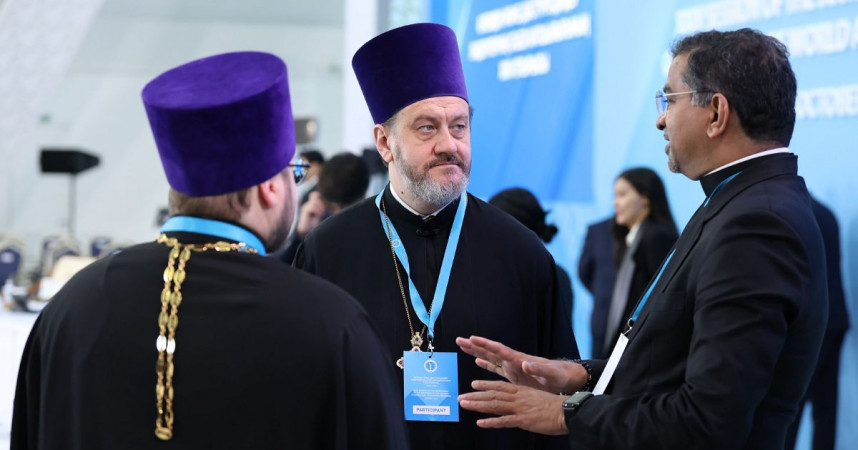
Representatives of the world’s major and traditional religions gathered in Astana on October 7 for the 24th meeting of the Secretariat of the Congress of Leaders of World and Traditional Religions, focusing on the ethical use of artificial intelligence, climate change, the protection of terminally ill children and the development of interfaith dialogue.
The meeting was held at the Palace of Peace and Reconciliation under the leadership of Erlan Karin, Vice President of Kazakhstan and chairman of the Congress Secretariat. More than 30 representatives of religious communities, international organizations, government bodies and civil society groups from 20 countries took part.
Islam, Christianity, Judaism, Hinduism, Buddhism, Taoism, Shinto and the Baháʼí Faith were among the traditions represented at the gathering.
The Russian Orthodox Church was represented by Archpriest Igor Vyuzhanov, deputy chairman of the Department for External Church Relations of the Moscow Patriarchate, and Archimandrite Sergius (Karamyshev), rector of the Assumption Cathedral in Astana. Vyuzhanov conveyed greetings from Metropolitan Anthony of Volokolamsk and emphasized the importance of interfaith dialogue.
A key outcome of the meeting was the adoption of two international documents: one outlining ethical principles for the use of artificial intelligence in the religious sphere and another addressing the role of religious communities in combating climate change.
The issue of AI has become increasingly relevant for religious organizations as neural networks are used for text processing, education and information dissemination. At the same time, their growing use has raised questions about the reliability of AI-generated content, responsibility for misinformation and the appropriate boundaries of technology in spiritual life.
Against this backdrop, the Secretariat agreed on common ethical guidelines for the use of AI. The initiative to develop the documents was proposed by Kazakh President Kassym-Jomart Tokayev at the eighth Congress of Leaders of World and Traditional Religions in 2025.
Climate change was another major focus. The adopted document calls for religious communities to be recognized as participants in international efforts to promote environmental responsibility and protect the environment.
The meeting also highlighted a Kazakhstan-Vatican initiative to develop a Charter on the Rights of the Terminally Ill Child. The document is being prepared with the participation of Kazakhstan, the Holy See and Rome’s Bambino Gesù Children’s Hospital.
The initiative focuses on safeguarding children’s dignity and ensuring humane treatment, access to medical and psychological care, and support that takes into account their religious and philosophical beliefs.
The discussion followed the second Kazakhstan-Vatican Colloquium, held in Astana on October 2–3. The event brought together representatives of the Kazakh government and the Holy See, religious leaders, specialists in pediatrics, bioethics and theology, as well as experts on children’s rights.
The eighth Congress of Leaders of World and Traditional Religions was held in Astana on September 17–18, 2025, bringing together more than 100 delegations from around 60 countries. The main theme was “Dialogue of Religions: Synergy for the Future.”
The congress concluded with the adoption of the 2025 Astana Declaration for Peace, in which participants called for stronger interfaith and intercultural dialogue, efforts to counter intolerance and violence, and the development of a global movement for peace.






-

The Right Moment
Alyona Bogolyubova
All Authors