With the blessing of His Holiness Patriarch Kirill of Moscow and All Russia and at the invitation of His Holiness Patriarch Tawadros II of Copts, a delegation of representatives of the monastic community of the Moscow Patriarchate headed by Metropolitan Vikenty of Tashkent and Central Asia visited Egypt on November 8-15.
On November 8-9, the delegation visited the homeland of Christian monasticism — the ancient monasteries of the Nitrian Desert (Wadi an-Natrun), located between Cairo and Alexandria to the west of the Nile Delta.
The first stop of the delegation was the monastery of St. Macarius the Great. This monastery, which traces its history back to 360, is the site of the earthly exploits described in the Egyptian Paterica and the blessed death of one of the founders of monasticism.
On November 9, the 22nd Week after Pentecost, Metropolitan Vincent, co-served by Bishop Sergius and Bishop Joseph, celebrated the Divine Liturgy in one of the ancient churches of the monastery.
Then the delegation visited the monastery of St. Paisius the Great (Anba Bishoi), founded by this saint around 357. The delegation venerated the relics of St. Paisius the Great, who reside in the monastery, and also visited the grave of His Holiness Patriarch Shenouda III of Copts (1971-2012), who was buried here. A meeting was held with the abbot of the monastery, Bishop Agapit, and the brethren.
Then the pilgrims from Russia went to the monastery of the Syrians (as-Suriani), founded at the end of the fourth century by the disciples of St. Paisius the Great on the site where his distant cell was located, and named in memory of the stay here for several centuries of monks originally from Syria. The monastery has historically strong traditions of hermitage. The name of St. Ephraim the Syrian is associated with the monastery of as-Suriani, who, according to legend, once came here to see St. Paisius the Great.
Then the delegation visited the monastery of the Romans (al-Baramus), founded around 335 by St. Macarius the Great and the first men's monastery in the Christian world. It got its name in memory of Maximus and Domitius, the sons of the Roman Emperor Valentinian, who labored here at the end of the fourth century under the leadership of this great ascetic.
On November 10, the delegation visited the monastery of the Holy Great Martyr Damiana of Egypt, located in the north of the country in the eastern part of the Nile Delta. It is generally believed that this is the earliest Christian convent founded.
By the decision of the Holy Synod of October 30, 2025 (journal No. 101), the Great Martyr Damiana of Egypt and the forty virgin martyrs who were killed with her were included in the Calendar of the Russian Orthodox Church. The memory of the Holy Great Martyr Damiana and the Forty Virgin Martyrs is celebrated on January 8/21.
Then the delegation visited the church of the Most Holy Theotokos and the Great Martyr Abanub of Nekhisi in the city of Samannud, where his holy relics rest.
On the same day, the delegation visited the city of Sakha, located in the Nile Delta. This place is one of the first stops on the way of the Holy Family in Egypt. Unlike other similar stops (there were more than twenty in total), where, according to legend, the Holy Family received a warm welcome from the locals, they did not find one in Sakha — no one even gave the Pilgrims water. And here a miracle was performed: the Blessed Virgin, exhausted by wandering, placed Her Son on the rocky ground, and a spring came out from there. The touch also preserved an imprint on the stone of the foot of the Infant of God, reverently preserved by Egyptian Christians and located today in the Coptic church built on this site in the name of the Blessed Virgin Mary. Vladyka Vincent and the members of the delegation bowed to the great shrine.
The delegation then headed to the Eastern Desert near the Red Sea.
On November 11, the pilgrims visited the monastery of St. Paul of Thebes and worshiped the tomb of the ascetic.
Metropolitan Vincent, co-served by members of the delegation in the episcopal rank, celebrated the Divine Liturgy in the cave temple of the 5th century, where one of the holy monks of the monastery once labored.
On November 12, representatives of the Moscow Patriarchate visited another ancient lavra of the Eastern Desert, the monastery of St. Anthony the Great. This monastery, built at the beginning of the fourth century near the mountain where the founder of monasticism lived in a cave cell, has been one of the most important places of Christian pilgrimage for more than one and a half thousand years.
On November 13, representatives of the Russian Orthodox Church went to Cairo. On the way, in the new administrative capital of Egypt, they visited the Cathedral of the Nativity of Christ, one of the largest in the Christian world. The grand opening and consecration of the cathedral took place on January 6, 2019 in the presence of Egyptian President al-Sisi.
On the same day, the pilgrims visited the Coptic monastery of the Great Martyr Theodore Stratelates (Amir Tadros) in the Old City, where they were warmly welcomed by its abbess, Abbess Yedrosis, and the sisters of the monastery.
In Cairo, the delegation met with Bishop Theodosius of Giza, responsible for the care of Coptic parishes in Russia, and received a reception in honor of the guests.
On November 14, Metropolitan Vincent celebrated the Divine Liturgy at the Church of St. Sergius of Radonezh in Cairo, a parish of the Patriarchal Exarchate of Africa.
Then the delegation visited the historical Christian center of Cairo, where the great shrines of the Christian world are located: the grotto, in which, according to legend, the Infant of God with His Most Pure Mother and Saint Joseph hid from persecution for three months. In 58, a temple was built here, one of the very first in the Christian Church; built over it in the IV century. the church of the Martyrs Sergius and Bacchus, where parts of their relics reside. Among the places visited by the pilgrims is the temple in honor of the Great Martyr Barbara, where a fragment of her relics is located, as well as fragments of the relics of the martyrs Juliania and Damiana and other saints.; the famous Coptic "Hanging" Church ("Muallaka"); the Coptic Museum; the convent of the Great Martyr Mercury (Abu Seifen), where the delegation was solemnly welcomed by Abbess Kyria and the sisters.
On November 15, the members of the delegation left for Moscow.
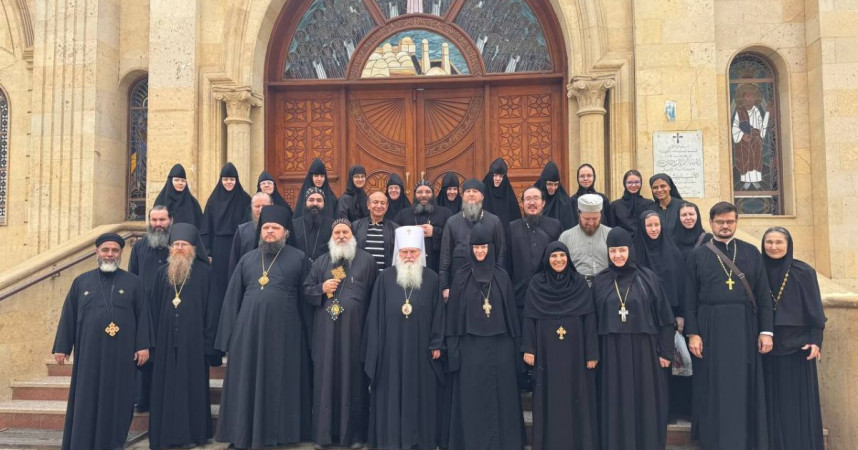
A delegation of representatives of the monasticism of the Russian Orthodox Church visited Egypt on a pilgrimage
18.11.2025, 09:00





-

The Strength of Weakness
Alexey Shirikov
All Authors