On September 1, 2024, the portal "Memory of the Church. Conversations with witnesses of the life of the Church in the Soviet era."
The new portal is a project of the Educational Committee of the Russian Orthodox Church, its goal is to preserve and transmit from generation to generation the memories of eyewitnesses of the life of the Church and believers in the Soviet Union.
The Soviet era became one of the most dramatic pages in the history of the Russian Orthodox Church. At that time, faith in God and godlessness, freedom of religion and persecution of faith, life in the hope of the Kingdom of Heaven and frantic attempts to build communism collided. How was life for those who believed in God and heard threats from the authorities to "show the last priest"? The Memory of the Church project answers this question through personal recollections of eyewitnesses to the life of the Church and Orthodox believers during the Soviet Union. The participants of the project — bishops, clerics, laypeople — share stories about themselves and their loved ones, mentally return to the years of their childhood, enter their first temples, hide from vigilant teachers, find themselves back in the offices of the commissioners, talk about home life.
A unique database of materials is compiled under the guidance of the Educational Committee of the Russian Orthodox Church by all theological schools in the territory of the Russian Federation. The project is designed to promote the preservation of historical memory, in-depth scientific study of the church history of this period, as well as the education of young people through the assimilation of the life experience of past generations.
The site presents memoirs of contemporaries of the Soviet era, multimedia materials. In cooperation with theological schools, the portal will be regularly updated with new materials.
For questions and suggestions, you can contact the editorial office of the project at pamyat-tserkvi@uchkom.info .
***
Archpriest Maxim Kozlov, head of the Memory of the Church project, Chairman of the Educational Committee of the Russian Orthodox Church, about the project and the opening of the portal:
"The Memory of the Church project, the first results of which are now being presented to public attention, has as its main goal to preserve the priceless and rapidly disappearing — the memories of our older contemporaries about church life in the Soviet decades, church-state relations, church politics, the lives and lives of martyrs and confessors.
The problems and achievements of spiritual education and the external affairs of the Church are in one way or another reflected in detail in church historical works today and are the field of study of academic science. The task of our project is to preserve what, for the most part, was not included in these works. People's memory of the daily, everyday life of a believing Orthodox Christian in the Soviet decades: how they prayed, which churches they went to, what joys they had, what problems they experienced at school or at work, which holy places they could visit, where church books and icons were taken from, much, much more that is connected with everyday life and that can only be conveyed to us by living witnesses of the era. At the same time, in order for the picture to become complete, chronological coverage, geographical coverage, and sociological coverage are important here. Therefore, bishops, laypeople, professors of theological academies, villagers from the Russian hinterland, residents of central cities, and rural priests are represented in the project. And each of them in his own way - the way it is imprinted in his heart, soul, memory — tells about those years and decades. And all together, I really hope, this will form a mosaic of the picture of the life of church people, which is very important and dear to us.
Of course, every story is subjective, every person remembers what they remember and how they remember it. Therefore, when implementing the program, it was an idea at the initial stages to immediately upload the minimum required number of memories — we start with fifty, and the next steps will be fifty. And when we get three or four hundred memories, then we can add them individually. It is equally important that almost all the theological schools of the Russian Orthodox Church participate in the implementation of the project. Students and teachers meet with older contemporaries, write down their stories, decipher these recordings. And for them, I think this communication is extremely important. This is the genuine and ecclesiastical, and at the same time patriotic education, which is being talked about a lot now, and which, in my opinion, when implementing this project becomes a reality, not a declaration.
We are grateful to everyone who has already participated in the project today, and we invite all our theological schools and students of Soviet higher educational institutions to cooperate, and anyone who wishes to participate in it through their own memories of the former, or through their willingness to become one of the interlocutors for our older contemporaries. I wish you all an interesting, inspiring, and sometimes touching reading of the stories of our older contemporaries."
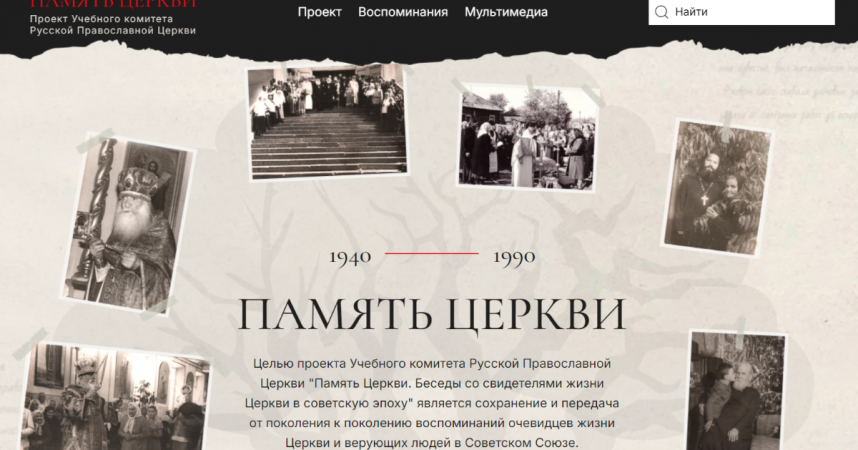
The portal "Memory of the Church. Conversations with witnesses of the life of the Church in the Soviet era"
02.09.2024, 13:00





-
“I Praise You, Brothers”: The Spiritual Art of Recognizing the Good
Alexey Shirikov
All Authors