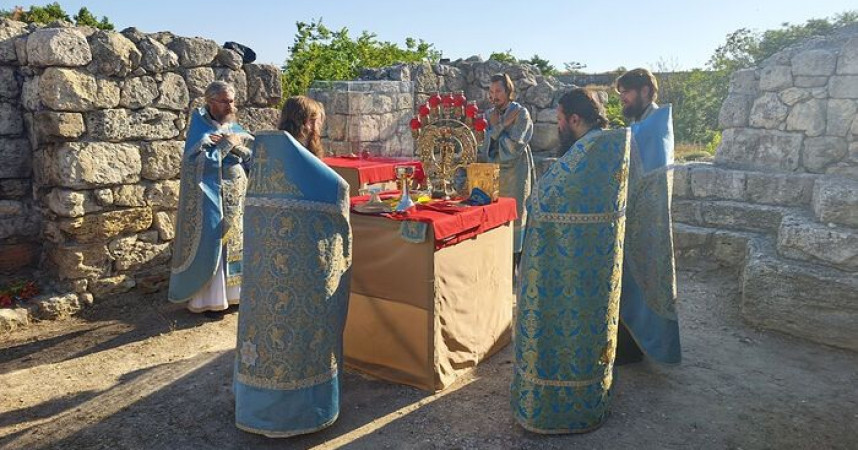
On the patronal feast of the church of the Blachernae Icon of the Mother of God, on July 20, 2026, the Divine Liturgy was celebrated in the open air. The divine service was led by the dean of the monastery, Archimandrite Siluan (Pasenko).
According to a long-standing tradition, the community of St. Vladimir's Monastery takes care of the historical temples of Tauride Chersonesos. One of these shrines is the church of the Blachernae Icon of the Mother of God, a place where the Divine Liturgy has been celebrated since ancient times. According to legend, St. Martin the Confessor, Pope of Rome, defender of the Orthodox faith of the seventh century, was buried here.
On the eve of the patronal feast, the parishioners of the monastery worked hard on a clean-up to put the area around the ruins of the ancient Blachernae temple in order.
Today, the temple consists of fragments of stone walls and an altar.
The dilapidated Blachernae Church (as well as more than 50 tombs) was discovered in 1902 during excavations conducted by Karl Kosciuszko-Valujinich, the founder and first director of the Chersonese Museum. Among the burials there were both those made according to the pagan rite in the I–II centuries of our era, as well as Christian burials dating back to the IV–VIII centuries. Later, in 1953, Christian burials, a chapel, a large cruciform temple and rooms that could be used as residential and utility rooms were opened inside the stone monastery fence.
The temple has a cruciform shape, with an altar in the center. The remains of Pope Martin I, exiled to Chersonesos in 655, rested nearby. It was here that the Christian martyr met his end and was buried in the "necropolis of saints in the beautiful house of the Virgin Mary, called Blachernae, outside the walls, at a distance of a stage from the blessed city of Kherson." Today, we can only talk about the proposed burial site. The remains of the saint were taken to Rome in the same 7th century, where they are still kept in the church of St. Martin on the Hills.
Interestingly, in 1902, Nicholas II visited the Church of Our Lady of Blachernae on the Rural Necropolis of Chersonesos. There is the following entry in the Emperor's diaries: "September 18… After breakfast, we drove to the Grafskaya pier and set off in carriages to the Chersonesos Monastery. After a short prayer service, we visited the museum and the new excavations of Kosciusko-Valyuzhinich. The walls of the ancient city and the ruins of a church with a magnificent mosaic floor are particularly remarkable. There are catacombs with a well of clean water right under it."
Traditionally, the clergy and brethren of St. Vladimir's Monastery of Chersonesos hold festive divine services here on the days of the celebrations of the Mother of God of Blachernae and the memory of St. Martin the Confessor, Pope of Rome.
The territory of the temple, or rather even the temple complex, is being put in order. Orthodox youth, children and their mentors from the Sevastopol youth center "Point of Support" take an active part in the cleaning.
Based on the materials of the Crimean Archdiocese




-
Woe to You, Actors
Alexey Shirikov
All Authors