
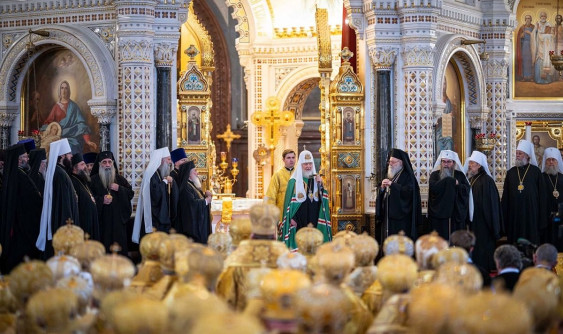
On June 30, 2024, a solemn canonization of Venerable Martyr Stepanida of Bitola and Skadar took place in the Cathedral of St. Demetrius in Bitola. The Divine Liturgy was co-officiated by Serbian Patriarch Porfirije and Archbishop of Ohrid and Macedonia Stefan, reports the Macedonian Church's information portal, liturgija.mk. The service was attended by representatives of various Orthodox churches, as well as priests from Bulgaria, Poland, the Czech Republic, and Slovakia.
Following the Liturgy, Patriarch Porfirije delivered a sermon emphasizing the importance of unity and mutual understanding within the Church. He likened the languages of faith and love to the languages of the apostles, which were understood by all the peoples who came to Jerusalem on the day of Pentecost. Patriarch Porfirije highlighted that by speaking the language of the Holy Spirit and Orthodoxy, believers can achieve true unity.
The decision to canonize Stepanida of Bitola was made by the Holy Synod of the Macedonian Orthodox Church - Ohrid Archbishopric in April 2024. Evidence of the life of St. Stepanida was gathered over many years by Metropolitan Amfilohije, head of the Montenegro Metropolis. He traveled to her native region, corresponded with people who remembered her, and compiled a complete biography of the saint, which served as the basis for her hagiography.
Stepanida of Skadar and Bitola, born Stevka Djurdjevic (1887–1945), was born in the village of Vraka in present-day Albania. She did not receive formal education but taught herself to read and write, studying the Holy Scriptures and spiritual literature. Stepanida's life spanned the difficult periods of the Balkan Wars and both World Wars. From a young age, she led a monastic-like life in the world; she dressed entirely in black, strictly fasted, slept on a bare board, and sought to receive Holy Communion as often as possible.
After World War I, in the 1930s, Stepanida moved with her family to Metohija and continued her ascetic life. She spent her final years in Bitola, where she took monastic vows and dedicated herself to caring for orphans. Stepanida died in 1945 and was buried in the Monastery of St. Christopher near Bitola.
Photo: liturgija.mk








-
The True Meaning of a Miracle
Anton Atroshenko
All Authors