Saint Nina, Equal to the Apostles, an educator of Georgia, was born around 280 in the city of Kolastra, in Cappadocia, where there were many Georgian settlements. Her father Zabulon was a relative of the Holy Great Martyr George (commemorated on April 23). He came from a noble family, from pious parents, and enjoyed the favor of Emperor Maximian (284-305). While in the military service of the emperor, Zabulon, as a Christian, facilitated the release of captive Gauls who had converted to Christianity. Saint Nina's mother, Susanna, was the sister of the Patriarch of Jerusalem (some call him Juvenal).
At the age of twelve, Saint Nina came to Jerusalem with her parents, who had an only daughter. By their mutual consent and with the blessing of the Patriarch of Jerusalem, Zebulon devoted his life to the service of God in the deserts of Jordan, Susanna was appointed deaconess at the Church of the Holy Sepulchre, and the upbringing of St. Nina was entrusted to the pious elder Nianfora. Saint Nina showed obedience and diligence, and two years later, with the help of the grace of God, she firmly learned to follow the rules of faith and read the Holy Scriptures with zeal.
One day, when she was crying and empathizing with the evangelist describing the crucifixion of Christ the Savior, her mind stopped on the fate of the Lord's Chiton (John 19: 23-24). When asked by Saint Nina where the Lord's Chiton resides (information about it was posted on October 1), the elder Nianfora explained that the unshaven Chiton of the Lord, according to legend, was attributed by the Mtskheta Rabbi Eleazar to Iberia (Georgia), called the Lot of the Mother of God. The Most Pure Virgin herself, during Her earthly life, was called by apostolic lot to enlighten Georgia, but the Angel of the Lord, appearing to Her, predicted that Georgia would become Her earthly lot later, at the end of time, and God's Providence prepared for Her apostolic ministry on Mount Athos (also called the Lot of the Mother of God).
Having learned from the elder Nianfora that Georgia had not yet been enlightened by the light of Christianity, Saint Nina prayed day and night to the Most Holy Theotokos, may she deign to see Georgia turned to the Lord, and may she help her to find the Lord's Chiton.
The Queen of Heaven heard the prayers of the young righteous woman. One day, when Saint Nina was resting after long prayers, the Most Pure Virgin appeared to her in a dream and, handing her a cross woven from a vine, said: "Take this cross, it will be your shield and fence against all visible and invisible enemies. Go to the Iberian country, proclaim the Gospel of the Lord Jesus Christ there and you will find grace with Him: I will be your Patroness."
Upon awakening, Saint Nina saw a cross in her hands (now kept in a special nod in the Tbilisi Zion Cathedral), rejoiced in spirit and, coming to her uncle, the Patriarch of Jerusalem, told about the vision. The Patriarch of Jerusalem blessed the young virgin for the feat of apostolic ministry.
On the way to Georgia, Saint Nina miraculously escaped the martyrdom of the Armenian king Tiridates, to which her companions, Princess Hripsimia, her mentor Gaiania and 35 virgins (memory of September 30), who fled to Armenia from Rome from the persecution of Emperor Diocletian (284-305), were subjected. Strengthened by the visions of the Angel of the Lord, who appeared for the first time with a censer, and for the second time with a scroll in her hand, Saint Nina continued her journey and appeared in Georgia in 319. Her fame soon spread in the vicinity of Mtskheta, where she labored, for her preaching was accompanied by many signs. On the day of the glorious Transfiguration of the Lord, by the prayer of Saint Nina, during a pagan sacrifice performed by the priests in the presence of King Mirian and a large people, the idols Armaz, Gatsi and Gaim were overthrown from a high mountain. This phenomenon was accompanied by a strong storm.
Upon entering Mtskheta, the ancient capital of Georgia, Saint Nina found shelter in the family of a childless royal gardener, whose wife, Anastasia, through the prayers of Saint Nina, was delivered from infertility and believed in Christ.
Saint Nina cured the Georgian Queen Nana of a serious illness, who, after receiving holy Baptism, turned from an idolater into a zealous Christian (her memory is celebrated on October 1). Despite the miraculous healing of his wife, King Mirian (265-342), listening to the instigations of the pagans, was ready to subject Saint Nina to cruel torments. "At the very time when the execution of the holy righteous was being planned, the sun faded and an impenetrable mist covered the place where the king was." The king suddenly went blind, and the horrified retinue began to beg their pagan idols for the return of daylight. "But Armaz, Zaden, Gaim and Gatsi were deaf, and the darkness multiplied. Then the terrified ones unanimously called out to the God whom Nina preached. The darkness instantly dissipated, and the sun illuminated everything with its rays." This event took place on May 6, 319.
King Mirian, cured of blindness by Saint Nina, received holy Baptism together with his retinue. After a few years, Christianity was finally established in Georgia in 324.
The chronicles tell us that Saint Nina, through her prayers, discovered where the Lord's Chiton was hidden, and the first Christian church in Georgia was erected there (at first a wooden, now a stone cathedral in honor of the 12 holy Apostles, Svetitskhoveli).
By that time, with the help of the Byzantine Emperor Constantine (306-337), who sent the Antiochian Bishop Eustathius, two priests and three deacons to Georgia at the request of Tsar Mirian, Christianity had finally consolidated in the country. However, the mountainous regions of Georgia remained unenlightened, Accompanied by Presbyter James and one deacon, Saint Nina went to the upper reaches of the Aragvi and Iori rivers, where she preached the Gospel to the pagan highlanders. Many of them believed in Christ and received holy Baptism. From there, Saint Nina went to Kakheti (Eastern Georgia) and settled in the village of Bodbe, in a small tent on the mountainside. Here she led an ascetic life, staying in constant prayers, converting the surrounding residents to Christ. Among them was the Queen of Kakheti, Soja (Sofia), who was baptized along with her courtiers and many people.
Having completed her apostolic ministry in Georgia, Saint Nina was informed from above of her imminent demise. In a message to King Mirian, she asked him to send Bishop John to prepare her for her last journey. Not only Bishop John, but also the tsar himself, along with all the clergy, went to Bodbe, where they witnessed many healings at St. Nina's deathbed. Edifying the people who came to worship her, Saint Nina, at the request of her disciples, told about her origin and life. This story, recorded by Solomiya Ujarmskaya, served as the basis for the life of Saint Nina.
Reverently communing with the Holy Mysteries, Saint Nina bequeathed that her body be buried in Bodbe, and peacefully departed to the Lord in 335 (according to other sources, in 347, in the 67th year of birth, after 35 years of apostolic exploits).
The tsar, the clergy and the people, grieving over the death of Saint Nina, wanted to transfer her remains to the Mtskheta Cathedral Church, but could not move the coffin of the ascetic from her chosen resting place. At this place in 342, King Mirian founded, and his son King Bakur (342-364) completed and consecrated a temple in the name of St. Nina's kinsman, St. George the Great Martyr; later a convent in the name of St. Nina was founded here. The relics of the saint, hidden under a bushel by her command, were glorified by many healings and miracles. The Georgian Orthodox Church, with the consent of the Patriarchate of Antioch, named the enlightener of Georgia equal to the Apostles and, beatified, established her memory on January 14, the day of her blessed death.
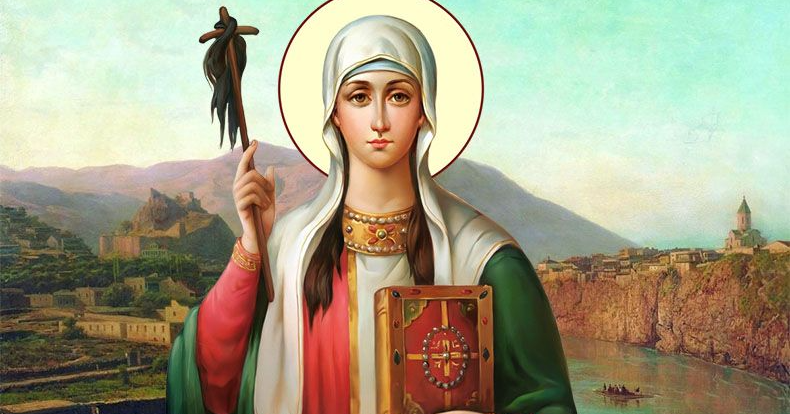
The Church remembers the Holy Equal-to-the-Apostles Nina
27.01.2024, 06:00


-

Faith vs. Fitness? The Real Battle Isn’t Where You Think
Alyona Bogolyubova
All Authors